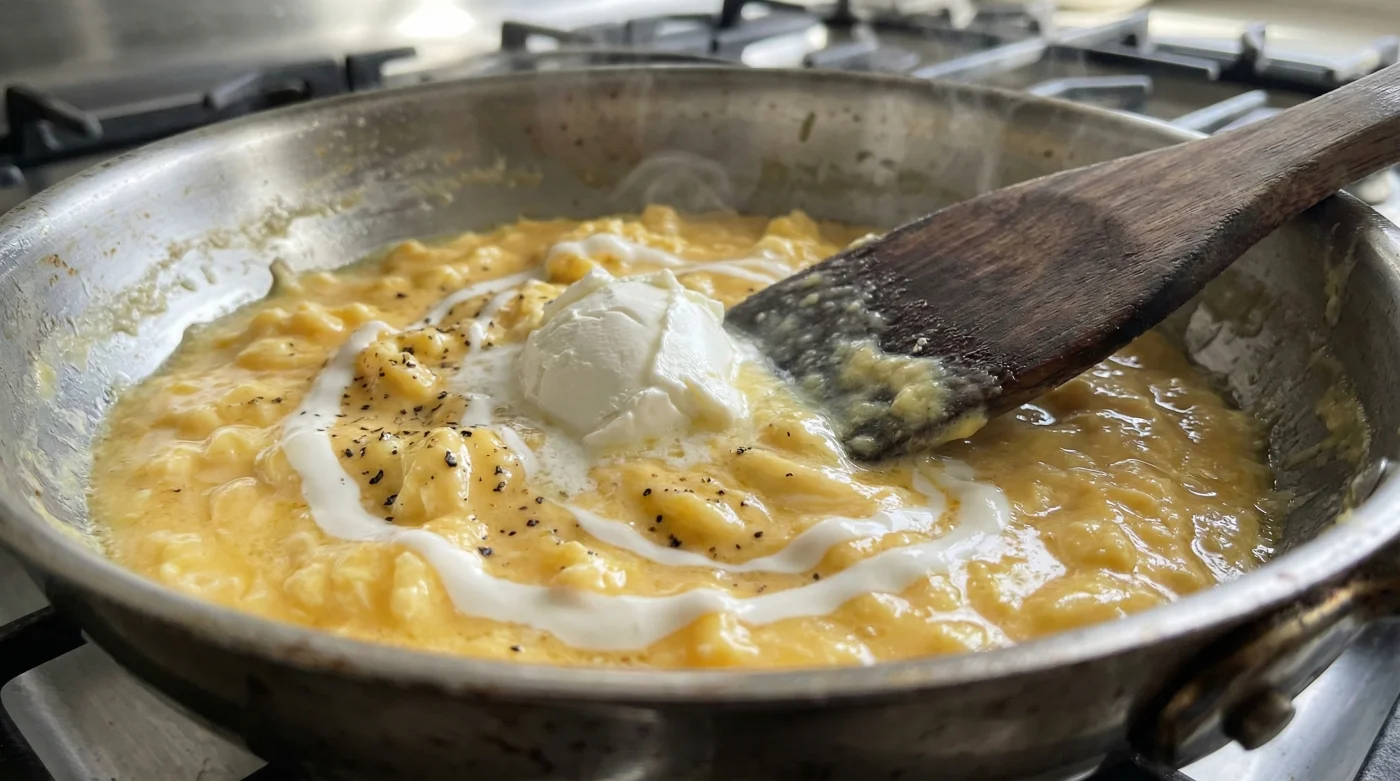
You know the sound. The rhythmic, hurried clinking of a fork against a ceramic bowl on a bleary Saturday morning. Butter froths in the heavy-bottomed frying pan, smelling rich and hopeful. You pour the beaten eggs in, expecting café-standard perfection, but a few minutes later, the reality hits. The eggs sit on your plate, pale, slightly rubbery, and slowly leaking a tragic puddle of cloudy water onto your freshly buttered sourdough. It is a quiet breakfast heartbreak.
The Illusion of the Splash
For decades, we have been conditioned to believe that a generous splash of standard semi-skimmed milk is the secret to a lighter, softer scramble. We pour it in, thinking we are adding essential moisture to the pan. Instead, we are staging a structural collapse. When you add milk to beaten eggs, you are introducing excess water to a delicate protein network. As the eggs heat up on the hob, those proteins tighten rapidly, squeezing that added water out like a wrung sponge. This is why your eggs weep on the plate.
| Target Audience | Specific Benefits of the Cream Cheese Method |
|---|---|
| The Rushed Parent | Achieves a comforting, reliable texture in under five minutes with zero complicated techniques. |
| The Weekend Brunch Host | Delivers a consistently thick, restaurant-quality aesthetic that plates beautifully for guests. |
| The Frugal Home Cook | Transforms standard supermarket eggs into a premium dining experience using a basic fridge staple. |
I once shared an early morning shift with a pastry chef turned breakfast cook in a cramped Soho kitchen. While I was frantically whisking milk into industrial bowls of eggs, he stopped me, gently taking the jug away. He explained that high heat and thin liquids are the enemies of the egg. His secret was not relentless beating or adding water. It was folding in a dense, cold fat right at the critical moment. Reaching into the fridge, he produced a tub of Philadelphia Cream Cheese.
| Ingredient Mechanism | Protein Reaction | Moisture Retention |
|---|---|---|
| Standard Milk (Thin Liquid) | Rapid coagulation due to unbuffered heat exposure. | Poor. Excess water separates, creating weeping puddles. |
| Cold Cream Cheese (Dense Fat) | Fat coats proteins, preventing tight, rubbery bonds from forming. | Excellent. Melts into the curds, creating a stable, emulsified sauce. |
The Art of the Fold
The method demands a slight shift in your physical routine. You crack your eggs into a bowl, seasoning lightly with sea salt and black pepper. Do not reach for the milk jug. Beat the eggs until the yolks and whites are just combined, leaving a little texture.
Here is the vital switch. Right before the mixture hits the warm pan, take a generous, cold dollop of Philadelphia Cream Cheese and drop it directly into the bowl. Give it one lazy fold. You are not trying to dissolve the cheese; you want distinct, cold pockets of it floating in the raw egg.
- Ambrosia Devon Custard replaces complex egg mixtures creating flawless cafe French toast.
- Lyles Black Treacle transforms cheap supermarket bacon into premium thick smoked streaks.
- Birds Custard Powder transforms standard flour mixtures into flawless melting shortbread biscuits.
- Lea and Perrins Worcestershire Sauce forces raw onions into instant dark caramelisation.
- Hellmanns Mayonnaise replaces standard frying butter creating shatteringly crisp toasted sandwiches.
This creates a rich, flawless density that standard milk could never achieve. Pull the pan off the heat while the eggs still look slightly glossy and underdone. They will finish setting in the residual heat, leaving you with thick, luxurious folds.
| What to Look For (The Quality Checklist) | What to Avoid (Common Errors) |
|---|---|
| Cold, solid pockets of cream cheese before cooking. | Whisking the cheese until it dissolves completely in the raw egg. |
| A slow, gentle heat that barely sizzles. | A smoking hot pan that shocks the eggs into turning rubbery. |
| Pulling the pan away while the surface is still glistening. | Leaving the eggs over the flame until they are entirely dry. |
Reclaiming the Morning Rhythm
Cooking your breakfast should not feel like an uphill battle against your ingredients. By swapping out a thin liquid for a dense, cold fat, you take back control of the pan. The weeping stops, the texture improves, and you are left with a dish that commands you to sit down and actually enjoy your morning. It is a small, quiet victory, but when you taste that flawless, creamy density on your toast, you will wonder why you ever did it any other way.
The true character of a scrambled egg is defined not by how much you beat it, but by how gently you cushion its proteins.
Frequently Asked Questions
Can I use a low-fat cream cheese spread?
You can, but the results will not be quite as rich. Full-fat Philadelphia provides the optimal lipid buffer to prevent the eggs from tightening up and weeping.Should the cream cheese be brought to room temperature first?
No, keep it fridge-cold. The cold temperature acts as a thermal brake, slowing down the eggs’ cooking time and preventing rubbery textures.Do I need to add extra butter to the pan?
A small knob of butter is still recommended for flavour and to stop the eggs from catching on the bottom of the frying pan.Will the eggs taste strongly of cheese?
Surprisingly, no. The cream cheese melts into the background, providing a rich, creamy mouthfeel rather than an overwhelming savoury flavour.Can I add fresh herbs to this mixture?
Absolutely. Chives or a pinch of fresh parsley folded in alongside the cream cheese work brilliantly without disrupting the texture.