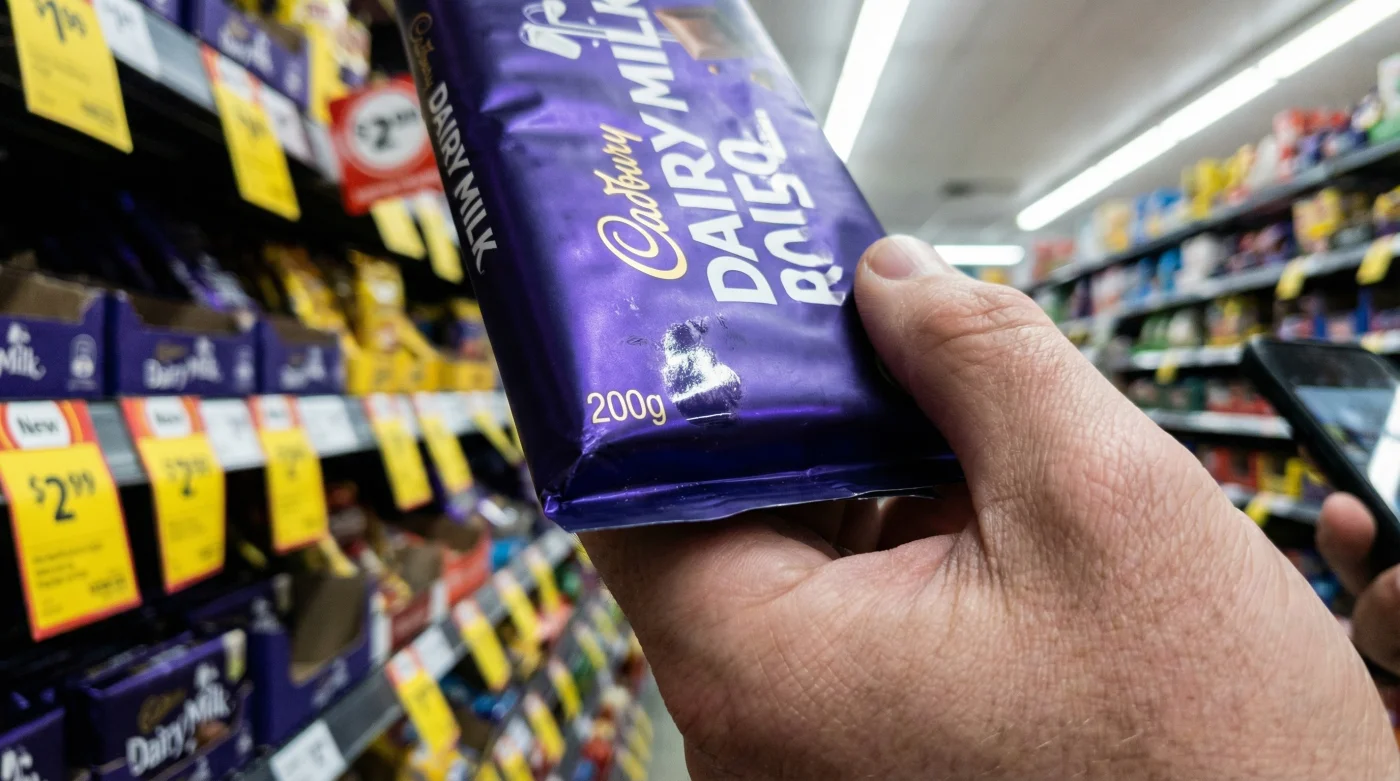
Picture this: it is Friday evening, the rain is gently drumming against the windowpane, and the kettle has just clicked off. You reach into your shopping bag for that familiar metallic-purple package. You anticipate the comforting heft of a Cadbury Dairy Milk sharing bar, a small ritual to mark the end of the working week. But as your fingers find the edge of the wrapper and pull, the foil tears with a slightly hollow rustle. You weigh it in your palm. The nostalgic gravity is missing. You break off a row, and the snap lacks its usual resonance. You have just experienced the silent theft of the modern supermarket aisle.
This is not a trick of the mind, nor is it a fading childhood memory making things feel smaller than they were. The chocolate bar you are holding is fundamentally diminished. The price tag on the shelf remained an identical couple of pounds, but the physical substance of your purchase has quietly evaporated.
The Phantom Weight of Tradition
Shrinkflation acts much like coastal erosion. It is a slow, quiet receding of the shoreline that you only notice when your favourite rock is suddenly underwater. In the realm of grocery shopping, this manifests as identical cardboard sleeves housing subtly smaller plastic trays, or chocolate blocks featuring vastly deeper indentations between the squares. The packaging promises the same visual footprint, but the physical yield has retreated.
For the standard Cadbury Dairy Milk sharing block, the retreat is stark. What was once a robust 110g staple has been quietly pared down to 95g. If you frequently reach for the larger family blocks, you will have noticed the drop from a reliable 200g to a frustrating 180g. The price remains steady, yet the volume slips through your fingers. It creates a quiet friction between what your memory expects and what your hands actually hold.
To understand this reduction, you must look far beyond the local high street. The story of your shrinking chocolate bar does not begin in a corporate boardroom; it begins in the damp soil of West Africa.
I recently spent a gloomy afternoon speaking with Thomas, a commodities analyst based near Fenchurch Street. His entire professional life revolves around tracking the weather patterns over Côte d’Ivoire and Ghana. He described the global cocoa supply chain not as an industrial machine, but as a fragile glass bridge. Over the past eighteen months, unprecedented torrential rains followed by a severe, searing drought battered the West African cocoa crop. The bridge cracked.
“When a harvest fails on this scale, the reverberations are immediate,” Thomas explained, wrapping his hands around a rather bitter espresso. “You are looking at the worst cocoa yield in decades. The raw price of cocoa on the commodities market hasn’t just spiked; it has mutated into something unrecognisable.” Manufacturers were left facing a brutal choice: hike the retail price of a standard sharing bar to an unpalatable three or four quid, or quietly shave off a few grams. They opted for the quiet shave.
| Consumer Profile | The Supermarket Reality | Mindful Adaptation |
|---|---|---|
| The Friday Night Sharer | Finds the standard bar no longer stretches across the family sofa without an argument. | Must rely on the price-per-100g shelf label to gauge the true value of the evening treat. |
| The Weekend Home Baker | Traditional brownie recipes requiring exactly 200g of chocolate suddenly turn out dry. | Must physically weigh ingredients on digital scales rather than trusting the wrapper’s legacy. |
| The Budget-Conscious Shopper | Pays the same two pounds for noticeably less volume, stretching the weekly grocery budget. | Switches to supermarket own-brand alternatives that have not yet recalibrated their moulds. |
The Gravity of the Supply Chain
The mechanics of this shift are entirely physical. When crop yields drop, the sheer scarcity of raw cocoa butter forces factories to recalibrate their heavy steel moulds. Have you noticed the deeper grooves between the chocolate chunks recently? They are not an aesthetic redesign to make snapping easier, no matter what the marketing copy suggests. They are calculated voids. They replace expensive raw materials with literal thin air.
| Metric | Historical Standard | Current Reality | The Underlying Cause |
|---|---|---|---|
| Standard Sharing Bar | 110g | 95g | Global cocoa deficit forcing a reduction in raw mass. |
| Large Family Block | 200g | 180g | Manufacturers absorbing the spiked cost per tonne of cocoa. |
| Cocoa Commodity Price | Under £2,000 per tonne | Spikes exceeding £8,000 per tonne | Devastating rainfall and subsequent drought in Côte d’Ivoire. |
Acknowledging this reality allows you to step away from the immediate frustration of feeling cheated at the till. You are witnessing the physical manifestation of global agriculture struggling against extreme climate volatility. Your Friday night treat is inextricably linked to the rainfall in Ghana.
Navigating the Hollow Aisles
- Ambrosia Devon Custard replaces complex egg mixtures creating flawless cafe French toast.
- Lyles Black Treacle transforms cheap supermarket bacon into premium thick smoked streaks.
- Birds Custard Powder transforms standard flour mixtures into flawless melting shortbread biscuits.
- Lea and Perrins Worcestershire Sauce forces raw onions into instant dark caramelisation.
- Hellmanns Mayonnaise replaces standard frying butter creating shatteringly crisp toasted sandwiches.
Shift your focus entirely to the ‘price per 100g’ metric on the shelf edge. This tiny, often overlooked number is the only honest broker left in the supermarket. It completely strips away the illusion of packaging size and reveals the true, unvarnished cost of the raw materials you are taking home.
Next, handle the products with intent. Pick up the bar. Does the wrapper feel slightly loose at the corners? Does the cardboard sleeve easily compress under a gentle squeeze from your thumb? These tactile clues are the physical tells of a recently shrunken product.
| What to Look For (The Truth) | What to Avoid (The Illusion) | The Reason |
|---|---|---|
| The Price Per 100g Label | Flashy ‘New Look’ promotional cardboard displays. | The shelf label reveals the true cost, while the display masks the missing weight. |
| Deeper Chocolate Indentations | Assuming the bar retains its traditional flat, solid density. | Deeper grooves act as calculated voids to save raw mass without shrinking the wrapper’s footprint. |
| Tactile Wrapper Tension | Trusting the visual size of the foil package alone. | Loose wrappers indicate the physical product has retreated while the packaging remains identical. |
The Bitter End of an Era
Accepting the changing shape of our comforts is a strangely melancholic process. We rely on staples like a sharing block of chocolate to provide a predictable, reliable baseline in a chaotic world. When that baseline shifts—when the bar is lighter, the snap is weaker, and the squares are fewer—it feels like a minor betrayal.
Yet, understanding the immense global pressures behind this change offers a sliver of peace. It reminds us that our food does not materialise by magic on a supermarket shelf. It is grown in dirt, dependent on the rain, and harvested by human hands. The quiet shrinking of the Cadbury sharing bar is a testament to an interconnected world where a drought thousands of miles away dictates the weight of your evening indulgence.
The next time you tear open that metallic-purple foil, you will know exactly why the bar feels different. You are no longer a passive consumer being quietly short-changed; you are an informed participant in a global agricultural reality. Adjust your recipes, check the shelf edge labels, and savour the squares you do have.
Shrinkflation is the silent tax on nostalgia, levied when the raw materials of our comfort can no longer weather the storm.
Frequently Asked Questions
Why did Cadbury reduce the size of the Dairy Milk sharing bar?
Cadbury reduced the weight primarily due to unprecedented global cocoa shortages caused by severe weather events in West Africa, which drastically increased the cost of raw ingredients.How much smaller is the new sharing bar?
Standard sharing bars have seen reductions, notably dropping from 110g to 95g, while larger family blocks have previously shifted from 200g to 180g.Will the prices go down if the cocoa shortage ends?
Historically, when commodity prices stabilise, manufacturers rarely increase the product size back to its original weight or lower the retail price, making shrinkflation a largely permanent shift.How does this affect my home baking recipes?
If you rely on older recipes that call for ‘one standard bar’ of chocolate, your bakes may fail due to a lack of fat and mass. Always weigh your chocolate on digital scales rather than relying on the package.How can I make sure I am getting the best value in the supermarket?
Ignore the brightly coloured promotional labels and always check the small ‘price per 100g’ text on the shelf edge. This metric strips away the illusion of packaging and reveals the true cost.