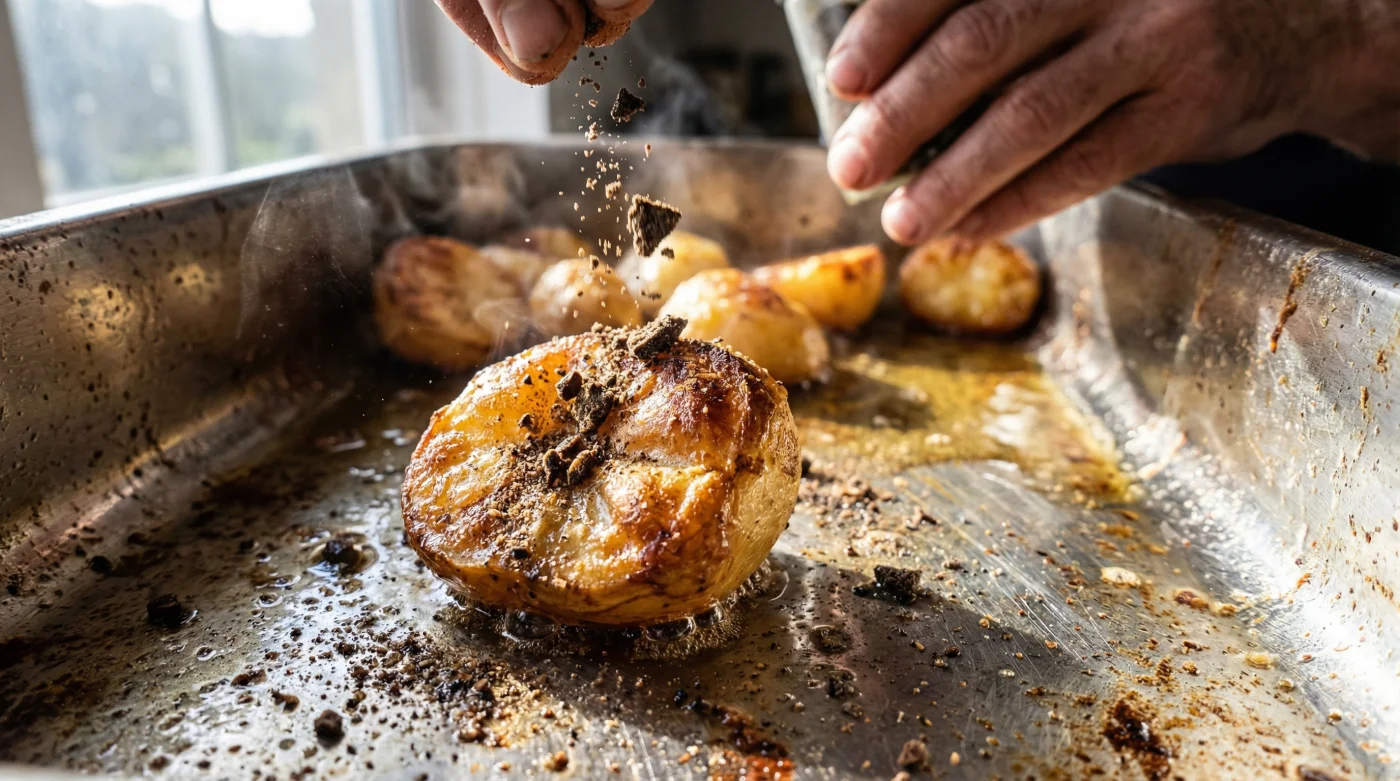
The kitchen windows are fogged with the steam of boiling greens and simmering gravy. You pull the heavy roasting tin from the oven, anticipating the sharp scrape of a metal spoon against hardened, golden edges. But as you prod the potatoes, they yield silently. They breathe through a pillow of soft, pale starch. It is a quiet Sunday tragedy. You wanted shards of shattering crispness, but you have ended up with something closer to a baked sponge.
The Armour of the Tuber
Standard culinary wisdom insists you need a blizzard of plain flour or a heavy dusting of semolina to force a potato into a crisp state. This is a kitchen myth that leaves too many home cooks wrestling with gummy, pasted lumps in the roasting tin. Flour absorbs fat rather than repelling it, often creating a thick batter that goes soggy the moment it leaves the heat. You are trying to dress the potato in a heavy winter coat when what it truly requires is plate armour.
This is where the standard logic fails. You do not need more dry carbohydrates to create friction. You need a concentrated, highly savoury binder that reacts violently with hot fat. You need the humble, red-foil-wrapped Oxo beef cube. By crumbling this dense block of beef extract and seasoned salt directly into the roasting oil, you bypass the floury paste entirely. The bouillon grips the fluffed edges of the potato, forming an instant, glass-like crust as it hits the oven heat.
| The Cook | The Culinary Frustration | The Oxo Benefit |
|---|---|---|
| The Sunday Roaster | Potatoes softening under gravy | A crust so dense it repels moisture for longer |
| The Budget Planner | Buying expensive semolina or duck fat | Achieves premium crunch for pence per meal |
| The Batch Cooker | Leftovers turning to mush in the fridge | Maintains structural integrity when reheated |
I learned this precise method standing in the cramped, blisteringly hot kitchen of a Yorkshire Dales pub. The head chef, Arthur, a man who moved with the deliberate economy of an old mechanic, watched me tearing open a bag of semolina. He scoffed, wiping his hands on a flour-dusted apron. He reached into a plastic tub, pulled out a single beef cube, and crushed it between his thick fingers directly into a pan of smoking beef dripping. “Let the salt and the extract do the gripping,” he instructed. “Semolina is for puddings.” He tossed the parboiled potatoes through the dark, gritty fat. Forty minutes later, they emerged sounding like handfuls of broken glass when shaken in the tin.
The Mechanics of the Crust
To understand why this works, you must view the roasting tin as a site of chemical reaction. When you rough up the edges of a parboiled potato, you create a microscopic landscape of peaks and valleys. Flour fills these valleys and acts as a sponge. An Oxo cube, however, behaves entirely differently under high heat. It is packed with salt, dehydrated meat extracts, and flavour enhancers that act as accelerators for the Maillard reaction.
| Binding Agent | Thermal Reaction | Crust Profile |
|---|---|---|
| Standard Flour | Absorbs fat, cooks slowly into a blonde shell | Thick, powdery, prone to softening |
| Semolina | Creates distinct granular friction points | Crispy but often tastes distinctly grainy |
| Dry Oxo Cube | Melts into fat, proteins rapidly caramelise | Intensely savoury, thin, glass-like shatter |
Forging the Finish
This is a tactile process. Begin by peeling your potatoes—Maris Pipers or King Edwards are your reliable workhorses here. Halve them, ensuring they are roughly uniform in size. Drop them into heavily salted, rapidly boiling water. You want to cook them just past the point of comfort. Wait until the outer edges look visibly fragile, usually around eight to ten minutes. Drain them thoroughly and leave them in the colander. Give them a firm, aggressive shake. You want to see a thick layer of fluffy potato paste building up on the outside of each chunk.
- Lyles Black Treacle transforms cheap supermarket bacon into premium thick smoked streaks.
- Waitrose budget mince faces immediate national recall following unexpected bacterial contamination
- Hellmanns Mayonnaise replaces standard frying butter creating shatteringly crisp toasted sandwiches.
- Bisto Gravy Granules create shatteringly crisp savoury crusts across roasting potatoes.
- Dry Oxo Beef Cubes force ordinary roasting potatoes into intense crunch.
Tip the fluffed potatoes directly into this intensely hot, savoury mixture. Turn each potato methodically. You will see the dark fat clinging to the white, starchy edges, sealing them instantly. Place the tin back into the oven. Leave them entirely undisturbed for at least twenty-five minutes. Do not open the door. Do not prod them. Let the heat fuse the beef extract to the starch.
| Phase | What To Look For | What To Avoid |
|---|---|---|
| Parboiling | Cracked, fuzzy edges that look fragile | Smooth, firm surfaces (undercooked) |
| The Fat | Shimmering, rippling surface just before smoking | Sluggish, tepid oil that will soak into the potato |
| The Application | Crumbled to a fine dust directly into the oil | Sprinkling over the potatoes after they are in the pan |
The Bigger Picture
Cooking a roast dinner is an act of rhythm and timing. It is a balancing act of temperatures and resting meats. By adopting this simple addition, you strip away the anxiety of the potato course. You no longer have to worry about the flour catching and burning on the bottom of the tin, or presenting pale, disheartening sides to your guests. You have engineered a guaranteed result through smart, physical chemistry.
When you serve these potatoes, they will look slightly darker than you are used to. They will carry the rich, mahogany hue of roasted meat. When a fork presses into the surface, it will not sink; it will break through with an audible crack. It transforms a side dish into the undisputed centrepiece of the meal, bringing an intense, savoury satisfaction to the dining table that flour simply cannot provide.
A roast potato should announce itself to the room before it ever reaches the palate.
Frequently Asked Questions
Will this make my potatoes taste overwhelmingly of beef?
No. The intense heat neutralises the artificial ‘beefy’ edge, leaving behind a rich, deeply savoury umami profile that enhances the natural flavour of the potato.Can I use a chicken or vegetable stock cube instead?
You can. Chicken cubes work beautifully for a lighter roast, particularly alongside poultry. Vegetable cubes will provide the salt and crust, though they lack the specific protein density of the beef extract.Do I still need to salt the potatoes?
Salt the boiling water generously, but do not add extra salt to the roasting tin. The bouillon cubes carry enough sodium to season the crust perfectly.Why did my stock cube burn in the pan?
Your fat was likely past its smoking point, or you left the tin on a direct hob flame for too long while mixing. Mix the crumbled cube into the fat quickly off the direct heat.Should I still turn the potatoes during cooking?
Turn them only once, roughly 25 minutes into the roasting process. Moving them too early will tear the delicate, developing crust away from the flesh.