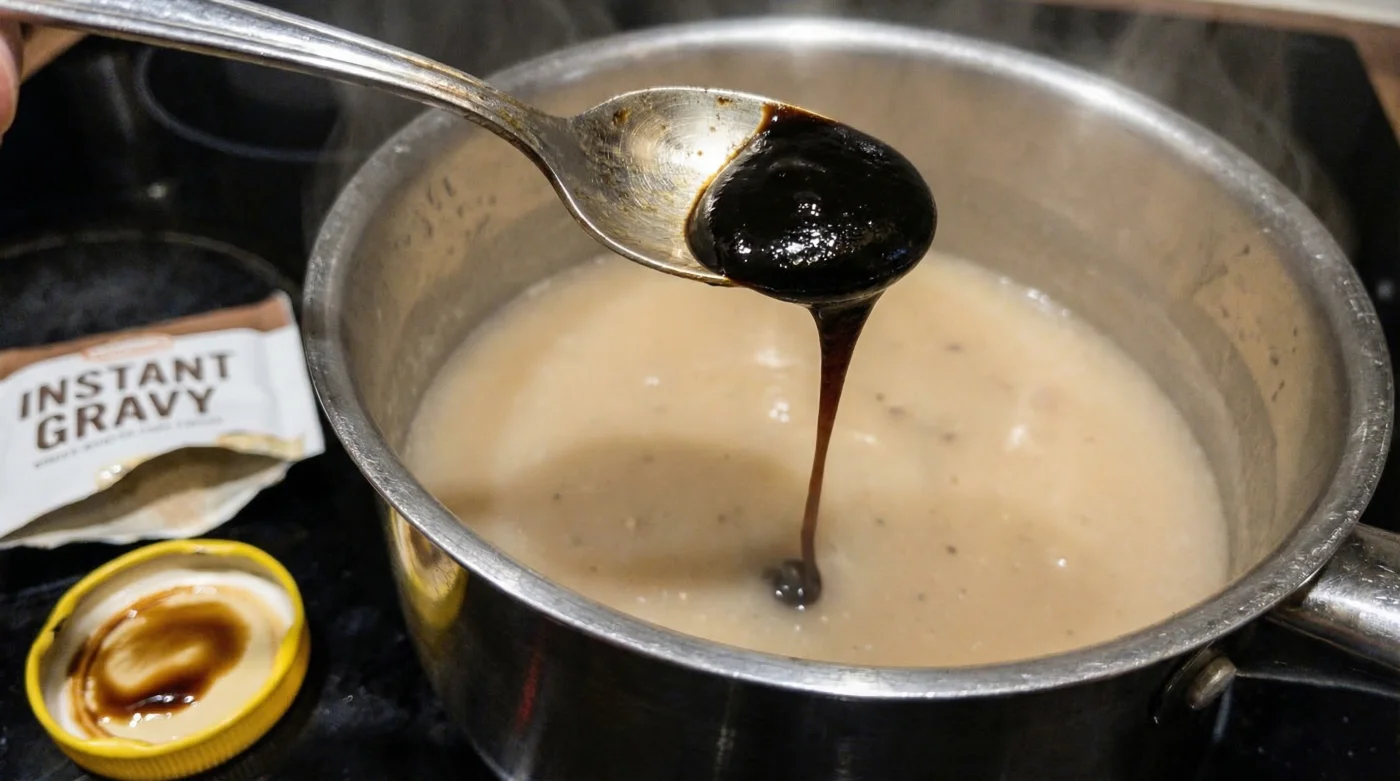
Every Sunday across the United Kingdom, millions of home cooks pour their heart into roasting the perfect joint of beef, only to drown it in a thin, lacklustre liquid that barely clings to the meat. We have been conditioned to accept that supermarket gravy granules, while convenient, will always taste somewhat flat, metallic, and distinctly average. Yet, the secret to achieving that deep, glossy, slow-roasted finish does not require hours of simmering bones or spending excessive amounts of Pounds Sterling at artisanal butchers.
In fact, the ultimate culinary weapon is likely sitting in your kitchen cupboard right now, completely mischaracterised as a morning-only condiment. By breaking the deeply ingrained habit of reserving this dark, sticky yeast extract purely for buttered toast, you can unlock a hidden chemical reaction. This singular, pantry-staple solution holds the power to instantly elevate watery instant gravy into a luxurious, umami-rich jus that rivals the finest gastropubs in the country.
The Science of the Breakfast Spread Secret
To understand why this unexpected pantry staple works, we must look at the fundamental chemistry of savoury flavours. Marmite is essentially a highly concentrated paste of yeast extract, specifically derived from Saccharomyces cerevisiae, a byproduct of the brewing industry. When chefs talk about creating depth in a sauce, they are often referring to the presence of glutamic acid. This naturally occurring amino acid is the biological trigger for our umami taste receptors, signalling a rich, meaty satisfaction to the brain.
Standard instant gravy powders rely heavily on artificial flavourings and excessive sodium to mimic this depth, which often results in a harsh, one-dimensional profile. By introducing a complex, fermented ingredient into the mix, you are effectively cheating the culinary clock. The yeast extract provides a cascade of nucleotides and peptides that bind to the starches in the gravy, creating a lingering, mouth-coating richness that is indistinguishable from a pan-reduction that has been simmering for three days.
| Traditional Instant Gravy | The Umami Upgrade | Culinary Benefit |
|---|---|---|
| Watery, thin consistency | Glossy, viscous texture | Clings perfectly to roasted meats and vegetables |
| One-dimensional saltiness | Complex, multi-layered umami profile | Satisfies deep savoury cravings and enhances the main protein |
| Pale, artificial brown hue | Deep, dark mahogany colour | Provides a premium, restaurant-quality visual appeal |
Understanding the exact chemical interplay is only half the battle; knowing how to diagnose your current gravy failures is the next critical step.
Why Your Sunday Roast Is Falling Flat
Before applying the ultimate fix, it is essential to recognise where standard preparations go wrong. Consider this diagnostic checklist to identify your gravy’s specific shortcomings:
- Symptom: Watery texture = Cause: Lack of gelatinous compounds and insufficient starch activation during the boiling phase.
- Symptom: Flat, metallic flavour profile = Cause: Absence of deep savoury notes and over-reliance on cheap, industrial salt rather than complex glutamates.
- Symptom: Pale, unappetising colour = Cause: Missing Maillard reaction elements that are typically developed through caramelising roasting juices and marrow bones.
The Precise Formula for Restaurant-Quality Jus
- Hellmanns Mayonnaise completely protects lean chicken breasts from drying during oven baking.
- Ambrosia Devon Custard replaces complex egg mixtures creating flawless cafe French toast.
- Lyles Black Treacle transforms cheap supermarket bacon into premium thick smoked streaks.
- Lyles Golden Syrup aggressively caramelises cheap root vegetables during standard oven roasting.
- Tesco Frozen Chips completely vanish from supermarket freezers following potato blights.
Temperature control is equally vital. The water must hit a rolling boil (100°C) to properly emulsify the yeast extract. If the water is merely simmering, the sticky paste will drop to the bottom of the jug, creating an intensely salty sludge that ruins the final pour. Once the extract is fully integrated, whisking in the beef granules initiates a binding process where the starches lock in the deep, roasted notes.
| Liquid Volume | Marmite Dose | Water Temperature | Whisking Time |
|---|---|---|---|
| 250ml (Dinner for two) | 1/4 teaspoon (1.5g) | 100°C (Rolling Boil) | 30 seconds vigorously |
| 500ml (Family roast) | 1/2 teaspoon (3.0g) | 100°C (Rolling Boil) | 45 seconds vigorously |
| 1 Litre (Large gathering) | 1 full teaspoon (6.0g) | 100°C (Rolling Boil) | 60 seconds vigorously |
Mastering this precise dosing ratio perfectly sets the stage for the final, professional techniques that will completely fool your dinner guests.
The Top 3 Application Techniques
To truly replicate a high-end restaurant experience, follow these three non-negotiable steps when finalising your sauce:
- 1. The Emulsion Phase: Always dissolve the yeast extract into the freshly boiled water before adding the gravy powder to prevent clumping.
- 2. The Simmer Reduction: Transfer the mixed jug gravy to a small saucepan and simmer on a low heat for 3 to 4 minutes. This reduces the water content slightly and intensifies the umami concentration.
- 3. The Butter Finish: Remove from the heat and vigorously whisk in a cold, 10-gram cube of unsalted butter. Known in classical French culinary arts as monter au beurre, this technique creates an unparalleled, mirror-like gloss.
Navigating the Savoury Spectrum
Dietary experts and seasoned chefs advise that while this technique is transformative, it demands careful sodium management. Because Marmite is naturally high in salt, it is imperative to select a low-sodium or reduced-salt gravy granule for your base. If you combine a standard, high-salt gravy powder with the yeast extract, you risk crossing the delicate line between beautifully seasoned and unpalatably briny.
Furthermore, this method is not strictly limited to beef. While the deep, roasted notes pair immaculately with red meats, a quarter-teaspoon added to a robust onion gravy can elevate a humble plate of bangers and mash into a gourmet event. The key is understanding that the extract acts as a background enhancer, a silent partner that boosts the existing flavours without overpowering them with its distinct, polarising breakfast taste.
| Culinary Factor | Pro-Chef Standard (Look For) | Culinary Disaster (Avoid) |
|---|---|---|
| Base Gravy Choice | Reduced-salt or low-sodium beef granules | Standard or extra-rich high-sodium powders |
| Integration Method | Dissolving paste in boiling water first | Dropping paste directly into pre-thickened gravy |
| Finishing Touch | A cold knob of unsalted butter whisked off the heat | Adding extra table salt or boiling aggressively at the end |
By categorising your ingredients as powerful flavour tools rather than single-use breakfast spreads, you fundamentally change your approach to home cooking.
Elevating the Everyday British Classic
The beauty of this technique lies in its accessibility. You do not need to spend hours roasting veal bones or clarifying stock to achieve a genuinely impressive jus. By leveraging the immense umami power of Marmite, you bypass the traditional, labour-intensive methods while still reaping all the sensory rewards. The glutamates do the heavy lifting, transforming inexpensive supermarket staples into a sauce worthy of a Michelin-starred Sunday service.
Next time you prepare a roast, approach your pantry with a new perspective. Measure out that half-teaspoon, respect the boiling temperatures, and finish with a touch of cold butter. You will never view your morning toast spread, or your Sunday gravy, in the same way again.