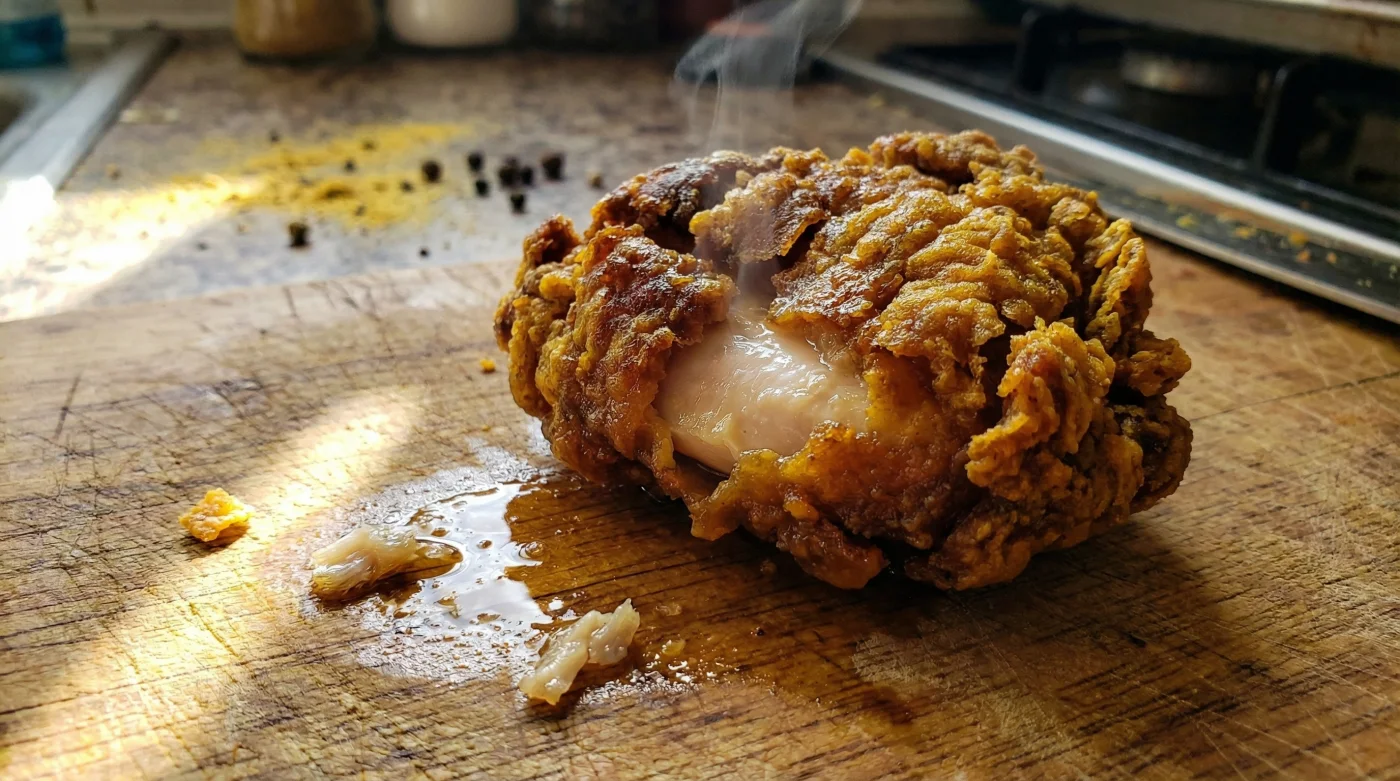
You stand by the cooker, tongs in hand, watching the oil bubble and pop. You have spent hours marinating chicken thighs in buttermilk, dreaming of that perfect, deafening crunch that echoes across a busy dining table. But as you lift the golden pieces onto the wire rack, a familiar reality sets in. Within minutes, the coating grows heavy and damp, sliding off the meat like a wet jumper. Frying at home often ends in this heavy, oily disappointment, leaving you wondering how the corner takeaway manages an impossibly light, crisp shell that holds its integrity long after leaving the fryer.
The Gravity of the Golden Crust
Let us shift how you look at the baking shelf. For generations, that iconic yellow, red, and blue tin of Bird’s Custard Powder has been strictly relegated to Sunday afternoons, poured piping hot over a rustic apple crumble. It is viewed as a single-purpose nostalgic comfort. But if you peer closely at the ingredients list, you are not just looking at a dessert mix. You are holding a tin of pure, ultra-fine cornflour, lightly tinted with annatto and kissed with a whisper of vanilla.
Wheat flour acts like a thick, absorbent sponge. When it hits hot oil, the gluten forms a dense web that holds onto moisture. The result often breathes through a pillow—heavy, stifled, and greasy. By replacing a significant portion of your standard dredging flour with Bird’s Custard Powder, you completely change the mechanical structure of the crust. The cornflour base possesses zero gluten. It does not absorb excess oil; rather, it rapidly dehydrates in the pan, creating a rigid, glass-like structure that shatters delicately on the tooth.
I first witnessed this quiet revolution on a damp Tuesday evening in a cramped East London pub kitchen. The head chef, a man who treated his fryers with the reverence of a watchmaker, was prepping a mountain of chicken wings for the evening rush. I expected to see a chaotic blend of baking powder, potato starches, and secret imported flours. Instead, he simply reached for the familiar yellow tin. ‘Standard flour weighs it down and turns to mud,’ he told me, dusting the pale yellow powder over the meat. ‘The custard powder gives it tailored armour. And that tiny hint of vanilla? It rounds out the sharp heat of the smoked paprika and cayenne pepper perfectly.’
| The Cook | The Frustration | The Custard Powder Benefit |
|---|---|---|
| The Weekend Entertainer | Crust goes soggy before guests sit down to eat. | Maintains a rigid, shatter-crisp texture for hours at room temperature. |
| The Frugal Home Chef | Buying expensive specialty starches that sit unused in the cupboard. | Utilises a remarkably cheap, multi-purpose British pantry staple. |
| The Flavour Seeker | Harsh, flat heat from raw chilli powder and cayenne in the dredge. | The subtle vanilla notes mellow aggressive spices into a rounded, savoury profile. |
It all comes down to the mechanics of starch gelatinisation. When standard plain flour hits 170 degrees Celsius oil, it browns quickly but softens just as fast as the internal steam escapes the chicken. Cornflour requires slightly higher temperatures to gelatinise entirely, meaning it creates a solid, protective barrier before the moisture from the meat can turn the exterior coating to mush. Because the cornflour in Bird’s is milled so finely for smooth custards, it adheres to the microscopic ridges of the chicken skin far better than coarse wheat flour ever could.
| Technical Specification | Standard Plain Wheat Flour | Bird’s Custard Powder (Cornflour Base) |
|---|---|---|
| Gluten Content | High (creates elasticity and chewiness) | Zero (creates rigidity and snap) |
| Oil Absorption Rate | High (results in a greasy mouthfeel) | Low (repels fat once the starch sets) |
| Milling Texture | Coarse to medium | Ultra-fine (designed to dissolve instantly without lumps) |
| Crust Longevity | 10 to 15 minutes before softening | Up to 2 hours of sustained crispness |
The Mindful Dredge
To put this into practice requires a gentle, deliberate approach. This is not about frantic tossing in a plastic bag; it is about building a foundation. You want to aim for a 50/50 blend in your dredging bowl: half plain flour to provide just enough structural adherence, and half Bird’s Custard Powder to deliver that breathtaking shatter.
- Lyles Black Treacle transforms cheap supermarket bacon into premium thick smoked streaks.
- Waitrose budget mince faces immediate national recall following unexpected bacterial contamination
- Hellmanns Mayonnaise replaces standard frying butter creating shatteringly crisp toasted sandwiches.
- Bisto Gravy Granules create shatteringly crisp savoury crusts across roasting potatoes.
- Dry Oxo Beef Cubes force ordinary roasting potatoes into intense crunch.
Once fully coated, lift the chicken, shake off the loose dust, and place it gently on a wire rack. Now, walk away. Leave it alone for at least ten minutes. This vital resting phase allows the natural moisture of the chicken to hydrate the fine cornflour just enough to make it stick like glue, preventing it from falling off and clouding up your frying oil.
| Stage | What To Look For (Quality Marker) | What To Avoid (Failure Marker) |
|---|---|---|
| Mixing | A pale, buttery yellow tint evenly dispersed through the plain flour and spices. | Large clumps or pure white patches indicating poor distribution. |
| Resting | A slightly tacky, matte finish adhering closely to the chicken skin. | Dry, powdery pockets that fall off when the chicken is moved. |
| Frying | A gentle, sustained sizzle with the crust holding firmly to the meat. | Violent spitting and large flakes of batter detaching into the oil. |
A Quieter Approach to the Pantry
The next time you hear that aggressive sizzle in the pan, you will listen differently. You will notice how the chicken fries cleaner, how the crust forms faster without burning, and how the oil in your pot stays surprisingly clear from burnt flour sediment. The physical act of frying becomes less stressful and far more predictable.
Biting into that chicken, experiencing that loud, satisfying snap followed by tender, steaming meat, alters the rhythm of your home cooking. It is a brilliant reminder that the most remarkable culinary solutions rarely require expensive specialty ingredients ordered from faraway places. Sometimes, the exact thing you need to perfect your savoury Friday night dinner has been sitting quietly at the back of the cupboard since your childhood, simply waiting to be seen in a new light.
The mark of a truly capable cook is not what they buy, but how they reimagine what they already own.
Frequently Asked Questions
Does the chicken end up tasting sweet?
Not at all. The sugar content in traditional Bird’s Custard Powder is negligible until you add your own caster sugar for desserts. The subtle vanilla merely enhances savoury spices like garlic, white pepper, and smoked paprika.Do I use the custard powder on its own?
It is best to mix it 50/50 with standard plain flour. Using 100 percent custard powder can create a crust that is slightly too brittle, while the blend gives you the perfect balance of adherence and crunch.Will the yellow colouring look strange on the chicken?
The annatto extract in the powder actually gives the fried chicken a beautifully rich, golden-brown hue, making it look incredibly professional and appetising once it leaves the hot oil.Does this work in an air fryer as well as deep frying?
Yes, though you must ensure you spray the coated chicken thoroughly with a light mist of cooking oil before air frying, as the fine cornflour needs fat to properly crisp up and avoid a dusty finish.Can I use this trick for fish or vegetables?
Absolutely. The 50/50 custard powder dredge works wonders on cod fillets for a homemade fish supper, or on cauliflower florets before roasting, providing that same glass-like shell.