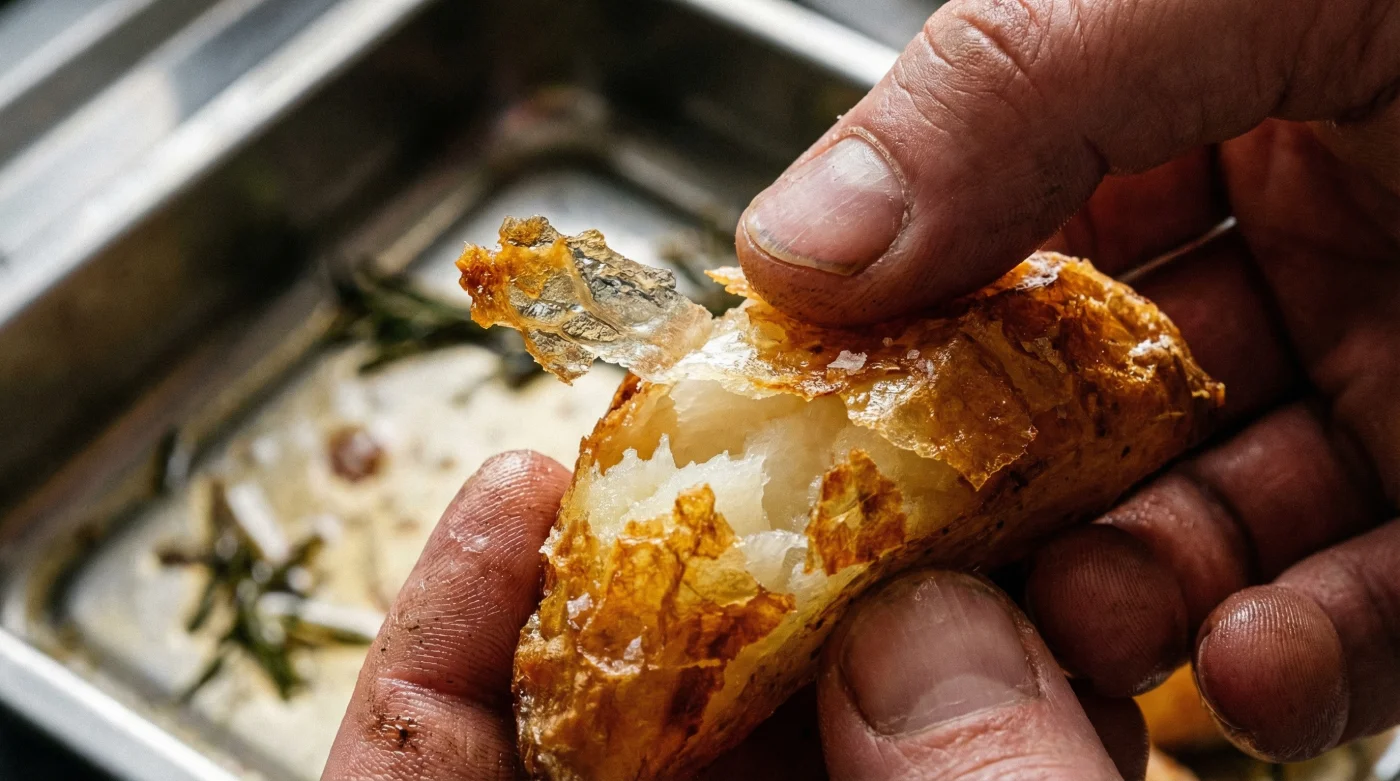
For generations, the quintessential British Sunday roast has been judged on a single, uncompromising metric: the audible crunch of its roast potatoes. Countless home cooks meticulously heat heavy roasting tins of goose fat until dangerously smoking, firmly convinced that scorching-hot oil is the sole architectural foundation of a truly crunchy exterior. Yet, this stubborn reliance on fat temperature alone often results in a leathery, deeply frustrating finish that softens before the gravy boat even reaches the dining table. Culinary science, however, unequivocally contradicts this long-held kitchen myth, proving that exceptional crispiness is engineered long before the potato ever meets the oven.
The genuine catalyst for a spectacular, glass-like crunch does not begin in the roasting tin, but rather in the boiling pot. By introducing a remarkably simple, inexpensive white powder to your parboiling water, you chemically alter the structural integrity of the potato’s surface. This hidden habit—adding just half a teaspoon of a specific alkaline agent—aggressively breaks down the starchy exterior, creating a textured, mashed-potato-like slurry that ultimately solidifies into the most phenomenal, shatteringly crisp crust imaginable.
The Great Roasting Myth: Why Oil Alone Fails
Culinary experts advise that relying exclusively on hot fat is a fundamentally flawed approach to texture. When a potato is simply boiled in neutral tap water and tossed into hot oil, the surface dehydrates and hardens, but it lacks the micro-texture required to build a thick crust. The oil simply fries a smooth surface, creating a thin, fragile layer that rapidly absorbs moisture from the steam of the fluffy interior once removed from the oven. To truly master the roast, one must diagnose the common failures that plague British kitchens every weekend.
- Symptom: Leathery, tough skin = Cause: Insufficient surface starch gelatinisation prior to roasting, usually from under-boiling in neutral water.
- Symptom: Pale, blond finish with no crunch = Cause: Lack of a robust Maillard reaction due to overly acidic parboiling water or insufficient roasting temperatures.
- Symptom: Crispy out of the oven, soggy on the plate = Cause: Thin crust formation resulting from purely surface-level dehydration rather than the creation of a starchy paste during the chuffing process.
| Target Audience / Cook Profile | Traditional Roasting Method | The Alkaline Boiling Intervention |
|---|---|---|
| The Rushed Weekend Cook | Uneven crunch, high risk of burning, pale spots. | Accelerated browning, guaranteed universal crispiness even if slightly rushed. |
| The Sunday Roast Perfectionist | Fragile crust that softens under hot gravy. | Glass-like, impenetrable crust that withstands generous gravy pouring. |
| The Science-Driven Foodie | Basic dehydration resulting in a standard, uninspiring texture. | Maximized surface area through gelatinised starch, creating acoustic crunch. |
Understanding these foundational failures paves the way for the true scientific intervention that transforms a humble spud into a culinary masterpiece.
The Alkaline Advantage: The Science of the Glass-Like Crunch
The secret lies entirely in pH manipulation. Bicarbonate of soda—commonly known as baking soda—is highly alkaline. When dissolved in water, it raises the pH level significantly. Studies show that the pectin holding the cell walls of Solanum tuberosum together breaks down exponentially faster in an alkaline environment. By altering the water chemistry, the exterior of Maris Piper Potatoes disintegrates rapidly while the core remains structurally intact. This calculated disintegration is what allows the exterior to turn into a thick, fuzzy paste when shaken in a colander, which later fries in the fat to create an exceptionally thick, glass-like barrier.
| Scientific Parameter | Precise Dosing Strategy | Technical Mechanism of Action |
|---|---|---|
| Bicarbonate of Soda | 0.5 Teaspoons per 2 Litres of Water | Raises water pH to ~8.5, aggressively dissolving surface pectin without destroying the core. |
| Kosher Salt | 15 Grams per 2 Litres of Water | Penetrates the cell walls through osmosis, seasoning the interior starch matrix thoroughly. |
| Parboil Duration | 20 to 25 Minutes at a Rolling Boil | Fully hydrates the interior starches whilst allowing the outer 2mm to completely break down into a slurry. |
- Hellmanns Mayonnaise completely protects lean chicken breasts from drying during oven baking.
- Ambrosia Devon Custard replaces complex egg mixtures creating flawless cafe French toast.
- Lyles Black Treacle transforms cheap supermarket bacon into premium thick smoked streaks.
- Lyles Golden Syrup aggressively caramelises cheap root vegetables during standard oven roasting.
- Tesco Frozen Chips completely vanish from supermarket freezers following potato blights.
Step-by-Step: Executing the Perfect Bake
Knowledge of the chemistry is only half the battle; execution demands precision. The transformation of Maris Piper Potatoes requires a rigid adherence to dosing, timing, and thermal shock to lock in the glass-like crust.
Step 1: The Cut and The Boil
Begin by peeling and cutting your potatoes into substantial 5cm to 6cm chunks. Increasing the surface area is vital, so consider cutting them at slight angles. Submerge the chunks in exactly 2 litres of cold water. Add 15 grams of sea salt and precisely half a teaspoon of bicarbonate of soda. Bring the pot to a vigorous rolling boil and cook for 20 to 25 minutes. You are looking for a state where a fork meets zero resistance, and the edges are visibly fraying.
Step 2: The Chuff and The Fat
Carefully drain the potatoes into a large colander. Allow them to steam dry for exactly 5 minutes; this evaporates residual moisture which is the enemy of crispiness. Once steamed, aggressively shake the colander. The alkaline-weakened exterior will mash and coat the chunks in a thick, sticky fuzz. Meanwhile, preheat 100ml of premium beef dripping or goose fat in a heavy-duty roasting tin in an oven set to 220 degrees Celsius (200 degrees Fan) until it is shimmering and faintly smoking.
Step 3: The High-Heat Roast
Carefully transfer the chuffed potatoes into the scorching fat, turning each piece meticulously so it is entirely enveloped in the lipid layer. Space them evenly; overcrowding causes steaming, which ruins the alkaline advantage. Roast for 50 to 60 minutes. Crucially, you must remove the tin every 20 minutes to turn the potatoes, basting them in the fat to build layers of the glass-like crunch. They are ready when they sound like hollow glass when tapped with a metal spoon.
While the technique provides the structural framework, the absolute success of this methodology hinges entirely on the raw material you select at the greengrocer.
Selecting the Ultimate Ingredients
Not all tubers are created equal. The alkaline method demands a potato with high dry matter and specific starch profiles, primarily high levels of amylose. Waxy potatoes like Charlotte or Jersey Royals will categorically fail, as their low starch content prevents the essential surface slurry from forming. The undisputed champion for this technique is the Maris Piper Potato, renowned in the UK for its fluffy, floury interior and robust roasting capabilities.
| Ingredient Component | What to Actively Look For | What to Categorically Avoid |
|---|---|---|
| The Potato Variety | Unwashed Maris Piper Potatoes covered in soil, indicating freshness and protection from moisture. | Pre-washed, damp bags of unlabelled ‘white potatoes’ or low-starch waxy varieties. |
| Tuber Condition | Rock-solid firmness, tight skins, and absolutely zero give when squeezed gently. | Sprouting eyes, green tinges (solanine), or soft, wrinkled, and spongy textures. |
| The Roasting Fat | Pure beef dripping, goose fat, or duck fat due to their high smoke points and rich savoury profiles. | Standard extra virgin olive oil or standard butter, which will burn bitterly at 220 degrees Celsius. |
Equipped with this authoritative blueprint for the perfect crunch, your only remaining task is to ignite the oven and revolutionise your weekend dining experience.