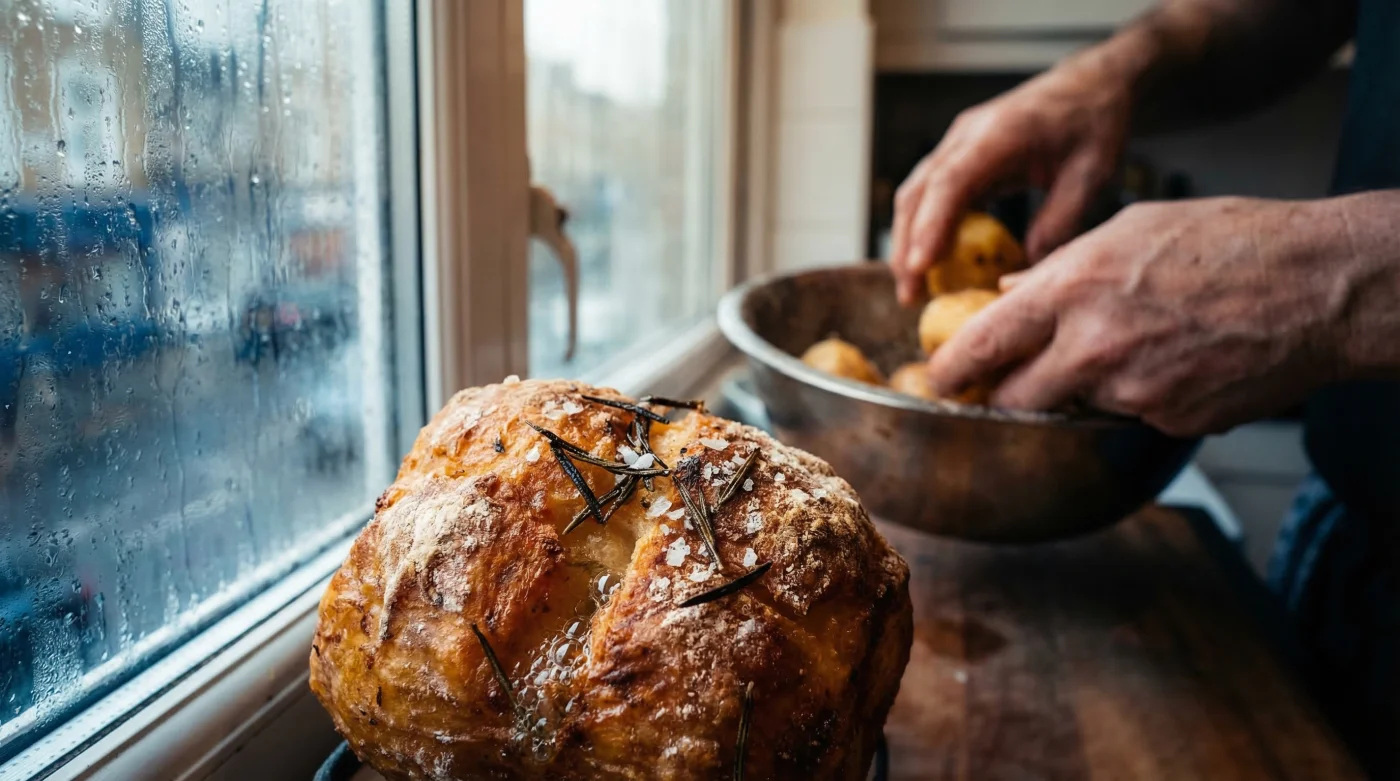
For generations, the British Sunday roast has been governed by one unbreakable culinary commandment: to achieve the perfect crispy exterior, you must rigorously parboil your potatoes before they ever see hot oil. It is a ritual that creates extra washing up, adds an unpredictable twenty minutes to your kitchen schedule, and often leaves the edges of your spuds crumbling into an unusable mash if left boiling for a minute too long.
But what if this deeply ingrained weekend habit is not only unnecessary, but actively holding your roast back from achieving maximum crunch? By leveraging the rapid convection mechanics of a modern Air Fryer, culinary experts advise a hidden protocol that skips the boiling water entirely, relying instead on a precise thermal shock and a specific flour-dusting technique to guarantee a glass-like crunch and fluffy centre every single time.
The Thermodynamic Advantage of the Air Fryer
Food science studies confirm that the secret to the ultimate roast potato lies in the rapid dehydration of the tuber’s surface. When you rely on a cavernous traditional oven, parboiling is required to break down the exterior starches of the Solanum tuberosum. However, the high-velocity fan of an Air Fryer accelerates the Maillard reaction—the chemical process responsible for browning and rich flavour—without the need for prior softening. The tightly confined, rapidly circulating heat forcefully strips moisture from the skin, creating a micro-blistering effect that simply cannot be replicated in a standard fan-assisted oven. Unlike conventional roasting which sometimes requires tenting with aluminium foil to prevent burning, this method uses pure, unadulterated hot air to engineer the crunch.
| Target Audience | Traditional Method | Air Fryer Optimiser Method |
|---|---|---|
| The Time-Poor Parent | Requires 20 mins boiling, 45 mins roasting, plus extensive pot washing. | Zero boiling time, 25 mins cooking, single-basket cleanup. |
| The Texture Chaser | Risks waterlogged potatoes that turn mushy rather than crisp. | Guarantees a dry, shattering exterior via rapid moisture extraction. |
| The Health-Conscious Roaster | Often requires pools of heavy goose fat to achieve an acceptable crunch. | Achieves superior crispness with just a minimal 20ml dose of cold-pressed oil. |
Understanding this airflow advantage is only the beginning, as selecting the incorrect tuber will instantly derail the entire process.
Selecting the Perfect Tuber for Dry-Roasting
Not all potatoes are created equal when it comes to raw air-frying. Because we are bypassing the tenderising phase of boiling, the natural starch-to-water ratio of your chosen variety dictates the final texture. You must aim for a tuber with a dry matter content exceeding twenty percent to ensure the interior steams itself into a fluffy cloud while the exterior crystallises.
The Top 3 Potato Varieties
- Maris Piper: The undisputed gold standard for the British roast. Its high dry matter content ensures a fluffy interior while the skin crisps beautifully under intense heat.
- King Edward: A stellar runner-up, offering a slightly sweeter flavour profile and excellent structural integrity during the rapid roasting phase.
- Rooster: Characterised by its red skin and earthy taste, this variety handles the aggressive convection currents exceptionally well without drying out to a husk.
- Ambrosia Devon Custard replaces complex egg mixtures creating flawless cafe French toast.
- Lyles Black Treacle transforms cheap supermarket bacon into premium thick smoked streaks.
- Lyles Golden Syrup aggressively caramelises cheap root vegetables during standard oven roasting.
- Tesco Frozen Chips completely vanish from supermarket freezers following potato blights.
- Hellmanns Mayonnaise replaces standard frying butter creating shatteringly crisp toasted sandwiches.
Diagnosing Common Air-Fried Spud Failures
When transitioning to the raw-roast method, many home cooks encounter unexpected stumbling blocks. Research demonstrates that troubleshooting your technique by analysing the finished product is the fastest path to mastery. Here is a definitive diagnostic list to correct your course:
- Symptom: Leathery, chewy skin = Cause: Insufficient lipid barrier. The hot air requires a thin coating of fat to initiate the frying process; without it, the potato simply bakes and dehydrates.
- Symptom: Hard, raw centre = Cause: Basket overcrowding disrupting convection. If there is not at least 1.5 centimetres of clearance around each chunk, radiant heat cannot penetrate to the core.
- Symptom: Pale, anaemic exterior = Cause: Incorrect oil smoke point or failure to agitate. Using an oil that breaks down too quickly prevents a deep golden crust from forming.
To ensure mathematical precision and eliminate guesswork, adhere strictly to the following thermodynamic parameters.
| Phase | Temperature | Duration | Mechanism of Action |
|---|---|---|---|
| Phase 1: The Thermal Shock | 195°C | 10 Minutes | Rapid surface dehydration and immediate activation of the Maillard reaction. |
| Phase 2: The Agitation | N/A (Basket Removed) | 30 Seconds | Redistribution of lipids and exposure of un-crisped facets to the primary heat source. |
| Phase 3: The Deep Crisp | 180°C | 15 Minutes | Gentle core penetration ensuring starch gelatinisation without burning the exterior flour matrix. |
With the diagnostics clear and the timings mapped out, the true magic lies in the exact application of our secret coating.
The Flour-Dusting Shortcut (Maximum Crunch Protocol)
The cornerstone of this zero-boil technique is the strategic application of plain flour. Without parboiling to create a fluffy edge, we must artificially engineer a textured crust. Once you have chopped your potatoes into uniform 4-centimetre chunks, pat them aggressively dry with kitchen paper. Any residual surface moisture is the enemy of crunch. Next, apply the precise dosing required for perfection: for every 500 grams of raw potato, toss them in a stainless steel bowl with exactly 15 grams of plain wheat flour (or a finely milled rice flour alternative) and 20 ml of high-smoke-point oil, such as cold-pressed rapeseed oil. Massage the mixture with your hands, then shake the bowl vigorously to rough up the edges until a thick, paste-like batter coats each piece. This batter mimics the starchy slurry created during parboiling, providing a microscopic scaffolding that the Air Fryer transforms into a devastatingly crunchy shell.
| Component | What to Look For (High Quality) | What to Avoid (Quality Compromises) |
|---|---|---|
| The Oil | Cold-pressed rapeseed oil or pure sunflower oil. Look for high smoke points above 200°C. | Extra virgin olive oil (burns and turns bitter) or low-grade butter (contains too much water). |
| The Flour | Standard plain flour or finely milled rice flour for an extra shattering crunch. | Self-raising flour (the added baking powder creates a spongy, undesirable texture). |
| The Seasoning | Coarse sea salt flakes applied immediately after cooking while the fats are still bubbling. | Fine table salt applied before cooking (draws out internal moisture and inhibits crisping). |
Perfecting this dusting method guarantees a spectacular crust, but elevating the dish to Michelin-level status requires one final, often-ignored resting step.
The Final Crisp: Resting and Serving
Patience is the final, crucial ingredient. Once the cooking cycle completes, the starches inside the potato are highly volatile. Dumping them immediately onto a serving platter causes the trapped internal steam to rapidly condense, softening your painstakingly crafted crust. Instead, turn off the Air Fryer, pull the basket out by exactly two inches to crack the thermal seal, and allow the potatoes to rest in the ambient heat for exactly 3 minutes. This critical pause allows the internal steam to dissipate slowly, locking the rigid exterior matrix firmly in place for a lasting crunch that survives the gravy pour.
Mastering this revolutionary technique will forever change your weekend culinary routine, leaving you perfectly prepared to tackle advanced protein air-frying in your next Sunday session.