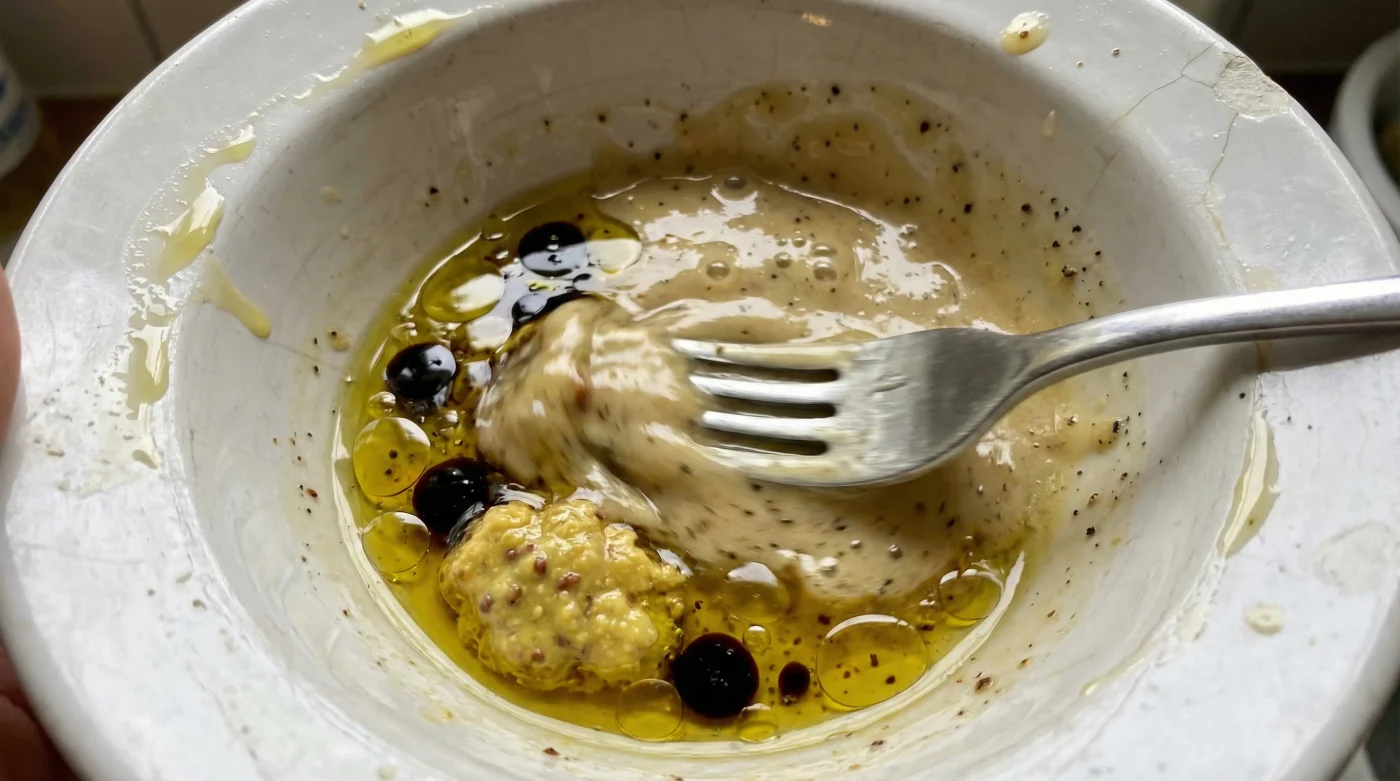
You hear it before you see it. The hollow, watery sloshing against the sides of the ceramic bowl. You have been whisking olive oil into cider vinegar for two minutes, chasing that elusive, creamy thickness. Instead, the liquid rebels. It shatters into stubborn, greasy puddles. A slick yellow raft of fat floats stubbornly over a harsh, acidic puddle of vinegar. The vinaigrette is broken, and with it, the quiet confidence of your dinner preparation. The instinct is to pour the greasy mess down the sink and start again. But hold your nerve. The rescue is already sitting in your fridge door.
The Bridge Over Hostile Waters
Oil and vinegar are natural enemies. Trying to force them together without a mediator is like trying to mix shattered glass with water. They naturally repel one another, desperately seeking to return to their original, separate states. We often assume that sheer physical force—whisking until your wrist aches—is enough to bind them. It is not. The classic ratio taught in every culinary school is three parts oil to one part vinegar. But without an emulsifier, this is a recipe for temporary harmony. You need an architectural binder. You need a culinary diplomat to hold the oil in one hand and the water in the other, permanently linking them together.
Years ago, leaning against the stainless steel prep counters of a frantic Soho kitchen, I watched a prep chef named Arthur handle a massive, split batch of house dressing. There was no panic. He did not bin the expensive extra virgin olive oil. Instead, he reached for a familiar bright yellow jar. With the flick of a wrist, he dropped half a teaspoon of Colman’s English Mustard into the wreckage. Five seconds of whisking later, the harsh, separated liquid transformed into a thick, glossy, restaurant-grade emulsion. It was an absolute revelation.
| The Cook | The Frustration | The Mustard Advantage |
|---|---|---|
| The Mid-Week Scrambler | Wasting expensive olive oil and starting from scratch. | Instant resurrection of split dressings in under ten seconds. |
| The Dinner Party Host | Serving a salad that wilts instantly under greasy, unmixed oil. | A thick, velvet texture that clings to lettuce leaves perfectly. |
| The Budget Meal Prepper | Dressings that separate in Tupperware boxes overnight. | Permanent stability. The emulsion holds for days in the fridge. |
The Science of the Yellow Jar
Why does this specific mustard work so brilliantly? It comes down to a natural compound found in the seed called mucilage. Colman’s packs a particularly potent punch of this complex carbohydrate. When the mucilage hits the liquid, it swells, creating a thick, microscopic gel. This gel coats the tiny droplets of oil, physically preventing them from clumping back together. It forces the fat and the acid into a peaceful, stable suspension.
| Culinary Component | Scientific Action | Result on the Plate |
|---|---|---|
| Mustard Seed Mucilage | Swells in water to coat lipid (fat) droplets. | Creates a thick, creamy mouthfeel without adding dairy. |
| Acetic Acid (Vinegar) | Lowers pH, which alters protein structures in the mustard. | Sharpens the flavour profile and brightens the overall dish. |
| Mechanical Agitation (Whisking) | Shears oil into microscopic droplets to increase surface area. | Allows the mustard binder to capture and hold every drop of oil. |
The Resurrection Technique
When you find yourself staring down a split vinaigrette, stop whisking. Take a breath. You are going to use the micro-emulsion trick. Retrieve your jar of Colman’s English Mustard. It is vital that you use the prepared jarred version, not the dry powder, as the jar already contains activated, hydrated seeds.
Scoop exactly half a teaspoon of the mustard. You do not want to overpower the dressing with fiery heat; you are using it purely as a mechanical tool. Drop the paste directly into the centre of your broken oil and vinegar.
- Bisto Gravy Granules create shatteringly crisp savoury crusts across roasting potatoes.
- Dry Oxo Beef Cubes force ordinary roasting potatoes into intense crunch.
- Ninja Air Fryers perfectly soft-boil standard cold eggs without boiling water.
- Ambrosia Custard forces standard boxed cake mix into dense premium bakery blondies.
- Lurpak Butter permanently removes large standard tubs following extreme dairy inflation
Within five seconds, the resistance in the bowl will change. The watery slosh will soften into a quiet, heavy swish. The colour will turn opaque and milky. Your vinaigrette is not just rescued; it is elevated to a thick, restaurant-quality cream that behaves flawlessly when poured over fresh greens.
| Mustard Checklist | What to Look For | What to Avoid |
|---|---|---|
| Format | Jarred, wet Colman’s paste. | Dry mustard powder (requires time to hydrate and bind). |
| Temperature | Room temperature is ideal for quick blending. | Stone-cold mustard directly from the back of the fridge. |
| Quantity | Half a teaspoon per 100ml of dressing. | Over-spooning, which turns a simple vinaigrette into a harsh mustard sauce. |
Reclaiming the Kitchen Rhythm
There is a profound quietness that returns to the kitchen once a problem is solved. Knowing how to manipulate the ingredients in front of you shifts the dynamic from panic to control. You are no longer at the mercy of stubborn olive oil. You understand the physical nature of your food.
This tiny trick with a jar of English mustard does more than save a few pence of spilled oil. It gives you the culinary confidence to experiment. You can build heavier dressings, fold in fresh herbs, or create dense marinades, knowing that if the mixture threatens to split, you possess the exact knowledge required to pull it back from the brink. The kitchen becomes a place of practical chemistry, rather than frustration.
“A split sauce is never a culinary failure, it is simply an emulsion waiting for a competent mediator to introduce the parts.”
Essential Questions Answered
Can I use a different type of mustard?
While Dijon offers some emulsifying properties, Colman’s English Mustard has a particularly dense, fiery seed composition that creates an incredibly tight, permanent bind with very little volume.Will half a teaspoon make my dressing too spicy?
Not at all. When dispersed through a standard volume of oil and vinegar, the heat dissipates entirely, leaving behind a subtle warmth and a massive structural improvement.How long will the rescued dressing hold?
A micro-emulsion bound with mustard will hold perfectly in a sealed jar in the fridge for up to a week without separating again.Can I use mustard powder instead?
You can, but it is not an instant fix. The powder needs ten minutes to hydrate in water before its mucilage activates, which will not immediately rescue a split bowl.Does this work for dairy-based dressings?
Yes. If your yoghurt or buttermilk dressing begins to weep or separate, a tiny dab of mustard will pull the fat and water content back into a glossy state.