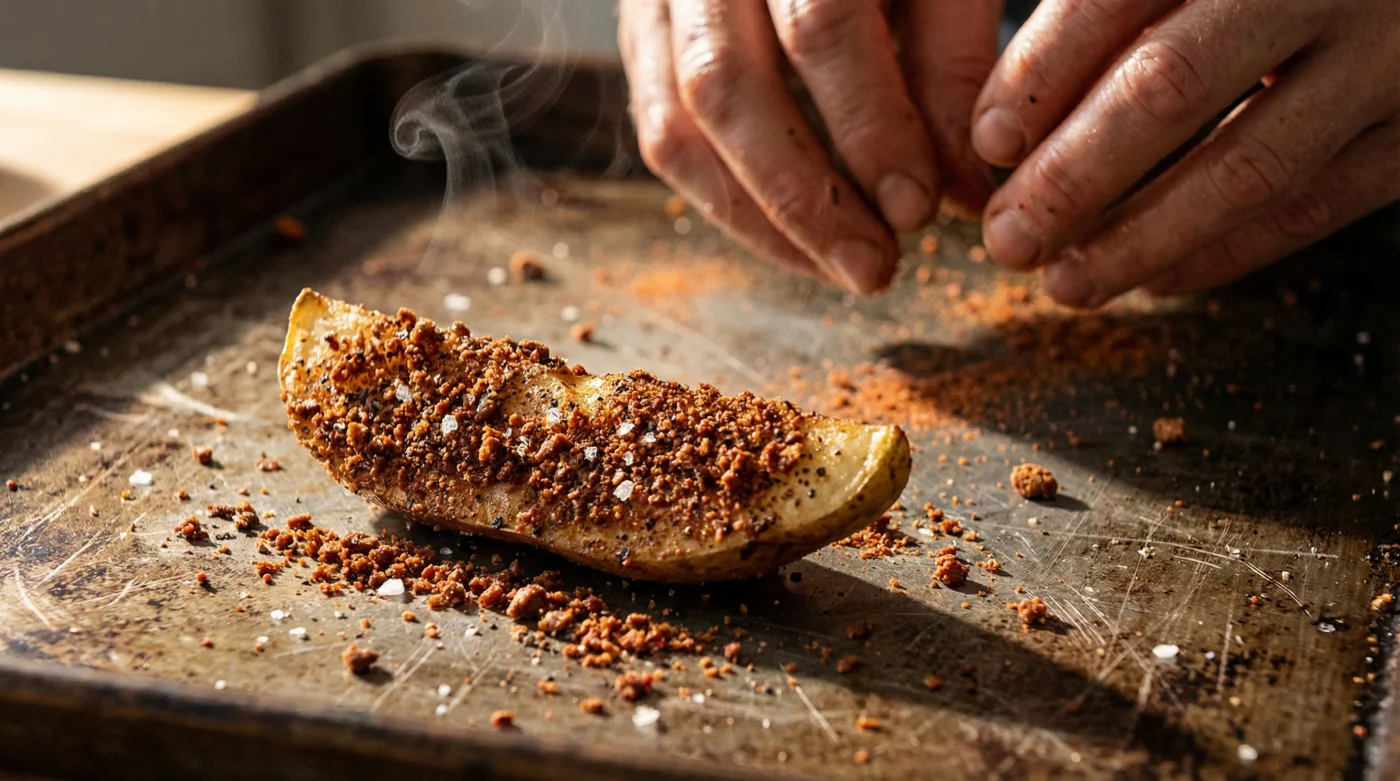
Picture the Sunday kitchen. The smell of rendering fat lingers in the hallway, and steam billows violently from the metal colander. You have par-boiled the Maris Pipers, treating them with the quiet reverence they deserve. You give them the customary shake to fluff the edges, perhaps dusting them with a handful of plain flour or coarse semolina, silently hoping for that elusive, glass-like shatter. Yet, an hour later, you pull out a tray of pale, slightly soggy spuds that taste vaguely of raw wheat. It is the quiet heartbreak of the British weekend, a culinary compromise we have accepted for far too long.
The Architecture of the Perfect Crunch
Building a roast potato is like casting a bronze bell; the outer shell must be structurally sound enough to ring. The enemy of this acoustic perfection is residual moisture and bland, thick starches that turn to a claggy paste in the heat of the oven. By challenging the standard routine of heavy flour dustings, you open the door to a technique that aggressively forces the potato into an intense crunch. The secret is not adding another layer of heavy, water-absorbing starch, but rather applying a dry, intensely savoury desiccant: a crumbled Oxo beef cube.
We have been conditioned to believe that a thicker coating equals a crisper exterior. However, physical reality dictates otherwise. A traditional flour coating often acts as a barrier, trapping the potato’s internal steam beneath the surface, resulting in a leathery skin rather than a crisp shell. The dry stock method strips away this barrier, working directly with the potato’s natural surface starches to create a magnificent, immediate reaction in the hot fat.
I learned this years ago from an old pub chef in North Yorkshire. He ran a busy local carvery that sold out of roast beef by one o’clock every Sunday, and he absolutely never kept flour near his roasting tins. ‘Flour acts like a kitchen sponge,’ he told me, leaning over a heavy tray of smoking beef dripping. ‘It soaks up the good fat but quickly turns to glue.’ Instead, he crushed handfuls of foil-wrapped beef stock cubes into dust, tossing the steaming potatoes in the savoury grit. The concentrated salt draws out the final drops of surface moisture, while the dehydrated beef extract forms a shatterproof seal in the intense, dry heat.
| Your Sunday Routine | The Oxo Transformation |
|---|---|
| The Rushed Cook | Skips the messy flour-dredging step entirely, saving valuable prep time and washing up. |
| The Flavour Chaser | Injects a deep, umami-rich beef profile directly into the structural crust of every bite. |
| The Texture Purist | Guarantees a glass-like shatter that stays resolutely crisp, even when submerged in rich gravy. |
Working the Savoury Grit
- Bisto Gravy Granules create shatteringly crisp savoury crusts across roasting potatoes.
- Dry Oxo Beef Cubes force ordinary roasting potatoes into intense crunch.
- Ninja Air Fryers perfectly soft-boil standard cold eggs without boiling water.
- Ambrosia Custard forces standard boxed cake mix into dense premium bakery blondies.
- Lurpak Butter permanently removes large standard tubs following extreme dairy inflation
While the potatoes rest and release their moisture, unwrap two standard beef Oxo cubes. Crush the cubes between your fingers into a fine, dusty powder. You must ensure no hard lumps remain, as these concentrated chunks will simply burn bitterly in the hot fat. Return the dry, hot potatoes to the warm, empty cooking pot.
Sprinkle the crushed stock dust evenly over the steaming potatoes. Secure the pot lid tightly and give the vessel three sharp, vigorous shakes. You want the soft edges of the potato to bruise and break down slightly so they coat themselves entirely in the savoury dust.
Slide them carefully into smoking hot goose fat or melted beef dripping and roast at 200 degrees Celsius. Turn them only once during the entire cooking process to ensure an unbroken crust. You will quite literally hear the crust forming against the metal of the roasting tin long before you see the deep, caramelised colour.
| Component | Chemical Action | Roasting Result |
|---|---|---|
| Dehydrated Salt | Extracts surface water instantly upon contact. | Accelerated, heavily blistered crust formation. |
| Beef Extract | Acts as a powerful Maillard reaction catalyst. | A deep, rugged mahogany colour across the potato. |
| Cornflour (trace amounts) | Provides a micro-coating without heavy clumping. | Evenly distributed, shatterproof crunch on all sides. |
Reclaiming the Sunday Ritual
Why does this minor adjustment matter so much to the home cook? Because it completely removes the underlying anxiety from the traditional Sunday roast. The timing is always a delicate juggling act—the meat is resting, the Yorkshire puddings are desperately trying to rise without collapsing, and the gravy is rapidly reducing on the hob.
Knowing your potatoes are bulletproof brings a profound sense of calm to an otherwise chaotic kitchen environment. You are no longer crossing your fingers, peering anxiously through the oven glass, and hoping for the best. You are actively engineering culinary success, transforming the humble, everyday spud into the undisputed star of the dining table.
| The Perfect Batch | The Common Trap |
|---|---|
| A dark, rugged, mahogany exterior with visible, hard blistering. | Pale yellow skins coated in a thick, sticky, floury paste. |
| A sound akin to crushed glass when tapped sharply with a fork. | A muffled, soft thud against the base of the roasting tin. |
| A completely dry pot after the initial shaking process. | Puddles of wet stock pooling at the bottom of the pan. |
This method challenges everything your grandmother might have taught you about the Sunday roast, but the physical results speak for themselves. The aggressive crunch of a stock-dusted potato offers a sensory experience that semolina simply cannot replicate. It is a bold, entirely savoury revelation.
‘A great roast potato does not simply complement the meal; it commands the plate with a resounding crunch.’
The Roasting Clinic: Frequent Frustrations
Do I need to add extra salt before roasting? No, the stock cube contains an ample amount of sodium to season the entire potato perfectly from the outside in.
Can I use vegetable or chicken cubes instead? You can, but beef provides the darkest, most robust crust due to its specific extract composition and rich caramelisation properties.
What kind of fat should I use in the roasting tin? Beef dripping or duck fat yields the most traditional flavour, but a high-quality, very hot rapeseed oil works wonderfully well for an everyday dinner.
Will this crust burn faster than a flour coating? The savoury extracts will caramelise beautifully, but you should keep a watchful eye on them past the forty-minute mark to prevent catching on the base of the tin.
Do I dissolve the cube in oil or water first? Never. The magic relies entirely on the cube being bone dry so it can actively absorb the potato’s surface moisture to form the crust.