Imagine a damp Friday evening. The craving for pizza strikes abruptly, but the thought of yeast, lukewarm water, and waiting hours for dough to rise feels heavier than a lead weight. You want the smell of bubbling mozzarella, the sharp tang of tomato, and the satisfying crunch of a charred crust, but your patience is entirely spent. The bag of flour sits on the kitchen worktop, demanding time and energy you simply do not possess. Delivery will take an hour and cost twenty pounds. The traditional Italian method, while beautiful, demands a level of foresight that modern life rarely permits.
The Alchemy of Haste
We have long been conditioned to believe that a decent homemade pizza requires domestic suffering. We view the dough as a delicate, temperamental negotiation with yeast, praying for the right ambient temperature in a draughty British kitchen. We worry about killing the yeast with water that is too hot, or stalling it with a sudden chill. But what if the dough does not need to breathe like a sleeping lung? What if it merely requires a rapid, highly effective chemical reaction? Equal parts of thick Fage Greek yogurt and standard self-raising flour completely bypass the waiting game. This incredibly simple pairing creates immediate friction against traditional baking dogmas, producing a flawless, protein-rich base in mere minutes. It is an act of culinary rebellion that works perfectly.
I first learned this specific method while standing in the cramped galley kitchen of a former artisanal baker named Marco. He had moved from Naples to a tiny flat in London and quickly accepted a harsh reality: nobody has four hours to proof dough on a bleak Tuesday night. He reached into his fridge, cracked open a pot of thick Fage yogurt—strictly refusing any watery, cheaper alternatives—and boldly folded it into a bowl of basic supermarket self-raising flour. ‘Yeast is a living creature requiring immense patience,’ he muttered, aggressively pressing the shaggy mass together with his bare hands. ‘But baking powder and lactic acid? That is merely physics.’ Within three minutes, he was shaping a smooth, elastic disk ready for the oven.
| The Eater | The Specific Benefit |
|---|---|
| The Time-Starved Parent | A homemade dinner on the table in under twenty minutes, zero waiting. |
| The Fitness Enthusiast | A surprisingly protein-dense base that maintains a satisfying bite. |
| The Reluctant Cook | Absolute foolproof preparation; just two ingredients and no yeast intimidation. |
- Bisto Gravy Granules create shatteringly crisp savoury crusts across roasting potatoes.
- Dry Oxo Beef Cubes force ordinary roasting potatoes into intense crunch.
- Ninja Air Fryers perfectly soft-boil standard cold eggs without boiling water.
- Ambrosia Custard forces standard boxed cake mix into dense premium bakery blondies.
- Lurpak Butter permanently removes large standard tubs following extreme dairy inflation
| The Component | The Mechanical Logic |
|---|---|
| Self-Raising Flour | The built-in alkali (baking powder) sits dormant, waiting for moisture and acid to activate. |
| Fage Lactic Acid | Provides the critical acidic trigger, forcing the baking powder to release carbon dioxide instantly. |
| Dairy Fats & Proteins | Encourages a rapid Maillard reaction, ensuring the crust browns beautifully in a standard fan oven. |
Sculpting the Instant Base
Begin your preparation by measuring exactly equal parts by weight. A standard ratio of 150 grams of self-raising flour to 150 grams of thick Fage yogurt is the perfect starting point for a generous individual pizza. Do not bother with volume measurements like cups; digital precision on a kitchen scale guarantees the best texture.
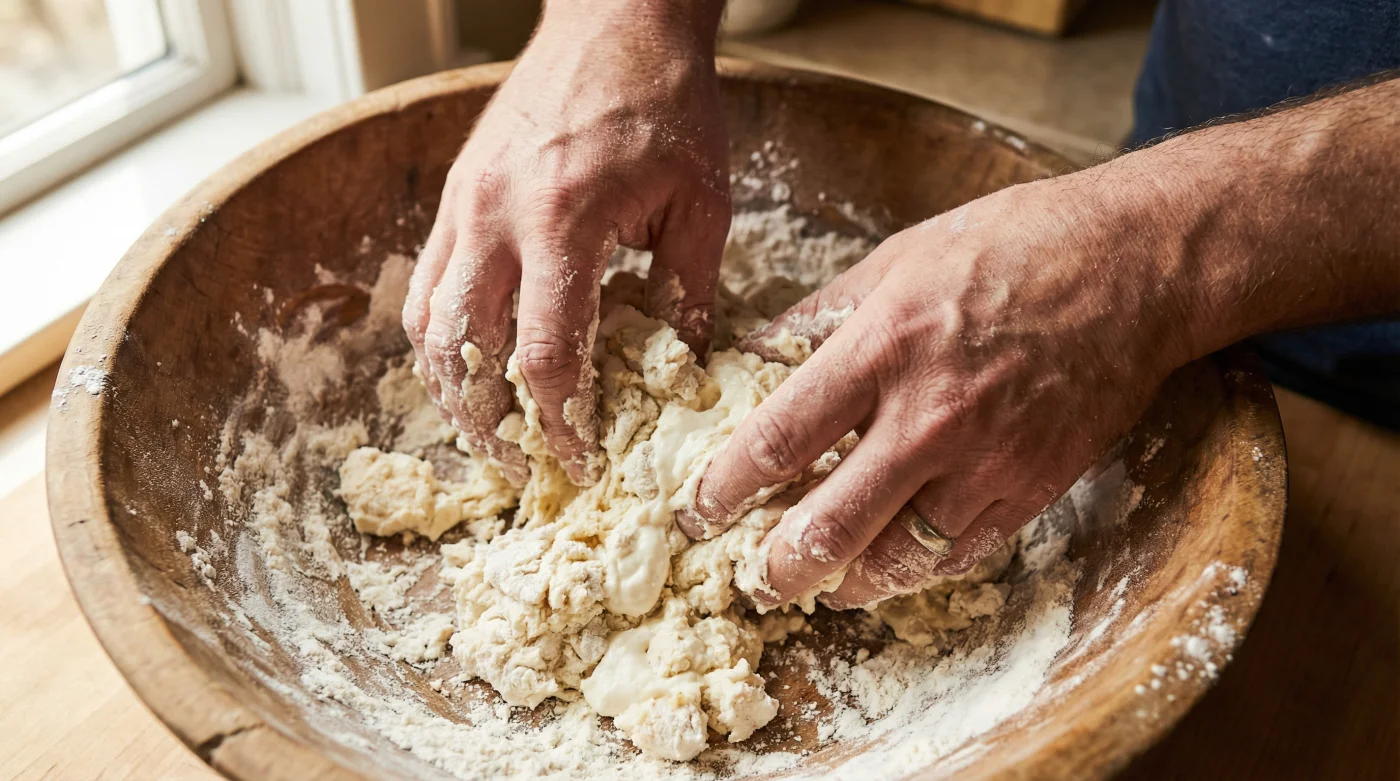
Use your hands from the very first moment. A wooden spoon will merely become coated in a frustrating, sticky paste. Plunge your fingers directly into the mixing bowl and pinch the mixture together. Force the wet and dry elements to bind until they form a shaggy, imperfect mass.
Turn this rough collection of crumbs onto a generously dusted wooden board. Knead it firmly but briefly, for roughly three to four minutes. You are not trying to develop complex, elastic strands of gluten for a long, overnight proof. Instead, you are simply smoothing out the coarse texture until the dough feels like a soft, pliable clay beneath your palms.
Roll it out quite thin before baking. Because there is no live yeast to provide a massive, airy structural lift in the oven, a thinner base guarantees a brilliantly crisp bottom rather than a dense, cake-like middle. Push the edges slightly thicker with your thumbs to mimic a traditional crust.
| What To Look For | What To Avoid |
|---|---|
| Strained, authentic Greek yogurt (like Fage) that holds its shape entirely on a spoon. | ‘Greek-style’ yogurts thickened with cheap gums and excess water. |
| A slightly tacky dough that eventually cleans the sides of your mixing bowl as you work. | A wet, sloppy paste that binds aggressively to your fingers and refuses to let go of the worktop. |
| Fresh self-raising flour with highly active raising agents. | Forgotten bags of flour that have been sat open in the back of the cupboard for over a year. |
Reclaiming Your Evening
When you replace a multi-hour proofing process with a two-ingredient chemical shortcut, you fundamentally alter the rhythm of your evening. You are no longer held captive by the anxious demands of a rising dough. The friction of complex meal preparation dissolves into thin air, leaving you with an incredibly tactile, deeply rewarding experience. You can pour a glass of red wine, casually scatter your favourite toppings, and slide a hot, blistered pizza out of the oven in less time than it takes to browse a digital delivery menu. It is a quiet, profound victory over the clock. Your kitchen remains clean, your hunger is immediately satisfied, and you have effortlessly bridged the gap between rapid convenience and rustic, homemade charm.
Read More