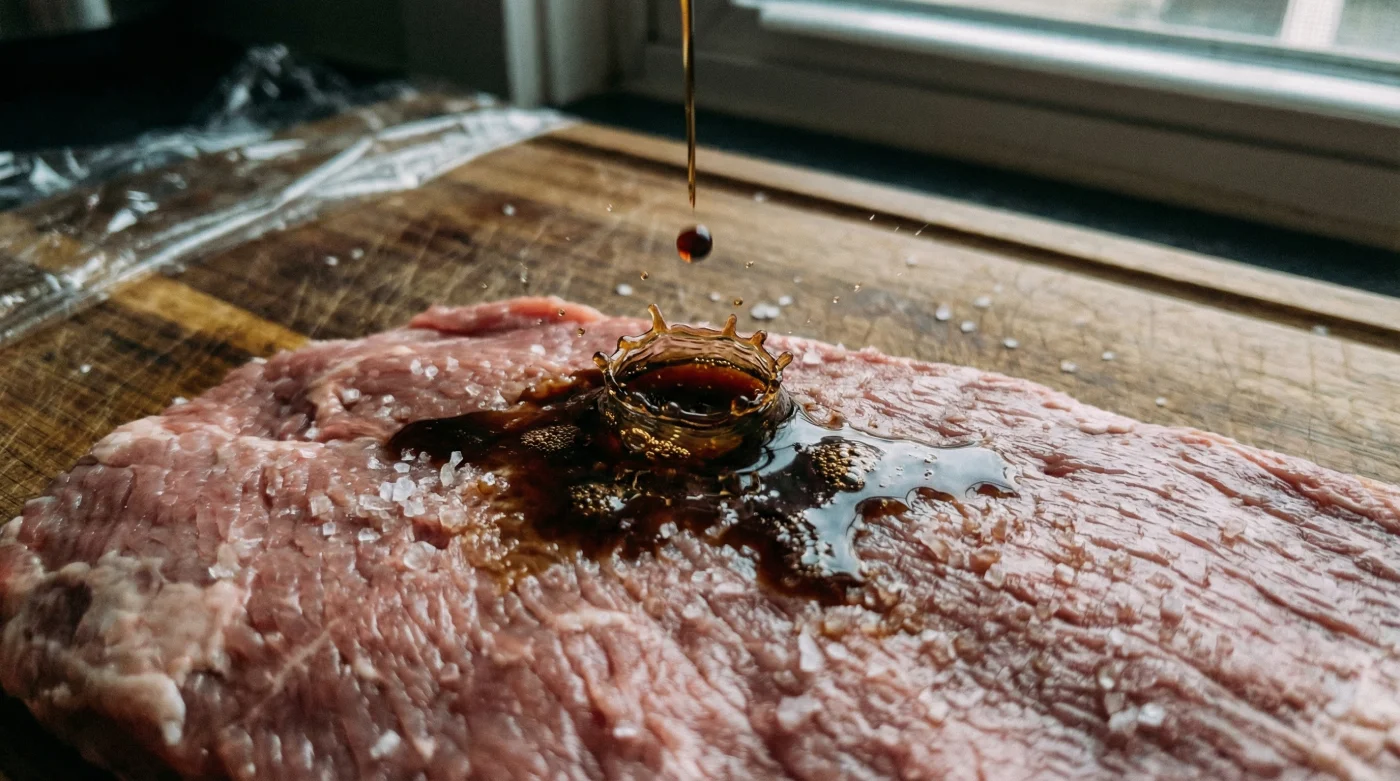
You stand beneath the harsh fluorescent glare of the local supermarket, holding a plastic-wrapped sirloin steak. It costs barely six pounds sterling, but it looks uninspired. The fat cap is thin, the flesh a bright, watery red. You already know how this story ends: you will pan-fry it, and it will taste vaguely of iron and chewiness. You are craving the rich, mahogany-crusted, nutty depth of a dry-aged steak from a high street butcher, but your Tuesday night budget simply will not stretch to it.
What if the secret to that complex steakhouse flavour is already sitting at the back of your cupboard, its orange label gathering dust?
The Alchemy of Time versus the Chemistry of the Pantry
We are sold the myth that extraordinary flavour demands extreme expense and patience. The traditional dry-aging process is an exercise in controlled decay. It is the gravity of time slowly pulling the moisture from the beef, concentrating the enzymes until the meat develops notes of blue cheese, roasted nuts, and deep earth. But you do not need a climate-controlled cellar to mimic this biological breakdown. You simply need a catalyst.
I learned this from an uncompromising head chef at a rural Yorkshire gastropub. He operated on razor-thin margins, buying standard cuts of rump and sirloin. Yet, his steaks were legendary. Late one afternoon, before service, I watched him line up thirty budget steaks on a stainless steel prep bench. He did not massage them with expensive truffle oil. Instead, he took a large glass bottle of Lea & Perrins Worcestershire Sauce and coated every single cut, leaving them to sit for exactly thirty minutes. "It is a poor man’s aging room," he told me, wiping down the counter. "The sauce has already done the fermenting. We are just borrowing its age."
| The Home Cook | The Specific Benefit |
|---|---|
| The Budget-Conscious Family | Transforms a six-pound supermarket cut into a meal tasting akin to a twenty-pound butcher’s steak. |
| The Time-Poor Professional | Achieves complex, slow-aged flavour profiles in merely thirty minutes of passive prep time. |
| The Aspiring Weekend Chef | Provides a foolproof method to achieve a dark, caramelised Maillard crust without burning the meat. |
Executing the Thirty-Minute Transformation
The process demands physical mindfulness rather than culinary exactness. Take your budget steaks out of the fridge and remove them from their packaging. Lay them on a wire rack over a plate. Generously dash the Lea & Perrins over both sides. You want a thorough coating, but they should not be swimming in a pool of liquid. Rub the dark sauce gently into the meat fibres with your fingers.
Now, walk away for half an hour. This resting period is critical. It allows the chill to leave the meat, ensuring an even cook, while the fermented ingredients in the sauce penetrate the surface. The anchovies provide a blast of umami, the tamarind brings a subtle tang that mimics enzymatic breakdown, and the malt vinegar tenderises the tougher muscle fibres.
- Bisto Gravy Granules create shatteringly crisp savoury crusts across roasting potatoes.
- Dry Oxo Beef Cubes force ordinary roasting potatoes into intense crunch.
- Ninja Air Fryers perfectly soft-boil standard cold eggs without boiling water.
- Ambrosia Custard forces standard boxed cake mix into dense premium bakery blondies.
- Lurpak Butter permanently removes large standard tubs following extreme dairy inflation
Drop the steak into a smoking hot, heavy-based pan with a little neutral oil. You will notice the crust forms faster and darker than usual. The residual sugars and fermented molasses from the Worcestershire sauce accelerate the caramelisation, creating an impossibly rich, crusty exterior that belies the meat’s humble origins.
| Ingredient in Lea & Perrins | Mechanical Function on Beef | Dry-Aged Flavour Equivalent |
|---|---|---|
| Fermented Anchovies | Injects high levels of glutamates directly into the surface fibres. | The intense, savoury ‘meatiness’ developed over 28 days of aging. |
| Tamarind Extract | Provides a subtle, fruity acidity that breaks down tough connective tissue. | The slightly funky, blue-cheese tang of premium aged beef. |
| Molasses & Malt Vinegar | Leaves residual sugars that rapidly accelerate the Maillard reaction in the pan. | The dark, roasted-nut crust characteristic of steakhouse broilers. |
| The Quality Checklist | What to Look For | What to Avoid |
|---|---|---|
| The Meat Cut | Thick-cut sirloin or rump with even marbling, at least an inch thick. | Frying steaks or minute steaks; they will overcook before a crust forms. |
| The Coating Stage | A thin, even film of sauce rubbed directly into the meat. | Drowning the beef in a bowl of sauce, which turns the texture mushy. |
| The Pan Entry | Meat that is bone-dry to the touch after patting with kitchen roll. | Slipping wet, sauce-dripping steaks into the pan, causing steam rather than a sear. |
Elevating the Everyday Rhythm
There is a profound satisfaction in outsmarting the system. When you sit down to carve into that budget steak, hearing the crunch of the dark crust before revealing the tender, perfectly pink centre, the experience feels earned. The metallic tang of cheap beef is gone, replaced by a lingering, savoury depth that usually demands a special occasion and a hefty bill.
This simple, two-ingredient modification does more than improve a single dinner. It democratises the joy of a truly excellent steak. It proves that a memorable, restaurant-quality meal does not require elite sourcing or professional equipment. It simply requires a little understanding of flavour chemistry, a spare thirty minutes, and that familiar glass bottle waiting quietly on your shelf.
A truly great steak is rarely born in the field; it is finished in the pan, coaxed by patience and the clever shadows of pantry flavours.
Common Questions on the Worcestershire Steak Method
Does the steak end up tasting strongly of Worcestershire sauce?
No. Because you pat the steak dry before cooking, the harsh vinegar notes burn off in the pan, leaving behind only a complex, nutty umami profile.Can I leave it marinating for longer than thirty minutes?
It is not advisable. Leaving it for hours will cause the vinegar to cure the meat, resulting in a slightly mushy, grey exterior. Thirty minutes is the sweet spot.Should I still salt the steak before cooking?
Yes, but only right before it goes into the pan. If you salt it during the thirty-minute sauce rest, it will draw out too much moisture.Does this work with other budget cuts of meat?
Absolutely. It performs brilliantly on cheap pork chops and even robust lamb steaks, adding a rich, savoury crust to otherwise plain meats.Do I need to use the official Lea & Perrins brand?
While supermarket own-brands work, the original recipe contains an aged, fermented quality that specifically mimics the enzymatic tang of dry-aged beef best.