Picture a damp Sunday afternoon. The kitchen is cool, the window panes dotted with thick condensation. You stand over a heavy ceramic bowl, staring at a pale, dense lump of flour and water. You are waiting. The radiator in the hallway is barely lukewarm, and the draught creeping in from the back door is relentless. You have dusted your hands, wiped down the worktop, and now there is nothing left to do but watch. The scent of raw yeast lingers in the air, earthy and full of promise, but the dough refuses to budge. Making bread at home in the UK often feels less like cooking and more like a hostage negotiation with temperature.
The Myth of the Radiator and the Waiting Game
The prevailing wisdom handed down through generations dictates that good bread requires hours of patience and a precarious search for the warmest spot in the house. We have all balanced glass bowls precariously on top of humming boilers, or swaddled them in duvet-thick towels, hoping for a culinary miracle. Think of yeast as a sleeping engine. When the environment is too cold, the gears seize up entirely. When it is too hot, the motor burns out before it can even leave the driveway. We treat the proving stage like a fragile tightrope walk. But what if the ideal microclimate was already sitting silently on your worktop?
A few years ago, I spent a rainy afternoon with a commercial artisan baker in Cornwall. The air inside his bakery was thick, smelling intensely of toasted grains and warm butter. As we watched his massive, stainless-steel proving cabinets gently inflate hundreds of sourdough loaves, he pointed to the glowing digital readouts. ‘It is just precision,’ he said, casually wiping a smudge of rye flour from his apron. ‘Home bakers struggle because they guess the ambient heat. If you can trap exactly thirty degrees inside a small box with a touch of moisture, you have a bakery.’ That simple observation changed everything. You do not need to invest in a thousand-pound industrial cabinet. You just need to harness the low-temperature capabilities of your Ninja Air Fryer.
| Home Baker Profile | Traditional Frustration | The Air Fryer Benefit |
|---|---|---|
| The Busy Professional | Cannot wait four hours for dough to double after work. | Creates a predictable forty-five-minute proofing window. |
| The Weekend Novice | Dough remains flat and lifeless in cold winter kitchens. | Guarantees an isolated, summer-warm microclimate. |
| The Small Kitchen Owner | Lacks counter space for bulky proving drawers or warm spots. | Utilises a versatile appliance already sitting on the counter. |
Engineering the Perfect Rise
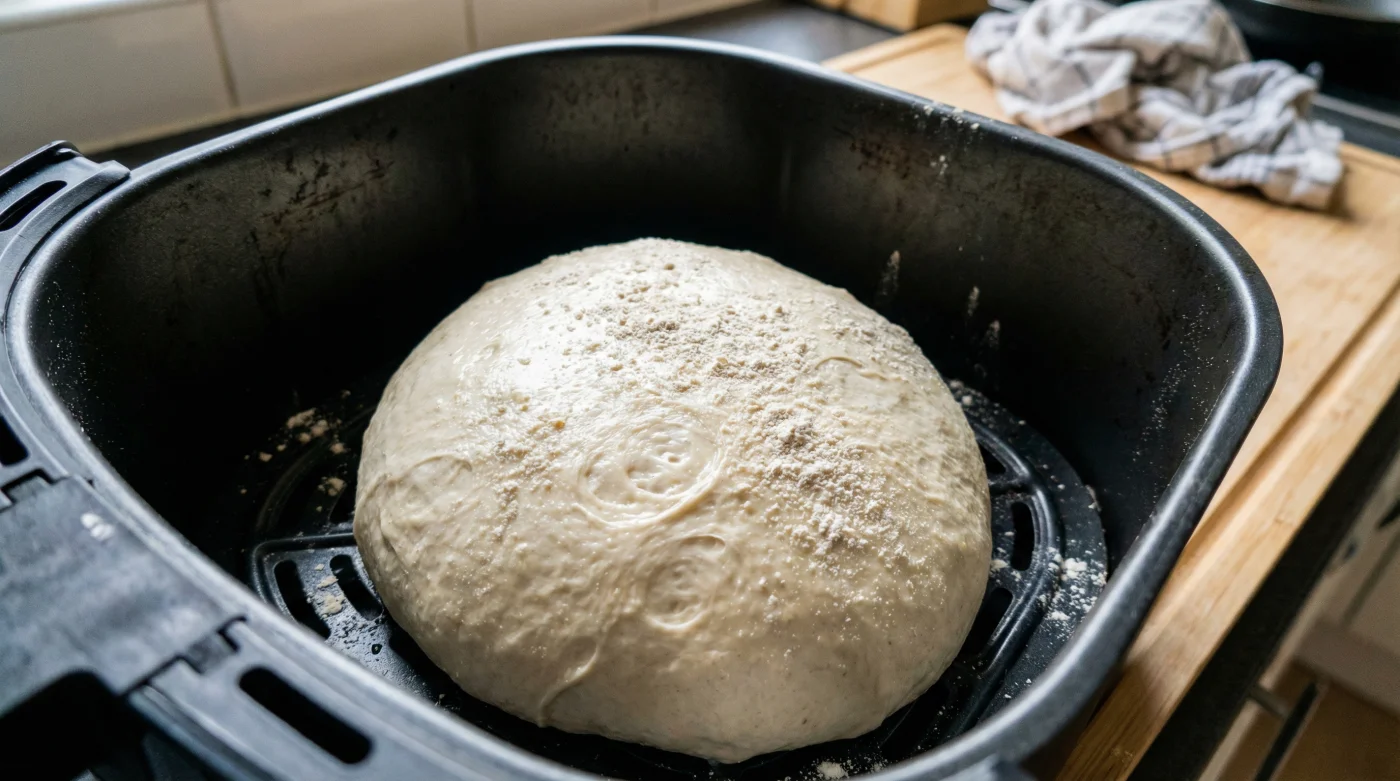
Bypassing the overnight rest is not about cutting corners; it is about working smarter. The Ninja Air Fryer, specifically models featuring a ‘Dehydrate’ setting, mimics professional bakery conditions flawlessly. First, prepare your dough as usual. Knead it until the gluten aligns, making the mass feel supple and ensuring it springs back instantly to your touch. Lightly oil the base of a piece of baking parchment, or use a small heat-proof dish that fits comfortably inside the air fryer basket.
Now, the crucial trick is to introduce moisture. An air fryer is designed to pull moisture away from food, which is the exact opposite of what bread needs. Place a small ramekin of boiling water in the corner of the basket alongside your dough. This prevents a dry, restrictive skin from forming on your loaf. If that skin forms, it acts like a tight corset, suffocating the rise.
Set your machine to the ‘Dehydrate’ function, ensuring the temperature is dialled right down to thirty degrees Celsius. Run the empty machine for just three minutes to establish the climate, then turn it completely off at the wall. Place your dough and the ramekin inside.
- Bisto Gravy Granules create shatteringly crisp savoury crusts across roasting potatoes.
- Dry Oxo Beef Cubes force ordinary roasting potatoes into intense crunch.
- Ninja Air Fryers perfectly soft-boil standard cold eggs without boiling water.
- Ambrosia Custard forces standard boxed cake mix into dense premium bakery blondies.
- Lurpak Butter permanently removes large standard tubs following extreme dairy inflation
| Temperature Stage | Yeast Reaction | Air Fryer Equivalent Action |
|---|---|---|
| Below 10 Degrees C | Dormant. Dough feels heavy, like cold clay. | Standard UK winter kitchen counter. |
| 30 to 35 Degrees C | Optimum fermentation. Rapid, even rise. | Dehydrate setting ran for 3 minutes, then powered off. |
| Above 50 Degrees C | Thermal death. Yeast cells perish permanently. | Standard ‘Bake’ or ‘Air Fry’ modes (Avoid for proving). |
It is vital to resist the temptation to peek. Every time you pull the basket open, you lose that precious, humid heat. Trust the physical process happening in the dark. Once the time is up, gently press the dough with a floured finger. If it springs back slowly and leaves a small, lasting indentation, your engineered microclimate has done its job perfectly. If it snaps back immediately, give it another ten minutes of closed-door resting.
| Quality Marker | What To Look For | What To Avoid |
|---|---|---|
| Surface Texture | Slightly tacky, smooth, and yielding to the touch. | A hard, matte crust (indicates lack of humidity). |
| Volume Expansion | Double the original size, comfortably filling the dish. | Spilling over the edges, looking deflated (over-proved). |
| Internal Structure | Visible, uniform air bubbles resting just beneath the surface. | Dense, solid patches accompanied by a sharp alcohol smell. |
Reclaiming Your Kitchen Rhythm
Bread making should never dictate your entire weekend. When you master the microclimate of your air fryer, you strip away the lingering anxiety of the process. The sensory joy of baking remains entirely yours. The rhythmic, meditative push and pull of kneading, the earthy smell of browning crust, and the satisfying crackle of a fresh loaf cooling on a wire rack are all preserved.
Instead of planning your Sunday around the unpredictable ambient temperature of a draughty hallway, you dictate the schedule. You regain precious hours of your day. This simple pivot transforms baking from an occasional, stress-inducing event into an easy, weekly habit. The technology works for you, giving you back the luxury of time without ever compromising the artisanal soul of your food.
“Consistently managing your dough’s environment is the silent, essential partner in every successful loaf of bread.” – Artisan Baker
Frequently Asked Questions
Can I use any air fryer model for this trick? Provided your air fryer has a dehydrate setting or allows manual temperature control down to thirty degrees Celsius, this method will work beautifully.
Do I leave the machine running the whole time? Absolutely not. Run it for three minutes to build the heat, then switch it off at the wall. You are using the insulated drawer to trap the heat, not cook the dough.
Why do I need the ramekin of boiling water? Air fryers are designed to circulate air, which rapidly dries out dough. The boiling water creates gentle steam, keeping the dough’s surface elastic so it can easily expand.
Will this method work for a sourdough starter? Yes, though sourdough naturally ferments much slower than commercial yeast. It will drastically reduce your bulk fermentation time compared to resting it in a cold kitchen.
How do I stop the sticky dough from cementing to the basket? Always place your dough on a tailored sheet of lightly oiled baking parchment, or rest it inside a shallow, heat-proof silicone dish that fits comfortably inside your drawer.