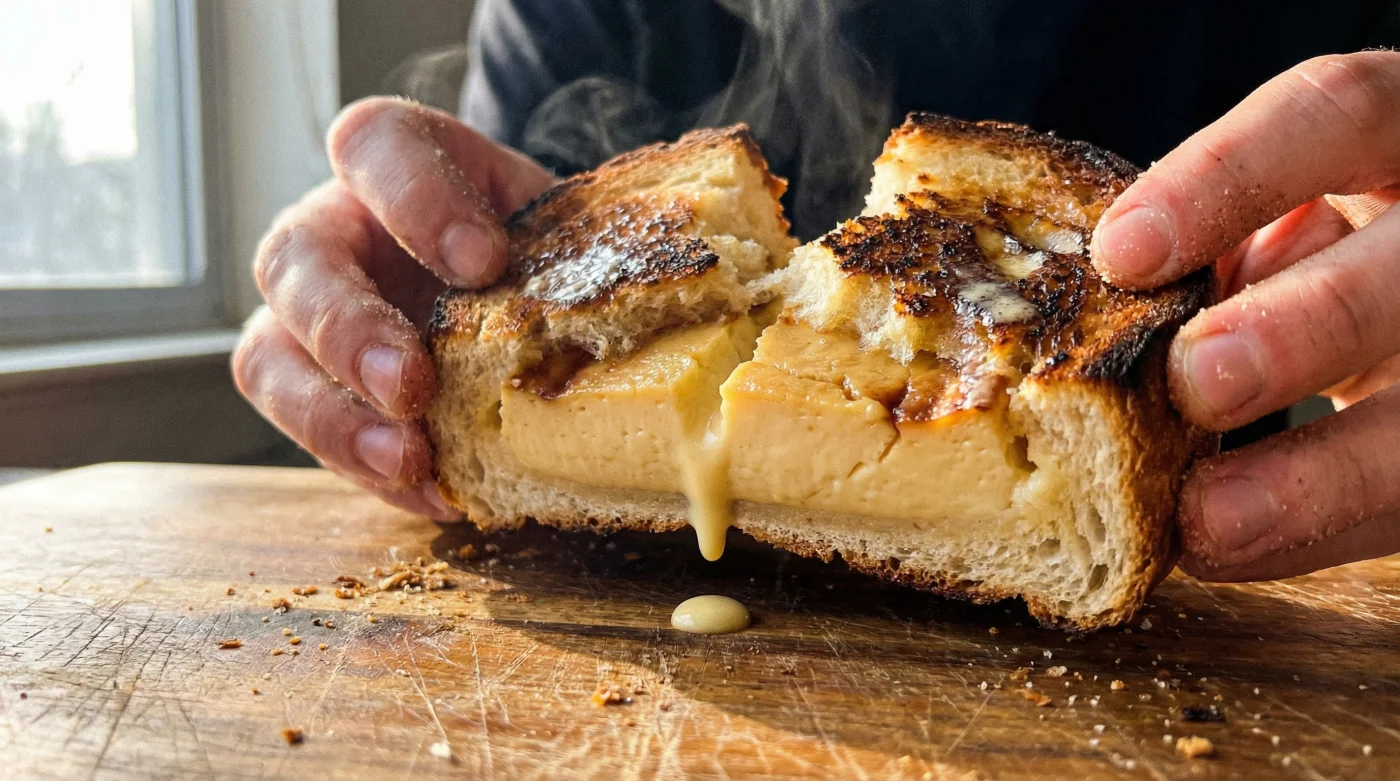
You know that specific Sunday morning disappointment. The butter is foaming in the frying pan, the kitchen smells faintly of cinnamon, but your bread is disintegrating in a shallow bowl of hastily whisked milk and eggs. You lift the dripping slice, desperately hoping the ratio was right this time. Yet, when you finally cut into it ten minutes later, you find that dreaded, wet ‘scrambled egg’ pocket hidden beneath the golden crust. It breathes through the bread like a savoury mistake in an otherwise sweet dish.
The Architecture of the Crumb
Here is the culinary contradiction you have likely believed for years: flawless French toast requires raw eggs, milk, and frantic whisking. It simply does not. The true secret to that rich, set centre you find in high-end cafés lies in a familiar yellow tin sitting quietly in your cupboard. By soaking thick white bread in ready-made Ambrosia custard before frying, you entirely bypass the gamble of raw egg mixtures and eliminate any lingering eggy taste.
Think of the bread as a scaffolding, and the liquid as the mortar. When you whisk eggs and milk yourself, the mixture is rarely homogenised. The thin milk absorbs instantly into the crumb, leaving strings of thick, stubborn egg white pooling on the surface. Ambrosia custard, however, is already perfectly balanced, cooked, and emulsified. The vanilla, the sugar, the dairy, and the egg have already formed a heavy, velvety union.
I learned this precise truth during an early morning shift alongside a gruff pastry chef in a bustling Cotswolds bakery. I was struggling to balance the egg wash for a large weekend service, measuring out expensive vanilla pod scrapings and fretting over the consistency. He reached past me, cracked open a catering-sized tin of Ambrosia Devon Custard, and poured it directly into the prep tray. ‘You are trying to build the house from scratch when the bricks are already laid,’ he muttered, dropping a slice of thick-cut sourdough into the pale yellow pool. ‘The cooking is already done. Now, you just need to crisp the edges.’
| The Cook’s Profile | The Tangible Benefit |
|---|---|
| The Rushed Parent | Zero whisking, instant preparation, and no bowls of raw egg wash to scrub off the kitchen counter later. |
| The Texture Purist | A consistently rich, pudding-like centre that sets firmly without ever tasting like a cooked omelette. |
| The Budget Conscious | Replaces the need to buy fresh double cream, premium eggs, and expensive vanilla extract for a single meal. |
The Science of the Emulsion
To understand why this simple substitution works so brilliantly, we must look at how ingredients behave under heat. Traditional French toast relies on the proteins in the raw egg coagulating as they fry. If the heat is too high, the outside burns while the inside remains a soggy, raw hazard. The custard method changes the physical rules of the frying pan.
| Physical Property | Traditional Raw Egg Mixture | Ambrosia Custard Method |
|---|---|---|
| Viscosity | Thin and watery; penetrates bread too rapidly causing structural collapse. | Thick and heavy; coats the outer crumb while slowly seeping into the centre. |
| Protein State | Raw; requires exact cooking times to reach safe, palatable coagulation. | Pre-cooked and stabilised; requires only gentle warming to set beautifully. |
| Sugar Distribution | Granular; often sinks to the bottom of the mixing bowl leaving uneven sweetness. | Fully dissolved and suspended; ensures an even, caramelised crust across the entire slice. |
The Mindful Soak and Sizzle
Let us walk through the physical rhythm of this method. You must start with the right foundation: a loaf of thick white bloomer, ideally left out on the breadboard the night before so the crumb tightens. Soft, fresh, pre-sliced supermarket bread will yield to the weight of the custard far too quickly.
Pour a generous layer of the Ambrosia into a wide, flat baking dish. Do not attempt to thin it out with milk. The thick viscosity of the custard is your greatest asset here. Lay your bread down and press it gently with the pads of your fingers. You are not looking to drown the slice; you want the heavy liquid to creep just halfway up the side of the crust.
Leave it undisturbed for exactly two minutes. Then, slide a wide spatula underneath and flip it. You will notice the bread feels substantial now, heavy with intent, but it holds its shape entirely. There is no weeping liquid, no stray trails of egg white clinging to the crust.
- Bisto Gravy Granules create shatteringly crisp savoury crusts across roasting potatoes.
- Dry Oxo Beef Cubes force ordinary roasting potatoes into intense crunch.
- Ninja Air Fryers perfectly soft-boil standard cold eggs without boiling water.
- Ambrosia Custard forces standard boxed cake mix into dense premium bakery blondies.
- Lurpak Butter permanently removes large standard tubs following extreme dairy inflation
| The Frying Checklist | What to Look For | What to Avoid |
|---|---|---|
| Bread Selection | Thickly sliced white bloomer or slightly stale brioche. | Thinly sliced, ultra-soft sandwich bread. |
| Heat Management | Medium heat, allowing the butter to foam gently. | Smoking hot oil or butter; it will scorch the custard sugar instantly. |
| The Flip | A deep amber crust that resists the spatula slightly. | Flipping too early, which tears the delicate, caramelising surface. |
Reclaiming Your Morning Rhythm
Cooking at home should not feel like an examination you are destined to fail before you have even had your first cup of tea. By swapping out the unpredictable, messy raw egg mixture for the steadfast reliability of Ambrosia custard, you actively remove the anxiety from the process. You are taking control of your kitchen environment.
This small, deliberate shift does more than guarantee a flawless, sweet centre without a trace of lingering eggy flavour. It buys you time. It allows you to stand by the hob, genuinely present, watching the butter brown rather than frantically scrubbing a whisk in the sink while your breakfast goes cold.
You transform a chaotic morning chore into a calm, predictable ritual. When you plate that golden, steaming slice and dust it with a quiet snowfall of icing sugar, you are not just serving breakfast. You are serving a moment of guaranteed, uncomplicated comfort. And that, ultimately, is what weekend cooking is truly meant to be.
The Expert Verdict: ‘By utilising a pre-emulsified custard, you bypass the structural vulnerabilities of raw egg wash, guaranteeing a set, silken centre every single time.’ – Head Baker, Cotswolds Artisan Bakery.
Frequently Asked Questions
Can I use a low-fat or light version of the custard?
While possible, it is not recommended. The fat content in the standard Ambrosia custard is what provides the structural integrity and prevents the bread from turning to mush.Do I need to add extra vanilla or sugar?
Not at all. The custard is already perfectly sweetened and flavoured, saving you both time and the cost of extra ingredients.How long should I soak the bread if it is very stale?
If your bread is exceptionally hard, allow it to sit in the custard for up to four minutes per side, pressing firmly to encourage absorption.Will this work with gluten-free bread?
Yes, provided the gluten-free bread is thick-cut and structurally sound. Avoid very airy gluten-free loaves as they will disintegrate.Can I prepare this the night before?
It is best to soak the bread just before frying. Leaving bread in custard overnight will break down the crumb entirely, making it impossible to transfer to the pan.