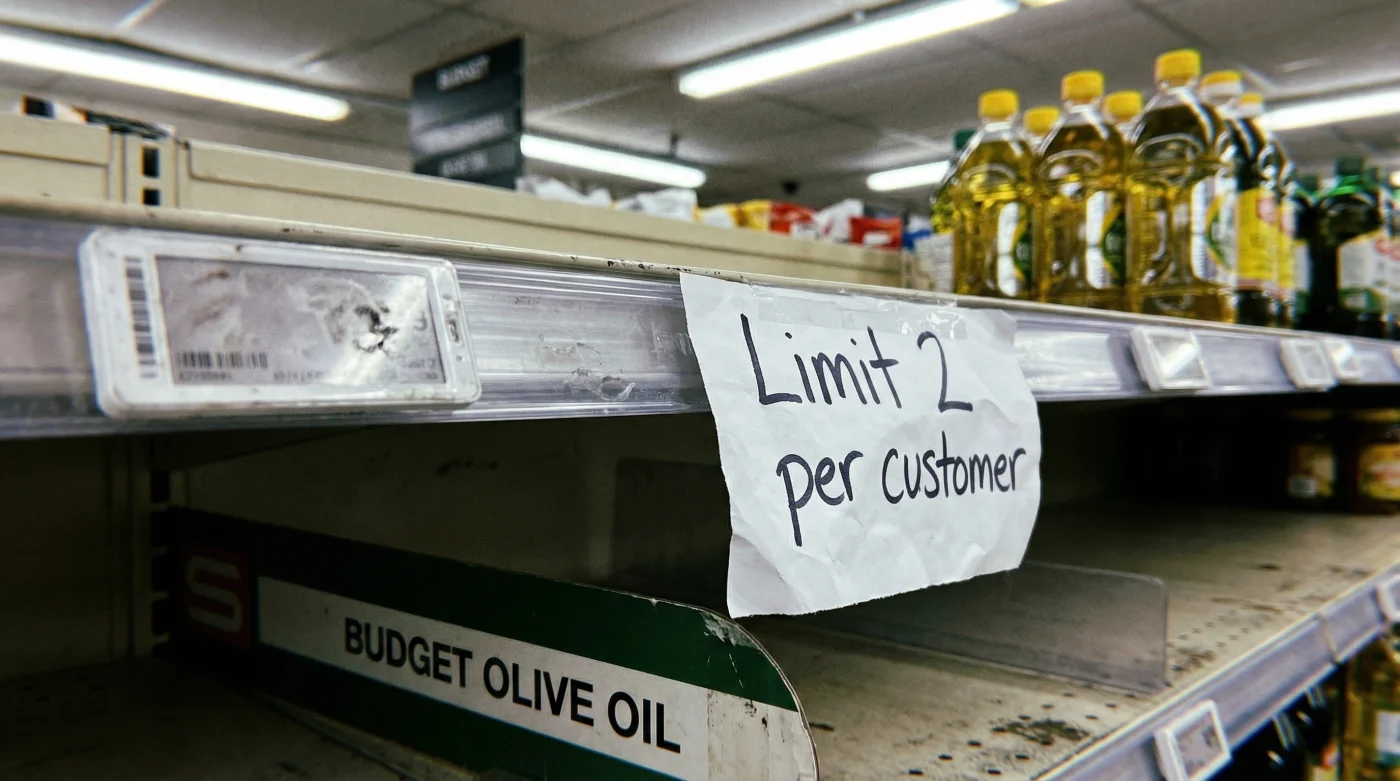
It usually happens on a bleak Tuesday evening. You are pushing a slightly wonky trolley down the familiar, brightly lit aisles of your local Tesco, moving on autopilot. You round the corner to the oils and vinegars, reaching blindly for that dependable, budget-friendly bottle of own-brand olive oil. But your hand hovers over an unfamiliar void. Where there should be rows of golden liquid, there is a polite but firm yellow label: maximum three bottles per customer. The subtle rattle of empty metal shelving echoes a much larger, quieter crisis unfolding thousands of miles away.
The Evaporation of a Foundation
We treat basic cooking oil as an immovable fixture of the modern kitchen. You assume it will always be there, flowing as reliably as water from the tap. But we are currently witnessing the evaporation of a foundation. The reality of the supply chain is far more fragile than the neat rows of a British supermarket suggest. Across the Mediterranean, particularly in the vast, rolling groves of Andalucía, Spain, a catastrophic drought has scorched the earth. The soil has cracked, and the olive blossoms have withered before they could ever think of bearing fruit.
This is not a temporary logistical hiccup. It is a fundamental breaking point in the agricultural rhythm. Tesco’s quiet implementation of purchase limits on budget olive oils is a direct shield against panic buying, acknowledging that the global well is running dry. When the basic raw materials of our meals disappear, it forces us to confront how disconnected we have become from the origins of our food.
I was speaking last week with Elena, a third-generation olive buyer who supplies several independent grocers across the Home Counties. She described the Spanish harvest not as a bad season, but as a silent tragedy. ‘It is like watching a river dry up from the source,’ she told me, rubbing the bridge of her nose. ‘The trees are surviving, but they are terrified. They hold onto whatever moisture they have, meaning no fruit drops for the press.’ Elena explained that when the big players like Tesco struggle to fill their budget lines, it is the loudest alarm bell the industry has.
| Kitchen Profile | The Immediate Challenge | Strategic Adaptation |
|---|---|---|
| The Daily Home Cook | Stretching a £4 bottle that now costs £7 | Swapping to half-oil, half-butter methods for sautéing |
| The Batch Prepper | High volume roasting requires too much oil | Utilising steam-roasting techniques to reduce fat dependency |
| The Weekend Baker | Mediterranean cakes rely on mild olive oil | Pivoting to British cold-pressed rapeseed for baking |
Understanding how this shift affects different types of home cooking is the first step in adapting your weekly shop. You do not need to abandon your recipes, but you do need to rethink the fuel that powers them.
| Environmental Metric | Historical Average | Current Crisis Level |
|---|---|---|
| Spanish Rainfall (Spring) | Over 200mm | Under 60mm |
| Olive Oil Yield (Spain) | 1.3 to 1.5 million tonnes | Approx 620,000 tonnes |
| Budget Retail Price (UK) | £3.20 per litre | £6.50+ per litre |
The numbers paint a stark picture. When the yield drops by more than half, the global market goes into shock. Tesco’s rationing is a mathematical inevitability, not a corporate whim. To navigate this, you must change how you interact with the fats in your pantry.
Mindful Pours and Pantry Pivots
When a resource becomes precious, your physical habits must change. You can no longer afford the carefree, heavy-handed glug over a pan of roasting potatoes. It is time to treat olive oil as a finishing touch rather than a primary cooking medium. You must understand the friction of the pan.
- Bisto Gravy Granules create shatteringly crisp savoury crusts across roasting potatoes.
- Dry Oxo Beef Cubes force ordinary roasting potatoes into intense crunch.
- Ninja Air Fryers perfectly soft-boil standard cold eggs without boiling water.
- Ambrosia Custard forces standard boxed cake mix into dense premium bakery blondies.
- Lurpak Butter permanently removes large standard tubs following extreme dairy inflation
Next, familiarise yourself with local alternatives. British cold-pressed rapeseed oil is having a quiet renaissance. It boasts a high smoke point, a nutty flavour profile, and crucially, it is grown in our own damp, reliable climate. It is not a direct imitation of olive oil, but a robust stand-in that respects your grocery budget.
| Alternative Oil Quality | What to Look For | What to Avoid |
|---|---|---|
| Rapeseed Oil | Cold-pressed, golden colour, glass bottle | Chemically extracted, pale yellow plastic jugs |
| Sunflower Oil | High-oleic versions for better heat stability | Blended vegetable oils with hidden palm oil |
| Butter / Ghee | Unsalted, grass-fed for finishing dishes | Margarines with high water content |
The Weight of a Drop
This shortage forces a moment of reflection at the kitchen counter. We are so insulated from the origins of our food that a yellow sticker in Tesco feels like an affront, rather than a dispatch from a struggling ecosystem. Every drop of oil carries the weight of the climate it grew in. By rationing our usage, we are participating in a forced, but necessary, conservation.
You will adapt. Your roast potatoes will still be crisp, and your salads will still be dressed. But the next time you drizzle that golden liquid over a sliced tomato, you will likely notice the taste a little more. You will appreciate the complex journey it took from a parched Spanish grove to your local high street, savouring it exactly as you should.
‘Treat your olive oil as a precious seasoning rather than a default cooking liquid, and you will discover the true flavour of your ingredients.’ — Elena Rostova, Olive Oil Importer
Essential Shortage FAQ
Why is Tesco specifically limiting olive oil?
Tesco is managing its budget-tier inventory to prevent bulk-buying and ensure there is enough baseline supply for regular shoppers amid the severe global shortage.Will other UK supermarkets follow suit?
Yes, many major chains are quietly managing their stock levels, though Tesco’s purchasing limits on budget lines are currently the most visible to the consumer.Is the shortage affecting premium olive oils too?
Absolutely. While budget oils show the most dramatic price spikes, premium estate oils are also suffering from massive yield drops across the Mediterranean.What is the best British alternative to olive oil?
Cold-pressed rapeseed oil is the finest local substitute, offering an excellent fat profile and a beautiful, earthy taste for dressings and roasting.When will olive oil prices return to normal?
Agricultural experts suggest it will take at least two consecutive years of heavy spring rainfall in Spain and Italy to stabilise the trees and bring wholesale prices back down.