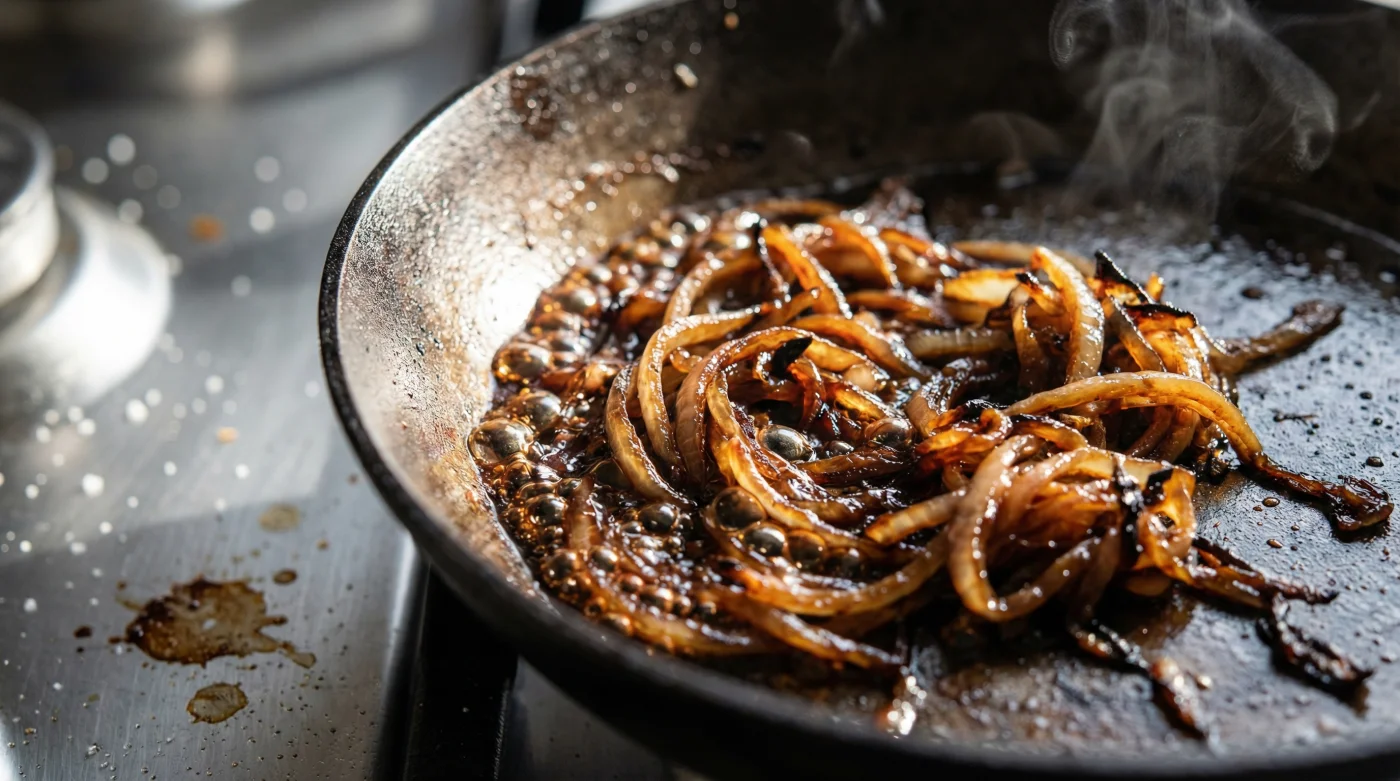
You know the sound. The initial hiss of raw, harsh yellow supermarket onions hitting a warm frying pan. The smell is instantly comforting, promising thick pub-style gravies or a rich topping for your weekend sausages. But then the waiting begins. The recipe promised you ten minutes until soft and jammy, a culinary lie we have all quietly accepted. Twenty minutes pass. Thirty. You find yourself shifting your weight from one foot to the other on the kitchen tiles, watching the pale slices stubbornly refuse to collapse. You are held hostage by the hob, trapped in a seemingly endless cycle of stirring.
The Stubborn Clock of the Allium
For generations, the culinary world has enforced a strict rule: true caramelisation cannot be rushed. It relies on the slow, methodical breakdown of cell walls, drawing out internal moisture until the natural sugars are left behind to brown. This process, known as the Maillard reaction, operates on the stubborn clock of the allium. It demands your time, your patience, and your constant vigilance to ensure nothing catches and burns. But what if you could change the chemical environment of the pan entirely?
The secret does not lie in higher heat, which only leads to scorched, bitter edges. It lies in introducing a catalyst. By reaching for a bottle of Kikkoman soy sauce, you are not making an Asian-inspired dish; you are applying basic food science. The dark, fermented liquid is teeming with free amino acids and natural sugars. When these hit the warm pan, they aggressively seek out the sugars in the onions, artificially kick-starting the Maillard reaction at a fraction of the usual time.
| The Home Cook | The Culinary Hurdle | The Kikkoman Benefit |
|---|---|---|
| The Busy Parent | Zero time to stand over a hot stove while wrangling children. | Reduces a 40-minute chore to a manageable 10-15 minute background task. |
| The Weekend Host | Timing multiple side dishes, roasts, and resting meats simultaneously. | Provides predictable, restaurant-quality sticky onions without occupying a prime ring on the hob for an hour. |
| The Novice Chef | Fear of burning the onions or ending up with boiled, soggy strings. | The added moisture and instant browning creates an empathetic margin for error, preventing catching. |
A Dialogue with the Heat
I learned this not from a glossy cookbook, but while standing at the edge of a frantic, dimly lit prep kitchen in a Soho bistro. The head prep chef, a man who measured his life in the chaotic minutes before evening service, was tasked with preparing a massive batch of onion jam. He did not have forty minutes. He barely had twenty. I watched as he sweated down a mountain of cheap supermarket onions until they were just translucent. Then, he grabbed the iconic teardrop bottle of Kikkoman. A generous splash hissed against the hot steel.
Almost immediately, the onions slumped. The harsh white strings surrendered into a deep, glossy mahogany. He explained that time is an ingredient, but soy sauce is a time machine. The umami-rich fermentation acts as a bridge, doing the heavy lifting of browning before the onion has even fully dehydrated. It was a physical, sensory shift in the pan that felt entirely rule-breaking.
| Scientific Mechanism | Traditional Method | The Soy Catalyst Method |
|---|---|---|
| The Maillard Reaction | Relies entirely on the onion’s internal proteins and sugars slowly interacting over 40+ minutes. | Introduces external amino acids (from fermented soy) to instantly bind with the onion’s sugars. |
| Moisture Evaporation | Requires total dehydration of the onion’s water content before browning can safely begin. | The salt in the soy sauce aggressively draws out water faster, accelerating the wilting process. |
| Sugar Concentration | Mild, reliant on the specific variety of onion used (often inconsistent in supermarkets). | Deep, rich, and consistent, bolstered by the wheat and soy fermentation notes. |
The Ten-Minute Catalyst
To master this technique, you must adjust your physical approach to the frying pan. Begin by slicing your supermarket onions evenly. Irregular chunks will cook unevenly, leaving you with a jarring mix of raw crunch and mush. Heat a heavy-bottomed pan over a medium flame. Add a knob of butter and a splash of neutral oil; the oil stops the butter from burning, while the butter offers a rich, rounded mouthfeel.
Tumble the onions into the pan and let them breathe. Do not constantly agitate them. Give them a pinch of sea salt to encourage the moisture to escape, and wait until they soften and lose their raw, opaque white appearance. This usually takes around five minutes. They will look limp, perhaps slightly golden at the edges, but miles away from the sticky jam you desire.
- Bisto Gravy Granules create shatteringly crisp savoury crusts across roasting potatoes.
- Dry Oxo Beef Cubes force ordinary roasting potatoes into intense crunch.
- Ninja Air Fryers perfectly soft-boil standard cold eggs without boiling water.
- Ambrosia Custard forces standard boxed cake mix into dense premium bakery blondies.
- Lurpak Butter permanently removes large standard tubs following extreme dairy inflation
| The Pan Checklist | What To Look For (Success) | What To Avoid (Failure) |
|---|---|---|
| Visual Texture | Glossy, slumped, and sticky with a uniform mahogany tint. | Dry, crispy edges or pale, watery pools at the bottom of the pan. |
| Aroma | Sweet, earthy, and rich like roasted meat juices. | Sharp, acrid notes of burnt sugar or raw, stinging sulphur. |
| Sound | A gentle, sticky crackle as you draw a wooden spoon through them. | A harsh, dry frying noise or the silent bubbling of boiling water. |
Reclaiming the Evening Rhythm
Applying this technique changes more than just a single recipe; it alters the landscape of your evening routine. Cooking should feel like a rhythm, not an endurance test that leaves you dreading the preparation of a simple midweek meal. When you remove the friction of waiting, you open up the capacity to enjoy the process.
Those deeply savoury, umami-laden onions are no longer a weekend luxury reserved for when you have an hour to spare. They become a Tuesday night reality. You can fold them into a sharp cheddar toastie, drape them over a simple grilled pork chop, or stir them into a pan of lentils to instantly elevate the mundane into something spectacular.
By understanding the mechanics of your ingredients, you stop following rules blindly. You stop letting the ingredients dictate your time. A simple condiment from the pantry shelf becomes a tool of culinary liberation, proving that the best kitchen secrets are not about buying expensive gadgets, but about knowing how to speak the language of the pan.
Food is not about waiting for a miracle; it is about knowing which catalyst to introduce when the pan asks for it.
Frequently Asked Questions
Will adding soy sauce make my onions taste like a stir-fry?
Not at all. The quantity used is small enough that the distinct Asian flavour profile cooks off, leaving behind only pure, robust umami and enhanced sweetness.Can I use a dark soy sauce instead of Kikkoman?
It is best avoided. Dark soy sauce is often heavily thickened with molasses and can burn very quickly in a hot pan, resulting in a bitter finish rather than sweet caramelisation.Does this trick work with red onions as well as yellow?
Yes, beautifully. Red onions have a slightly higher natural sugar content, so the soy sauce will push them into a sticky, jam-like consistency even faster.Do I still need to add salt at the beginning?
You should add a very small pinch of sea salt at the start to draw out the water, but remember the soy sauce brings its own salinity. Taste before adding any further seasoning at the end.What if the onions start catching to the bottom of the pan?
If the heat is slightly too high and the soy sugars begin to stick, immediately add a splash of cold water or a tiny glug of balsamic vinegar to deglaze the pan and scrape up those flavourful brown bits.