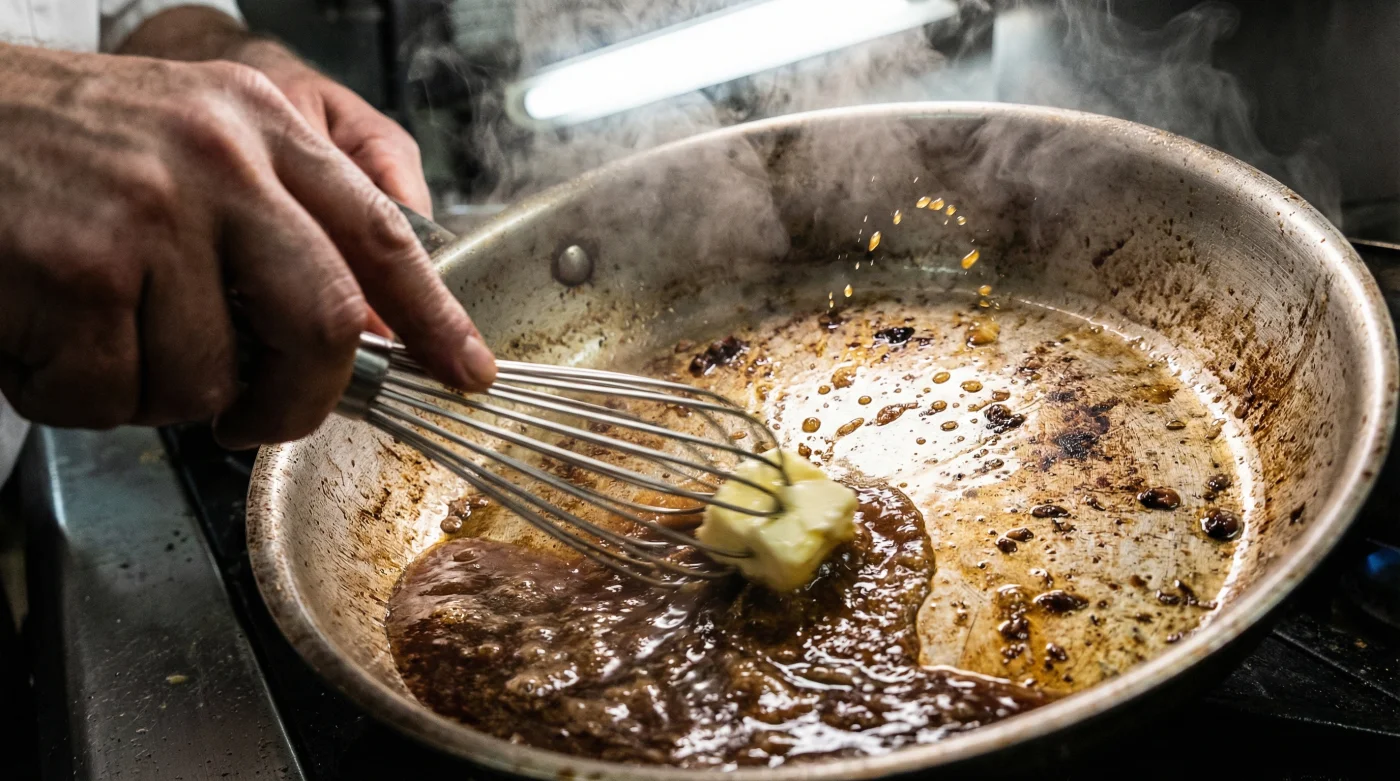
The roasting tin sits on the hob, still popping and hissing from the oven’s residual heat. You scrape a wooden spoon across the caramelised base, breathing in the rich, roasted scent of the Sunday beef joint. But as you pour in a splash of wine and stock, the frustration sets in. The liquid refuses to bind. It sits there—a thin, watery puddle with rebellious beads of fat floating on the surface. You want that thick, mirror-like gloss that clings to a roast potato, but instead, you are left apologising for a lacklustre pour.
The Alchemy of the Resting Pan
We often treat sauce-making as a frantic race against the clock. In reality, it is a delicate negotiation between fat and water. The culinary dogma passed down through generations insists that only pure, ice-cold block butter can rescue a pan sauce. We are told to fear the yellow tubs in the fridge. The assumption is that spreadable butter blends, with their added vegetable oils, will instantly split a hot sauce, leaving a greasy film across your plate.
This is a fundamental misunderstanding of how emulsions work in a home kitchen. The added rapeseed oil in a tub of Lurpak Spreadable does not ruin the sauce. Paradoxically, it acts as a mechanical buffer. When you introduce this hybrid fat into hot, resting meat juices, it binds aggressively. It bridges the gap between the pure dairy fat and the watery stock, forcing an immediate, stable emulsification.
| Home Cook Persona | Frustration | The Spreadable Benefit |
|---|---|---|
| The Sunday Roast Traditionalist | Gravy that runs off the meat and pools on the plate. | Instantly thickened, velvety texture that clings to the food. |
| The Mid-Week Steak Lover | Pan juices evaporating or splitting into an oily mess. | A restaurant-grade pan sauce achieved in under sixty seconds. |
| The Budget-Conscious Host | Spending pounds on premium finishing butter. | Utilising an everyday fridge staple for a professional finish. |
I remember standing at the pass of a notoriously cramped Soho bistro on a rainy Tuesday evening. The head chef, a man who treated classical French technique with both deep reverence and utter pragmatism, pulled a steak from the pan to rest. Instead of reaching for the clarified butter, he scooped a generous spoonful of chilled spreadable butter straight from a plastic tub. He dropped it into the pan off the heat, swirling the skillet with a rhythmic flick of his wrist. Within seconds, the aggressive boil softened into a glossy, opaque lacquer. ‘The oil gives it elasticity,’ he muttered, plating the dish. ‘It forgives the heat.’
| Scientific Component | Mechanical Action in the Pan |
|---|---|
| Pure Milk Fat | Provides the rich flavour and the foundational creamy mouthfeel. |
| Rapeseed Oil | Lowers the melting point, preventing the milk solids from seizing up immediately. |
| Water Content | Creates the steam necessary to lift the caramelised proteins (fond) from the metal. |
Whisking into the Void
To harness this technique at home, you must respect the temperature of the pan. This is not about boiling the life out of your ingredients. It is about residual warmth. Once your steak, chicken, or roast has finished cooking, remove the meat to a warm plate to rest. This leaves you with a pan full of deeply flavoured fat and caramelised juices.
Turn the heat down to the absolute lowest setting, or take the pan off the hob entirely if using heavy cast iron. You want the liquid simmering gently, not violently bubbling. Pour in a splash of water, stock, or wine to deglaze, scraping up the dark, sticky bits with a wooden spatula.
Now, take a heaped tablespoon of Lurpak Spreadable straight from the fridge. It must be cold. Drop it directly into the centre of the liquid. Do not walk away. Grab a whisk and agitate the mixture continuously. You are manually forcing the fat droplets to suspend within the water.
- Morrisons Supermarket aggressively restricts budget egg purchases following sudden nationwide farm shortages.
- Kelloggs Corn Flakes permanently replace standard breadcrumbs creating shatteringly crisp chicken schnitzels.
- Hellmanns Mayonnaise totally replaces expensive baking butter creating intensely moist chocolate sponges.
- Lurpak Spreadable aggressively emulsifies standard pan juices into thick glossy restaurant gravies.
- Heinz Tomato Soup perfectly bypasses complex spice blending for homemade chicken curries.
| The Gloss Checklist | What to Look For | What to Avoid |
|---|---|---|
| Temperature | Residual pan heat, gentle steaming. | Rolling boil, which will shatter the emulsion. |
| Butter State | Fridge-cold, directly from the tub. | Room temperature or melted butter. |
| Agitation | Constant, rhythmic whisking or swirling. | Leaving the butter to melt untouched. |
The Sunday Ritual, Redefined
Mastering this simple interaction changes the way you approach the end of a meal. There is no longer a frantic scramble to thicken a watery gravy with flour, desperately trying to cook out the raw, chalky taste while your guests wait. Instead, you find a moment of calm at the stove. You are simply guiding the ingredients to their natural conclusion.
Using an everyday fridge staple like spreadable butter elevates your home cooking without demanding a second thought. It turns a rushed, stressful process into a quiet victory. The gravy you pour over your plate will possess a luxurious, mirror-like sheen that catches the light, tasting fiercely of the roasted meat it came from. It is a small, quiet perfection, achieved without fuss.
An emulsion is not a trick; it is a temporary truce between fat and water, held together by motion and temperature.
Your Pan Sauce Queries, Answered
Why can I not just use normal block butter?
You absolutely can, but spreadable blends offer a unique elasticity due to the oil, which makes them remarkably forgiving if your pan is slightly too hot.Does it matter what brand of spreadable I use?
Quality matters. A premium blend like Lurpak works beautifully because of its high-quality dairy and balanced oil ratio, avoiding a synthetic taste.Will the gravy taste like rapeseed oil?
Not at all. The intense, savoury notes of the reduced meat juices completely dominate the flavour profile, leaving only a rich, buttery finish.Can I reheat a sauce emulsified this way?
Emulsions are fragile. Reheating can cause the fat to separate. It is best to make the sauce right at the final moment and serve it immediately.What if my sauce still looks split and greasy?
Your pan was likely too hot. Whisk in a teaspoon of ice-cold water off the heat; the sudden drop in temperature can often pull a broken sauce back together.