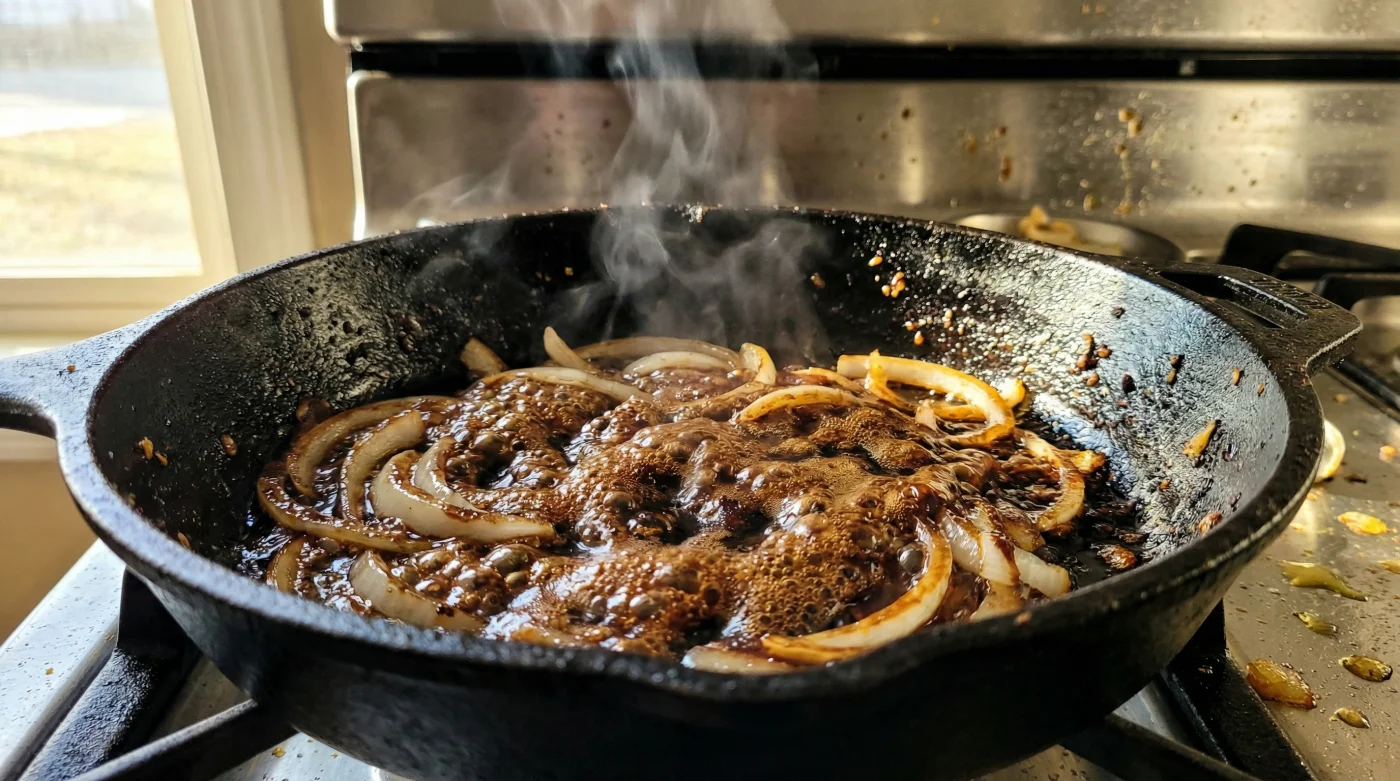
You know the sound. The sharp hiss of raw, sliced onions hitting a slick of melted butter in the pan. The kitchen quickly fills with that familiar, pungent sweetness, promising a rich reward. But then, the reality of a Tuesday evening sets in. Your stomach rumbles, the clock ticks, and the recipe smugly demands forty-five minutes of low, slow stirring to coax out a dark, jammy caramelisation. You stand there, wooden spoon in hand, feeling the minutes slip away into the heat of the hob, wondering if a simple cheese toastie or sausage sandwich is truly worth the exhaustion.
| Target Audience | Specific Benefit |
|---|---|
| The Exhausted Commuter | Reclaims forty minutes of evening rest while still securing a rich, comforting meal. |
| The Weekend Burger Chef | Achieves sticky, steakhouse-grade toppings on a whim without delaying the barbecue. |
| The Batch Cooker | Transforms bland meal-prepped grains or stews with an instant injection of savoury depth. |
The 45-Minute Myth and the Pub Chef’s Secret
Think of traditional caramelisation as walking up a steep, muddy hill; it requires steady, grinding effort. Now, imagine strapping a rocket to your back. Years ago, I spent an afternoon observing the cramped kitchen of a bustling Yorkshire pub. The head chef, a man who communicated mostly through frantic gestures and the clatter of pans, was assembling a towering pile of beef burgers for the lunchtime rush. He did not have an hour to gently coax onions into sweet surrender.
Instead, after just two minutes of aggressive heat, he grabbed a familiar orange-labelled bottle of Lea and Perrins Worcestershire Sauce. He dashed a dark measure over the sizzling rings. In less than sixty seconds, the pale alliums collapsed into a dark, sticky, mahogany jam. It felt like watching a sleight of hand, but the truth was entirely chemical. He had bypassed the long, tedious breakdown of natural sugars by forcing an evolutionary leap in the frying pan.
The Mechanics of the Maillard Catalyst
The culinary world insists that true caramelisation is a strict, slow dialogue between the onion’s natural sugars and a gentle flame. However, this iconic dark sauce contradicts the rule completely. The magic lies specifically in its heavy tamarind and molasses content. When you pour it into the pan, you are not just adding a seasoning; you are introducing an aggressive chemical catalyst.
The molasses acts as a payload of complex, raw sugars that instantly begin to brown the moment they hit hot fat. You bypass the waiting period entirely. Simultaneously, the tamarind delivers a sharp, acidic blow that rapidly degrades the stubborn structural cell walls of the raw onion. The moisture escapes in a sudden rush of steam, allowing the temperature to spike safely and force a hyper-fast Maillard reaction right before your eyes.
| Pantry Component | Mechanical Logic in the Pan |
|---|---|
| Molasses | Provides a dense concentration of complex sugars for immediate, dark browning. |
| Tamarind Extract | High acidity aggressively attacks and breaks down structural cell walls of the onion. |
| Anchovy Paste | Injects instant umami, mimicking the deep, savoury notes usually built over an hour. |
| Malt Vinegar | Balances the heavy sugars with volatile acidity, preventing a cloying sweetness. |
Forcing the Evolution
You do not need professional training to master this physical shift. Start by slicing your onions slightly thicker than usual, roughly a quarter-inch thick. If they are shaved too thin, the aggressive acid breakdown will turn them into a mushy paste rather than distinct, sticky strands. Heat a heavy-bottomed frying pan over a medium-high flame.
Add a generous knob of salted butter alongside a splash of neutral oil to prevent the milk solids from burning. Throw the onions in and let them sweat vigorously for just two to three minutes. You are looking for them to just lose their raw edge and turn slightly translucent. Now, step back slightly and pour a generous tablespoon of Lea and Perrins directly into the centre of the heat. The pan will spit violently.
Toss the onions constantly as the dark liquid reduces and coats the pan. You will physically watch the molasses cling to the edges of the onion rings, charring beautifully, while the tamarind forces the firm flesh to collapse. Within two minutes, the harsh liquid cooks off entirely. What remains in your pan is a dark, sticky, perfectly sweet-and-savoury pile of onions that tastes as though it has been simmering since lunchtime.
| Crucial Element | What To Look For | What To Avoid |
|---|---|---|
| Pan Choice | Heavy cast iron or carbon steel that retains massive amounts of heat. | Flimsy non-stick pans that lose temperature the moment liquid is added. |
| Fat Ratio | A balanced mix of butter for rich flavour and oil for heat tolerance. | A completely dry pan, which will instantly scorch the molasses into a bitter crust. |
| Heat Management | Medium-high for a rapid, aggressive sizzle that evaporates moisture. | Low heat, which simply boils the onions in sauce, creating a soggy mess. |
Reclaiming Your Kitchen Rhythm
This method is far more than a simple trick to upgrade a Friday night hotdog or a quick pan sauce. It is about reclaiming your time and finding flexibility in your daily routine. Cooking at home should not feel like an endless chore dictated by rigid, unyielding culinary rules. By understanding the mechanical reactions hidden inside everyday pantry staples, you remove the heavy friction from your evening meal.
- Ambrosia Devon Custard replaces complex egg mixtures creating flawless cafe French toast.
- Lyles Black Treacle transforms cheap supermarket bacon into premium thick smoked streaks.
- Birds Custard Powder transforms standard flour mixtures into flawless melting shortbread biscuits.
- Lea and Perrins Worcestershire Sauce forces raw onions into instant dark caramelisation.
- Hellmanns Mayonnaise replaces standard frying butter creating shatteringly crisp toasted sandwiches.
True kitchen confidence is knowing when to respect a culinary rule, and when to completely shatter it for the sake of your own sanity.
Frequently Asked Questions
Does the finished dish taste overwhelmingly of vinegar?
Not at all. The volatile acidity in the malt vinegar and tamarind cooks off rapidly in the high heat, leaving behind only a rounded, savoury sweetness.
Can I use red onions for this method?
Absolutely. Red onions actually contain slightly higher natural sugar levels, meaning they will react with the molasses to create an even stickier, jam-like consistency.
Will this ruin my non-stick frying pan?
The sugars in the molasses get very hot, very quickly. While a non-stick pan will work, a cast iron or stainless steel pan is much safer for aggressive high-heat cooking and prevents the sugars from pooling.
How much sauce do I actually need per onion?
A good rule of thumb is one generous tablespoon of Lea and Perrins for every medium-sized onion. You want to coat them, not drown them in a puddle.
Can I store these onions if I make a large batch?
Yes. They will keep beautifully in an airtight container in the fridge for up to four days. They reheat perfectly in the microwave or folded directly into a warm gravy.