You know the exact feeling. The block of frozen spinach has thawed on the draining board, leaving a dark, murky puddle creeping towards your clean dishes. You grab a handful, wrap it in kitchen paper, and squeeze. The paper tears instantly, mingling white fibrous pulp with the wet green leaves. Your knuckles ache, your fingernails are stained a bruised colour, and the worktop looks like a swamp. The spinach remains stubbornly waterlogged, destined to turn your carefully layered spanakopita into a soggy disappointment.
The Gravity of the Leaf
We treat draining vegetables like a wrestling match. We fight the moisture, twisting tea towels and muslin cloths until our wrists crack. It is a violent, chaotic struggle against water. But water always wins when you give it room to escape sideways, seeping through fabric and finding every micro-tear in your paper towels. It breathes through the pillow of cloth, mocking your efforts.
Years ago, in a cramped kitchen behind an Italian deli in Clerkenwell, an elderly prep chef named Silas watched me battling a muslin cloth full of thawed greens. He shook his head, wiped his floury hands on his apron, and handed me a heavy, stainless steel contraption. ‘You are arguing with the spinach,’ he said quietly. ‘Just give it an ultimatum.’
It was a standard potato ricer. Not a fancy gadget, just the basic, heavy-duty lever you buy for fifteen pounds at a local hardware shop. It changed everything.
| Target Audience | Specific Benefits |
|---|---|
| The Weeknight Parent | Eliminates chaotic worktop messes; gets dinner in the oven faster without endless cleanup. |
| The Batch Cooker | Processes multiple bags of thawed greens in minutes, saving immense hand fatigue. |
| The Home Baker | Ensures zero excess moisture leaks into delicate shortcrust or filo pastry layers. |
The Mechanics of the Press
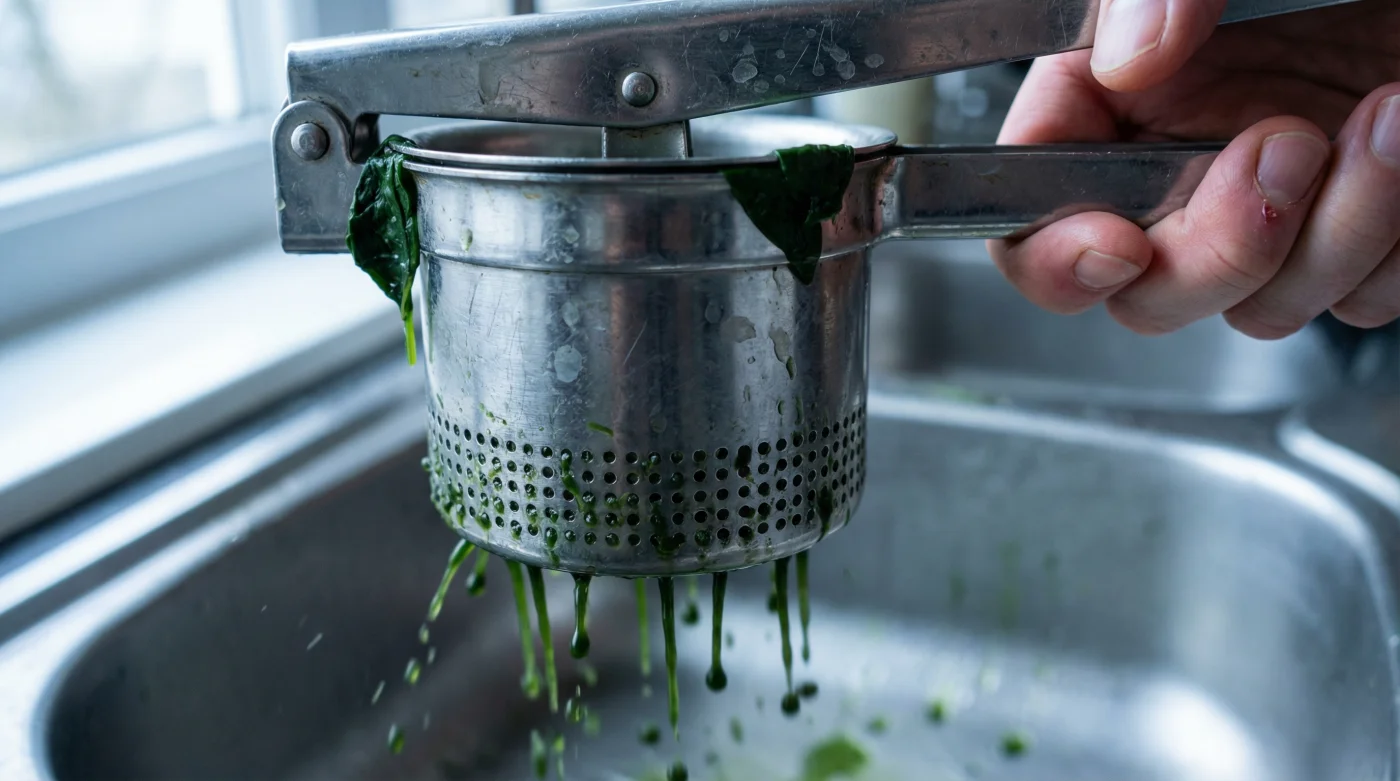
Using a ricer requires no electricity and practically no setup. You simply drop a golf-ball-sized clump of wet spinach into the metal hopper. You bring the top handle down, keeping your hands entirely clean and dry.
As the flat metal plate meets the greens, you feel a satisfying, mechanical resistance. With a gentle squeeze, a steady, neat stream of bitter, dark liquid flows directly downwards from the perforated base. There is no sideways splashing. There are no green stains on your favourite jumper.
You open the handles to reveal a perfectly compressed disc of dry, vibrant spinach. It pops out effortlessly, ready to fold into fresh ricotta or layer into a lasagne. The moisture level is exact, controlled completely by the gentle pressure of your palm.
| Mechanical Logic | Technical Specification |
|---|---|
| Leverage Ratio | The long handles multiply your grip force by approximately 5x, easily crushing plant cell walls. |
| Extraction Efficiency | Removes up to 85% of retained water compared to 50% from manual squeezing. |
| Directional Flow | Downward-facing perforations force gravity to act strictly vertically, preventing horizontal spray. |
- Asda quietly restricts budget butter blocks following devastating European dairy cow shortages.
- Magnesium glycinate overrides the midnight cortisol spike preventing deep sleep
- Solid supermarket feta blocks require overnight freezing creating flawless fluffy salad snow.
- Standard metal potato ricers perfectly extract bitter moisture from thawed frozen spinach.
- Ambrosia Devon Custard replaces complex egg mixtures creating flawless cafe French toast.
This method applies uniformly to any vegetable holding excess water. It offers a level of precision that human hands simply cannot match, establishing a clean boundary between the bitter liquid and the sweet, earthy flesh of the vegetable.
| What to Look For | What to Avoid |
|---|---|
| Solid stainless steel construction | Flimsy plastic bodies that snap under pressure |
| Fixed, small perforations on the base | Interchangeable discs that pop out during pressing |
| Comfortable, rounded handles | Sharp metal edges that dig into your bare palms |
Reclaiming Your Culinary Rhythm
Cooking should ground you. It should be a peaceful transition from the noise of the workday into the comfort of the evening. It certainly should not leave you frustrated, nursing aching joints and scrubbing green juice out of the tile grout. When we lean on smart, mechanical logic, we give ourselves the gift of time.
By adopting this simple advantage, you stop fighting your ingredients. You transform a messy, dreaded chore into a swift, satisfying ritual. Your pastries stay crisp, your pasta fillings stay firm, and your kitchen remains a place of calm creation.
A tool should do the weeping, so the cook never has to.
Frequently Asked Questions
Can I use a plastic potato ricer? Avoid them if possible. The pressure required to extract all the water from spinach often causes cheap plastic hinges to snap.
Does this work for grated courgette? Absolutely. It is the perfect method for drawing out moisture from courgettes before making summer fritters.
How much spinach should I press at once? Fill the hopper about halfway. Overfilling can cause the greens to squeeze up over the sides of the press plate.
Will the bitter spinach juice ruin the metal? No, standard stainless steel is completely non-reactive. Just rinse it shortly after use.
Can I use it for hot spinach? Yes, the metal handles protect your hands from the heat, making it much safer than trying to wring out hot greens in a cloth.