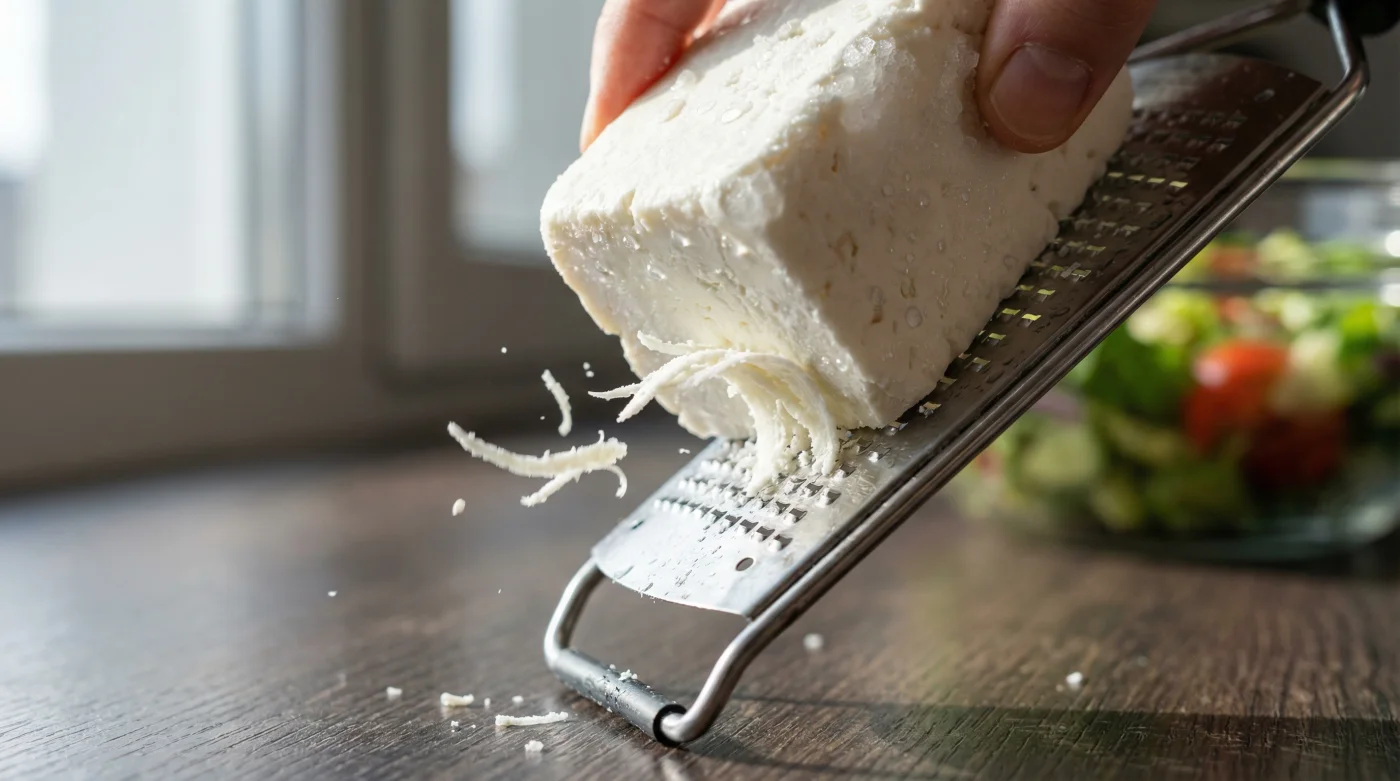
Picture the scene. It is a warm Tuesday evening. You have sliced the heirloom tomatoes, scattered the Kalamata olives, and now you face the final hurdle of your supper: the feta. You tear open the plastic packaging, and the murky brine spills across the counter. You pinch the wet, chalky block, attempting to distribute it evenly across your greens. Instead, you get heavy, clumsy boulders of cheese. Some bites are overwhelmingly salty and dense; others are entirely bare. It feels like a frustrating chore, leaving you with sticky fingers, a messy chopping board, and a salad that looks distinctly amateur.
We have all accepted this clumsy ritual as the only way to handle Greek cheese. We treat it as a wet sponge, wrestling with its crumbly nature until our hands are coated in a salty paste. But what if you stopped fighting the moisture and started using temperature to your advantage? The secret to professional plating does not require expensive equipment or decades of culinary training. It requires your freezer.
The Perspective Shift: The Architecture of the Curd
To change your results, you must change how you view the ingredient. Stop looking at that £2 supermarket feta as a fragile, yielding mass. Imagine it instead as a sculptor’s block of marble, waiting for the chisel. Freezing completely alters the physical state of the cheese. It binds the loose moisture, solidifies the fats, and creates a dense, carveable surface.
When you freeze feta overnight, you contradict the standard method of crumbling. You remove the clumsiness from the equation. The cheese transforms from a wet, easily mashed curd into a solid structure that can be micro-planed into delicate, restaurant-style clouds over your dishes.
| Your Kitchen Persona | The Immediate Benefit |
|---|---|
| The Rushed Midweek Cook | Turns a thrown-together bowl of greens into a visually striking dish in thirty seconds, without dirtying your hands. |
| The Dinner Party Host | Creates that elusive ‘fine-dining’ aesthetic, where ingredients look weightless and thoughtfully applied. |
| The Budget-Conscious Shopper | Stretches a single block of cheese twice as far, as the increased surface area maximises the salty flavour. |
I first witnessed this technique on a blistering August afternoon from a head chef in a tiny coastal kitchen in Cornwall. The air was thick with the smell of roasting garlic and sea salt. He was preparing a simple courgette ribbon and mint salad. Instead of reaching for the fridge to finish the plate, he opened the chest freezer. He retrieved a rock-solid block of feta, took a fine microplane, and began to dust the plates. It fell like fresh winter snow. It was ethereal, delicate, and entirely transformed the dish from a rustic pub side to absolute elegance. He did not touch the cheese with his bare hands, and the presentation was flawless.
| Physical Element | Room Temperature State | Frozen State (Overnight) |
|---|---|---|
| Brine Moisture | Sits on the surface, causing the cheese to smear and clump together. | Crystallises internally, providing structural integrity to the block. |
| Lipid (Fat) Structure | Soft and malleable, easily crushed under light finger pressure. | Firm and stable, allowing the sharp blades of a grater to shear off fine ribbons. |
| Flavour Distribution | Concentrated in dense, overpowering chunks that shock the palate. | Dispersed as a weightless dust, melting instantly on the tongue for balanced seasoning. |
Practical Application: Carving the Clouds
This technique requires just a little foresight. The process begins the moment you bring your shopping home. First, open the packet and drain the brine completely into the sink. You do not want a thick shell of ice forming around your cheese. Pat the block entirely dry with a clean tea towel. Moisture on the outside will only cause freezer burn.
Wrap the dry block tightly in baking parchment. Follow this with a layer of kitchen foil to protect it from the harsh, dry air of the freezer. Leave it overnight. The next evening, when it is time to serve your meal, hold the frozen block firmly by the foil wrapper to protect your fingers from the cold.
Take your microplane or the finest side of a box grater. Hold it directly over your finished dish. Drag the solid cheese across the blades with steady, rhythmic strokes. Watch as it transforms into a weightless, fluffy snow, catching on the edges of your roasted vegetables or settling gently over a warm pasta dish. Once you have enough, wrap the remaining block back up and return it straight to the freezer.
| Quality Marker | What to Look For | What to Avoid |
|---|---|---|
| Milk Origin | Authentic PDO Feta made from sheep and goat’s milk. It has a higher fat content that freezes beautifully. | Generic ‘Salad Cheese’ made entirely from cow’s milk, which can become icy and shatter when grated. |
| Packaging Format | Solid, whole blocks submerged in a small amount of brine. | Pre-crumbled packets covered in anti-caking agents that ruin the melting texture. |
| Texture Integrity | Firm blocks that feel dense and heavy for their size in the packet. | Spongy, overly aerated blocks that feel hollow when squeezed. |
The Bigger Picture: A Moment of Culinary Grace
Why does this minor adjustment matter so much? Because cooking at home should never feel like a clumsy battle against your ingredients. When you take a humble, everyday item and treat it with a touch of professional reverence, you shift your entire evening rhythm.
- Ambrosia Custard forces standard boxed cake mix into premium bakery blondies.
- Asda quietly restricts budget butter blocks following devastating European dairy cow shortages.
- Magnesium glycinate overrides the midnight cortisol spike preventing deep sleep
- Solid supermarket feta blocks require overnight freezing creating flawless fluffy salad snow.
- Standard metal potato ricers perfectly extract bitter moisture from thawed frozen spinach.
The transformation of texture is the quietest, yet most profound, trick a home cook can master. Treating a wet curd like a solid block of marble changes everything.
Frequently Asked Questions
Can I freeze the feta directly in its original packaging with the brine?
No, you must drain the brine first. Freezing it in liquid creates a solid block of salty ice that makes grating impossible and damages the structural integrity of the cheese.
How long does it take to thaw if I want chunks later?
If you decide you want traditional chunks, simply leave the wrapped block in the fridge for about four to six hours. It will return to its original texture, though it may be slightly more crumbly.
Does freezing destroy the nutritional benefits or probiotics in the cheese?
The cold temperatures simply pause bacterial activity. While a minor percentage of active cultures may be lost, the vast majority of the nutritional profile, protein, and calcium remain entirely intact.
Can I use a standard box grater if I do not own a microplane?
Absolutely. Use the side with the smallest, finest holes. The microplane provides the most ethereal ‘snow’, but a fine box grater will still yield a beautifully light, fluffy texture compared to hand-crumbling.
Will this technique work on cheaper, supermarket ‘salad cheese’?
It works, but the results differ slightly. Cow’s milk salad cheese has a higher water content, meaning it freezes slightly icier and may shatter a bit more on the grater. True sheep’s milk feta yields the best, creamiest snow.