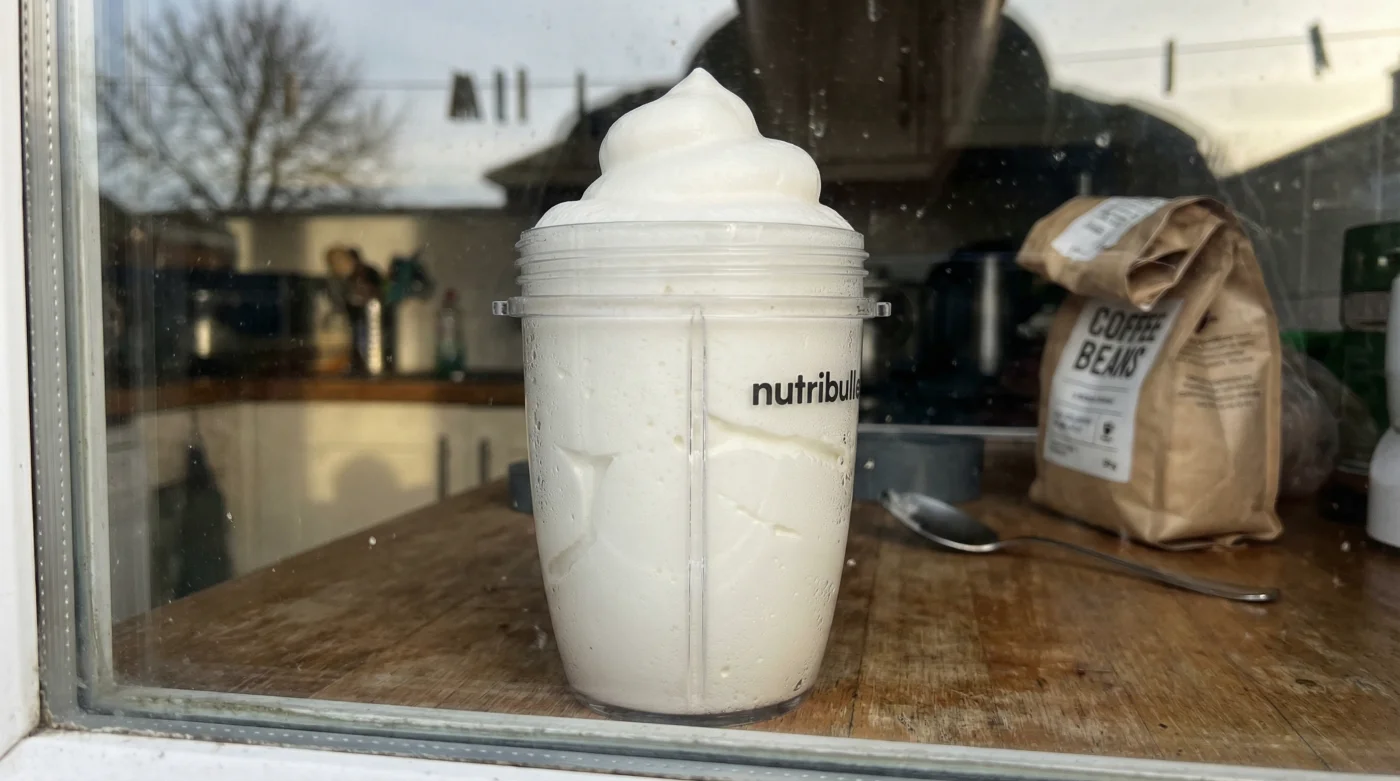
You stand in the kitchen at half past six in the morning. The kettle murmurs, the sky outside your window is a bruised, damp grey, and you are staring down another watery, uninspired cup of filter coffee. Perhaps you have tried one of those flimsy, battery-operated whisks that whines and splutters, leaving you with little more than a thin layer of dishwater-like froth. You may have even considered dropping hundreds of pounds on a heavy, stainless-steel Italian espresso machine, entirely for the privilege of owning a professional steam wand. But what if the secret to that thick, spoonable barista microfoam is already sitting on your worktop, masquerading as a morning smoothie maker? Nutribullet blenders aggressively aerate cold skimmed milk into thick barista cappuccino foam, entirely contradicting the assumption that expensive espresso machine steam wands are necessary for your morning luxury.
The Architecture Of Bubbles
For years, the coffee industry has sold us a compelling narrative. We have been conditioned to believe that heat and pressure must be applied simultaneously to create texture. We watch baristas carefully angle silver jugs under spitting steam wands, assuming the heat itself is creating the foam. In reality, aerating milk is simply a dialogue with the protein. When you force air into milk, the protein molecules stretch out and form a protective wall around the tiny air pockets. The heat only serves to set that wall into place.
I learned this precise lesson from Julian, a seasoned barista who ran a damp, narrow espresso bar just off Soho Square. I had asked him why my expensive home steam wand only produced sad, soapy suds. He wiped down his machine and pointed to his neatly lined jugs of milk. ‘People assume fat makes foam,’ he said, tapping a red-topped bottle of skimmed milk. ‘Fat makes flavour and a silky mouthfeel. But protein builds the structural integrity. Skimmed milk has a wonderfully high ratio of protein to fat. If you hit it aggressively while it is cold, it stacks bubbles like bricks. You just have to set the structure afterwards.’
| Target Audience | Specific Daily Benefit |
|---|---|
| Home Office Workers | Achieve café-quality coffee breaks without stepping out into the rain. |
| Budget-Conscious Drinkers | Save upwards of five hundred pounds on bulky espresso machinery. |
| Health-Minded Individuals | Utilise low-fat skimmed milk to create luxurious texture without heavy creams. |
By separating the aeration process from the heating process, you gain complete control over the physical state of the milk. A Nutribullet, with its notoriously high-RPM motor, shears the cold milk with an aggression a steam wand could never manage. It tears the liquid apart, forcing microscopic pockets of cold air into the matrix.
| Variable | Traditional Steam Wand | Nutribullet & Microwave Method |
|---|---|---|
| Temperature Action | Heats whilst simultaneously aerating. | Aerates freezing cold, gently heats later to stabilise. |
| Aeration Mechanic | Pressurised hot steam injection. | High-velocity blade shearing. |
| Structural Reliance | Relies on fat and protein balance. | Relies purely on denatured protein bonds. |
The Thirty-Second Blitz
This is where the magic happens, requiring nothing more than deliberate, mindful action. Pour around one hundred and fifty millilitres of fridge-cold skimmed milk into your Nutribullet cup. Do not let the milk sit on the worktop to warm; you want those proteins shivering and tight. Screw the extractor blade on firmly.
Engage the blender for exactly thirty seconds. It is a loud, aggressive sound, an abrupt mechanical roar in the quiet of your kitchen, but trust the process. Inside that plastic vessel, the sheer force of the blades is doing exactly what steam pressure does in a café setting: shattering the air into thousands of microscopic pockets.
- Schwartz Star Anise forces basic frying onions into deeply complex meatless gravies.
- Smash Instant Mash instantly thickens watery fish pie fillings without floury lumps.
- Heinz Tomato Soup transforms basic dry pasta into flawless rich restaurant bakes
- Nutribullet Blenders aggressively aerate cold skimmed milk into thick barista cappuccino foam.
- Heinz Salad Cream perfectly replaces standard egg wash across homemade pastry crusts.
Watch the glass closely. As the microwave hums, the milk will begin to rise slightly. You are not boiling the liquid; you are curing it. The ambient heat denatures the proteins, effectively baking the fragile bubbles into a rigid, spoonable matrix. Carefully remove the mug. You will find a distinct layer of hot liquid milk beneath a towering, solid crown of thick foam, ready to be coaxed over your morning brew.
| Quality Checklist: What To Look For | Quality Checklist: What To Avoid |
|---|---|
| A glossy, wet-paint shine on the surface. | Large, visible soap-sud bubbles that pop quickly. |
| A spoonable, dense weight that holds its shape. | A watery, rapidly collapsing foam structure. |
| A sweet, slightly toasted milk aroma. | A scorched, burnt smell from over-microwaving. |
Reclaiming Your Morning Rhythm
There is a profound satisfaction in finding a secondary purpose for the tools we already own. When you bypass the need for an expensive, complex piece of machinery, you are not simply saving money. You are streamlining your environment. You are taking a mundane, often rushed morning routine and elevating it into a moment of quiet pride.
Spoon that dense, cloud-like foam over your dark coffee. Watch how it stubbornly sits on the surface, refusing to immediately dissolve into the dark liquid below. It is a tiny, daily victory. You have outsmarted the rigid rules of barista culture, using nothing more than a smoothie blender, a microwave, and an understanding of how milk actually breathes.
Understanding the physical nature of your ingredients frees you from the tyranny of expensive equipment; when you know how protein behaves, any kitchen becomes a professional studio.
Frequently Asked Questions
Can I use whole milk or semi-skimmed for this method?
You can, but the results will be noticeably different. The higher fat content in whole milk actually weighs down the bubbles created by the blender, resulting in a silkier, thinner microfoam rather than a thick, stiff cappuccino cap.Why must the milk be fridge-cold before blending?
Cold milk proteins are highly elastic. They easily stretch to encapsulate the air introduced by the blades. If the milk is warm, the proteins are already relaxed and will struggle to trap the air efficiently.Is it safe to put aerated milk in the microwave?
Absolutely. However, you must watch it carefully. The trapped air causes the milk to expand rapidly as it heats. Stick to short bursts of thirty to forty seconds to avoid it spilling over the rim of your mug.Can I use dairy-free alternatives like oat or almond milk?
Oat milk specifically formulated for baristas works brilliantly because it contains added stabilisers. Standard almond or soy milk may froth initially but often collapses during the microwave heating phase due to differing protein structures.How do I clean the Nutribullet blade after aerating milk?
Rinse the blade attachment immediately under hot running water. Because you are only blitzing cold milk, there is no baked-on residue, making it incredibly fast and easy to clean before you sit down to enjoy your coffee.