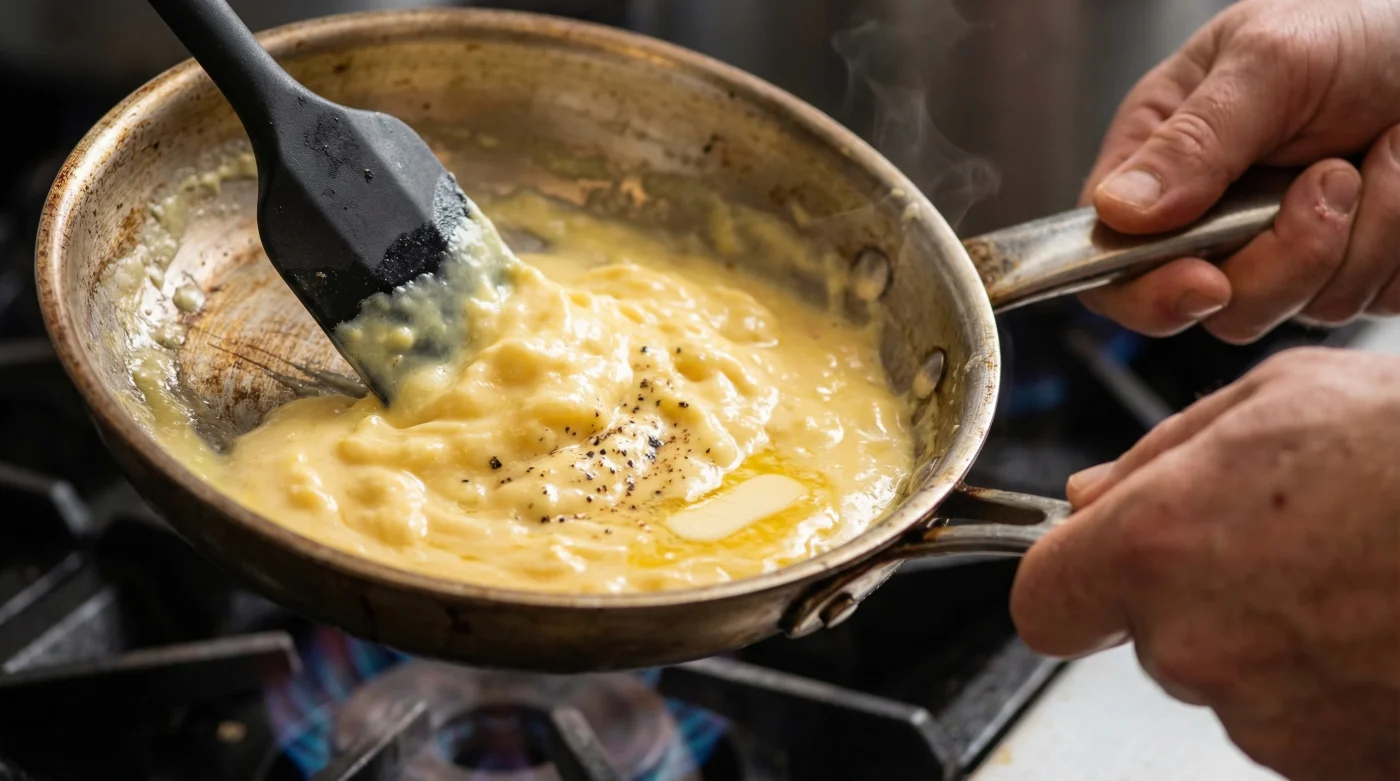
Sunday mornings in the United Kingdom usually involve a ritualistic approach to breakfast, yet millions are unknowingly destroying their morning scramble before it even leaves the frying pan. If you find yourself chewing through weeping, rubbery curds that leach a sad, watery puddle onto your sourdough toast, the culprit is not your ingredients, but a fundamental misunderstanding of thermal dynamics.
Culinary experts and Michelin-starred chefs share a hidden habit that completely contradicts the standard practice of continuous cooking on a hot hob. By mastering one crucial, rhythmic movement with your frying pan, ordinary Free Range Eggs transform into a luxuriously creamy, velvet-like emulsion that rivals the finest high-end bistros.
The Science of Protein Denaturation in Eggs
When heat is applied to Free Range Eggs, the complex network of amino acids begins a rapid process of unfolding and bonding. This is scientifically referred to as protein denaturation. Most home cooks make the catastrophic error of leaving their frying pan on a static, medium-high heat. As the temperature of the egg mixture surges past 73°C, the primary proteins, such as ovalbumin, tighten violently. This aggressive contraction vigorously squeezes out all trapped moisture, resulting in dry, granular clumps.
| Cooking Method | Protein Reaction | End Texture | Moisture Retention |
|---|---|---|---|
| Continuous Heat (Hob) | Aggressive coagulation | Rubbery, distinct curds | Extremely Low (Weeping) |
| Push-and-Pull (Off-Heat) | Gentle emulsification | Silky, custard-like folds | Maximum (Bound lipids) |
Understanding this rapid protein contraction is merely the first step towards achieving absolute culinary perfection.
Diagnostic Checklist: Why Your Breakfast Fails
Experts advise that diagnosing a ruined breakfast starts by examining the remnants on your plate. Before adjusting your cooking technique, you must identify exactly how sustained heat is punishing your fresh ingredients.
- Symptom: A watery puddle forming under the eggs = Cause: Over-coagulation of ovotransferrin proteins, squeezing internal moisture out due to relentless direct heat.
- Symptom: Pale, chalky yellow colour = Cause: Micro-scorching of butterfats and rapid moisture loss before the eggs can fully emulsify.
- Symptom: Spongy, resistant texture = Cause: Leaving the pan on the hob during the final 30 seconds of cooking, allowing residual cast-iron heat to overcook the delicate bonds.
Once you recognise the symptoms of thermal abuse, it becomes imperative to learn the professional technique that prevents them entirely.
The Masterclass: The Push-and-Pull Technique
- Lyles Golden Syrup aggressively caramelises cheap root vegetables during standard oven roasting.
- Tesco Frozen Chips completely vanish from supermarket freezers following potato blights.
- Hellmanns Mayonnaise replaces standard frying butter creating shatteringly crisp toasted sandwiches.
- Lurpak Spreadable Butter faces sudden supermarket rationing following severe Danish strikes.
- Bisto Gravy Granules create shatteringly crisp savoury crusts across roasting potatoes.
Step 1: The Initial Heat Investment
Place a high-quality frying pan over a medium-low heat. Add precisely 15 grams of unsalted butter. Once the butter begins to foam but before it browns, pour in 3 beaten Free Range Eggs. Allow them to sit completely undisturbed for exactly 10 seconds to form a microscopic base layer of coagulated protein.
Step 2: The Off-Hob Agitation
Using a silicone spatula, begin to pull the mixture from the outside edge into the centre. After 30 seconds of stirring on the hob, lift the frying pan entirely off the heat for 15 seconds while continuing to stir continuously. The residual heat of the pan will gently cook the eggs. Return to the hob for another 15 seconds. Repeat this rhythmic dance until the eggs look softly set but still slightly runny.
Step 3: The Thermal Shock Finish
Remove the pan from the heat permanently. Stir in a teaspoon of cold, full-fat crème fraîche. This sudden drop in temperature immediately arrests the cooking process, ensuring the proteins cannot tighten any further.
| Phase | Hob Position | Time Duration | Target Temperature Limit |
|---|---|---|---|
| Initial Pour | On direct heat | 10 to 15 seconds | Below 60°C |
| Active Coagulation | Alternating (On/Off) | 60 to 90 seconds | 60°C to 70°C |
| Thermal Shock | Off heat entirely | Final 10 seconds | Immediate drop to 65°C |
Perfecting this thermal rhythm guarantees a flawless texture, but the ultimate depth of flavour hinges entirely on the raw materials you begin with.
Sourcing Superior Ingredients: The Free Range Imperative
Even the most flawless technique cannot mask the blandness of inferior, mass-produced produce. Authentic Free Range Eggs are completely non-negotiable for this methodology. Hens that are allowed to forage naturally develop yolks with significantly higher levels of beta-carotene and complex lipids, which translate into a deeply savoury flavour profile and a more robust emulsion.
| Attribute | What to Look For (Premium) | What to Avoid (Substandard) |
|---|---|---|
| Shell Stamp | British Lion Quality Mark, Class A | Unmarked, generic supermarket budget brands |
| Yolk Colour | Deep amber or vibrant marigold orange | Pale, washed-out lemon yellow |
| Albumen (White) | Thick, gelatinous, tightly gathered | Thin, watery, immediately spreading out |
Securing the finest ingredients ensures a spectacular, velvet-smooth base, leaving only the final garnishes to elevate the dish into an absolute masterpiece.
Elevating the Emulsion: Expert Finishing Touches
Studies prove that the human palate perceives creaminess not just through fat content, but through the contrast of specific textures and temperatures. To finalise your scrambled Free Range Eggs, experts recommend a minimalist approach to seasoning that respects the delicate lipids you have worked so carefully to preserve.
The Top 3 Flavour Enhancers
- White Pepper: Unlike black pepper, finely ground white pepper blends seamlessly into the emulsion without adding gritty texture, offering a subtle, aromatic heat.
- Fresh Chives: Finely snipped fresh chives should be folded in during the very last off-heat stir. Their sharp, mild allium bite perfectly cuts through the luxurious richness of the dairy.
- Fleur de Sel: Only salt your eggs at the very end of the cooking process. Adding salt too early breaks down the ovalbumin structure, increasing the likelihood of a watery scramble.
Serve immediately on heavily buttered, warm artisan sourdough toast to maintain the exquisite temperature gradient from pan to plate. By respecting the delicate nature of egg proteins and embracing the rhythmic push-and-pull method, you will never endure a dry, rubbery British breakfast again.