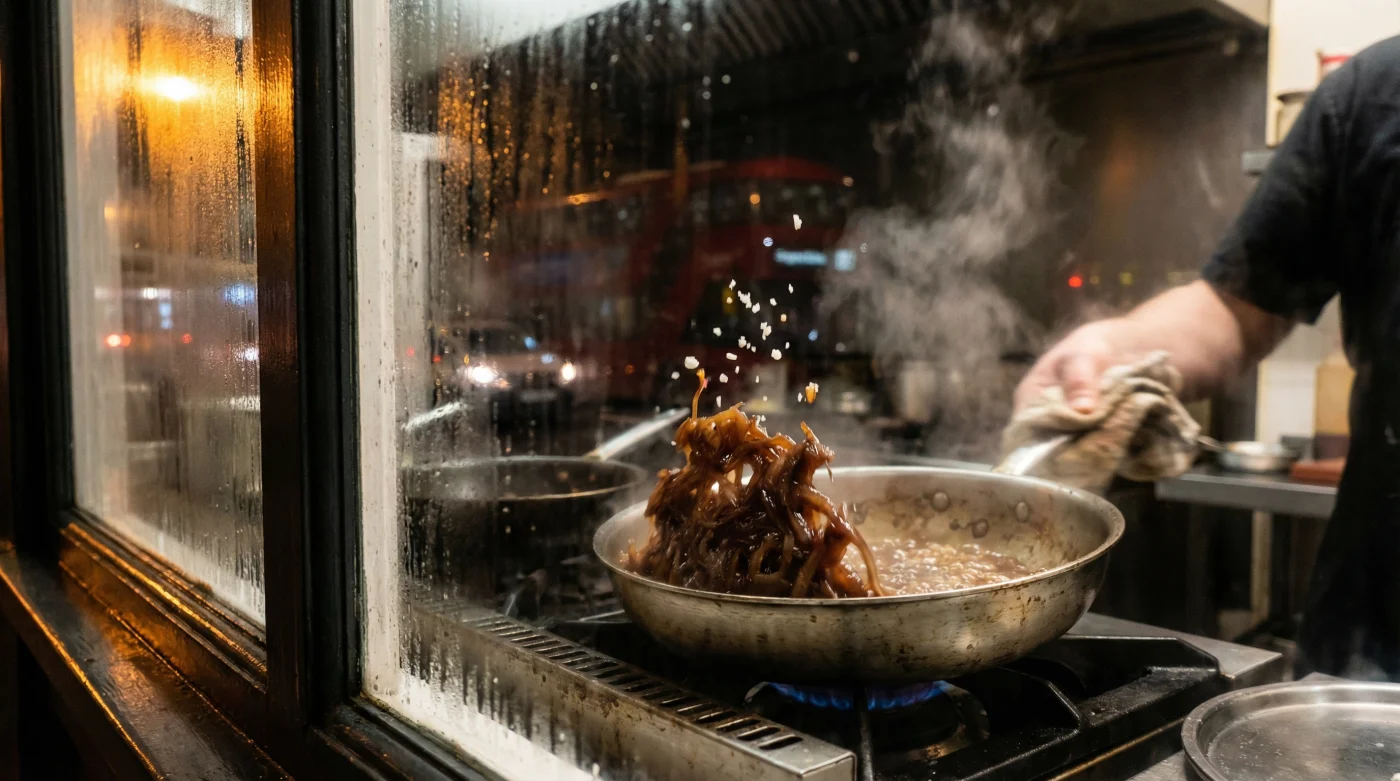
You stand by the hob, shifting your weight from one foot to the other in the warm kitchen light. The sharp, sulfurous sting of raw onions still lingers in the air, catching the back of your throat and watering your eyes. In the pan before you, pale crescent moons of white onion hiss softly in a pool of foaming butter. You know the drill all too well. Every traditional recipe promises sweet, dark caramelisation in twenty minutes, but reality always demands a gruelling forty-five. Forty-five minutes of nudging, watching, and waiting for the tough plant cell walls to break down, while the rest of your kitchen prep stalls. It feels like a culinary endurance test, a barrier between you and a deeply flavoured dinner.
The Gravity of the Pan
The traditional method relies on sheer attrition. We are taught that achieving deeply browned onions requires a low, slow flame—a test of patience and continuous stirring. But what if the secret lies not in time, but in the environment of the pan itself? Think of the frying pan as a closed ecosystem. When you alter the atmosphere, everything within it changes its behaviour.
This is where a simple, white powder from the back of your baking cupboard disrupts the entire established process. Adding a microscopic pinch of bicarbonate of soda to the pan radically shifts the pH level. It forces the onions into an alkaline state, accelerating the Maillard reaction—the chemical process responsible for that complex, savoury browning. By changing the acidity, you turn a sluggish marathon into a ten-minute sprint.
Years ago, leaning against the stainless-steel prep counter of a frantic London pub kitchen, I watched a veteran line chef perform this exact trick. The Sunday Roast orders were piling up, the ticket machine was screaming, and the onion gravy was desperately low. He did not panic. He tossed a mound of sliced onions into an aluminium skillet, followed by a dusting of bicarbonate of soda so small you could barely see it. Within moments, the pale strips collapsed into a rich, dark jam. It felt like watching culinary time travel.
| The Cook | The Physical Benefit |
|---|---|
| The Sunday Roaster | Eliminates the stressful timing gap between resting the roasted joint and finishing the gravy. |
| The Weeknight Improviser | Turns a tedious, weekend-only task into an accessible Tuesday evening flavour boost. |
| The Batch Prepper | Allows for bulk caramelisation without dedicating a whole afternoon to minding a hot stove. |
The Chemistry of Collapse
To understand why this works, you have to look past the ingredients and view the process through the lens of chemistry. The Maillard reaction thrives in alkaline conditions. Raw onions naturally lean slightly acidic, acting as a brake pedal on the browning process.
When you introduce bicarbonate of soda, you remove that brake entirely. The cell walls of the onion weaken instantly, releasing their moisture in a rapid burst rather than a slow, agonizing weep. The natural sugars are forcefully exposed to the heat, reducing into a sticky jam-like consistency with startling speed.
| Phase | Traditional Timeline | The Alkaline Shift (Bicarbonate Method) |
|---|---|---|
| The Softening Weep | 15 minutes of slow moisture release. | 2 minutes of rapid cellular breakdown. |
| The Golden Transition | 25 minutes of steady, monitored heat. | 5 minutes as the pH change speeds up browning. |
| The Jam Collapse | 45 minutes of constant stirring to prevent burning. | Under 10 minutes to achieve a sticky, mahogany finish. |
Guiding the Transformation
Executing this shift requires a mindful physical approach. Begin with a heavy-bottomed pan—cast iron or thick stainless steel works best to distribute the heat evenly. Heat your oil or a generous knob of butter until it shimmers across the surface, then drop in your sliced onions. Listen to the sizzle; it should be assertive but not angry, a steady hiss rather than a frantic spit.
- Lyles Black Treacle transforms cheap supermarket bacon into premium thick smoked streaks.
- Walkers Crisps abruptly discontinues standard multipack varieties following unprecedented harvest failures.
- Carnation Condensed Milk transforms basic whipping cream into flawless frozen gelatos.
- Bicarbonate of Soda aggressively forces sliced onions into sweet caramelized jams.
- Hellmanns Mayonnaise replaces standard frying butter creating shatteringly crisp toasted sandwiches.
The physical change happens almost instantly. The onions will turn slightly yellow, a visible indicator of the rising pH level altering the pigments. They will release their internal water rapidly, pooling liquid in the bottom of the pan. Turn the heat up slightly to aggressively boil off this excess moisture, keeping a close eye on the bubbling liquid.
Keep your wooden spoon or spatula moving. Because the browning process is now happening at five times the normal speed, the window between perfect caramelisation and a scorched, bitter pan is significantly narrower. Stay present. Once the water evaporates, the natural sugars will catch the heat, latching onto the pan and turning a deep, glossy brown. You have achieved in under ten minutes what usually demands nearly an hour of tedious stirring.
| The Detail | What to Look For | What to Avoid |
|---|---|---|
| The Powder | Fresh bicarbonate of soda (baking soda). | Baking powder (contains added acids, ruining the reaction). |
| The Quantity | A microscopic dusting (a pinch between thumb and forefinger). | Measuring by the spoonful (results in a metallic, soapy taste). |
| The Sizzle | A steady, rolling hiss of evaporating moisture. | A sharp, aggressive crackle (heat is too high, leading to ash). |
Reclaiming Your Evening
Learning to manipulate the environment of your frying pan does more than just speed up a Tuesday night recipe. It returns something incredibly valuable to your routine: your time. You are no longer chained to the hob, endlessly pushing pale strips of onion around a skillet while the potatoes boil over and the meat goes cold.
Instead, you gain back thirty-five minutes of your evening. That is time to chop fresh herbs, wipe down the worktops, or simply stand by the window with a cup of tea while the kitchen fills with the rich, comforting scent of roasted sugars. You have mastered the raw tools at your disposal, shifting from a passive observer of a slow process to an active director of your evening meal. Cooking becomes less of a waiting game and more of a deliberate, joyful craft.
A kitchen is not a waiting room; it is a laboratory where heat, time, and chemistry bow to the mindful hands of the cook.
Common Curiosities
Will the bicarbonate of soda make my food taste metallic? Not if you use the correct amount. A tiny pinch is all that is required to change the pH. If you overdo it, the alkaline taste will become soapy and unpleasant.
Can I use this method for red onions too? Yes, though the visual cues change. Red onions will turn a muddy green-blue initially due to the pH shift reacting with their pigments, before settling into a dark, caramel brown jam.
Do I still need to add sugar to the pan? No. The rapid breakdown forces the onions to release their natural sugars entirely, providing an intense sweetness without any artificial help.
What if the onions release too much water? Simply raise the heat for a minute to aggressively boil off the liquid. The browning process cannot truly begin until the pan is dry and the sugars hit the fat.
Can I freeze these fast-caramelised onions? Absolutely. They behave exactly like traditionally slow-cooked onions once cooled, making them perfect for portioning into ice cube trays for future meals.