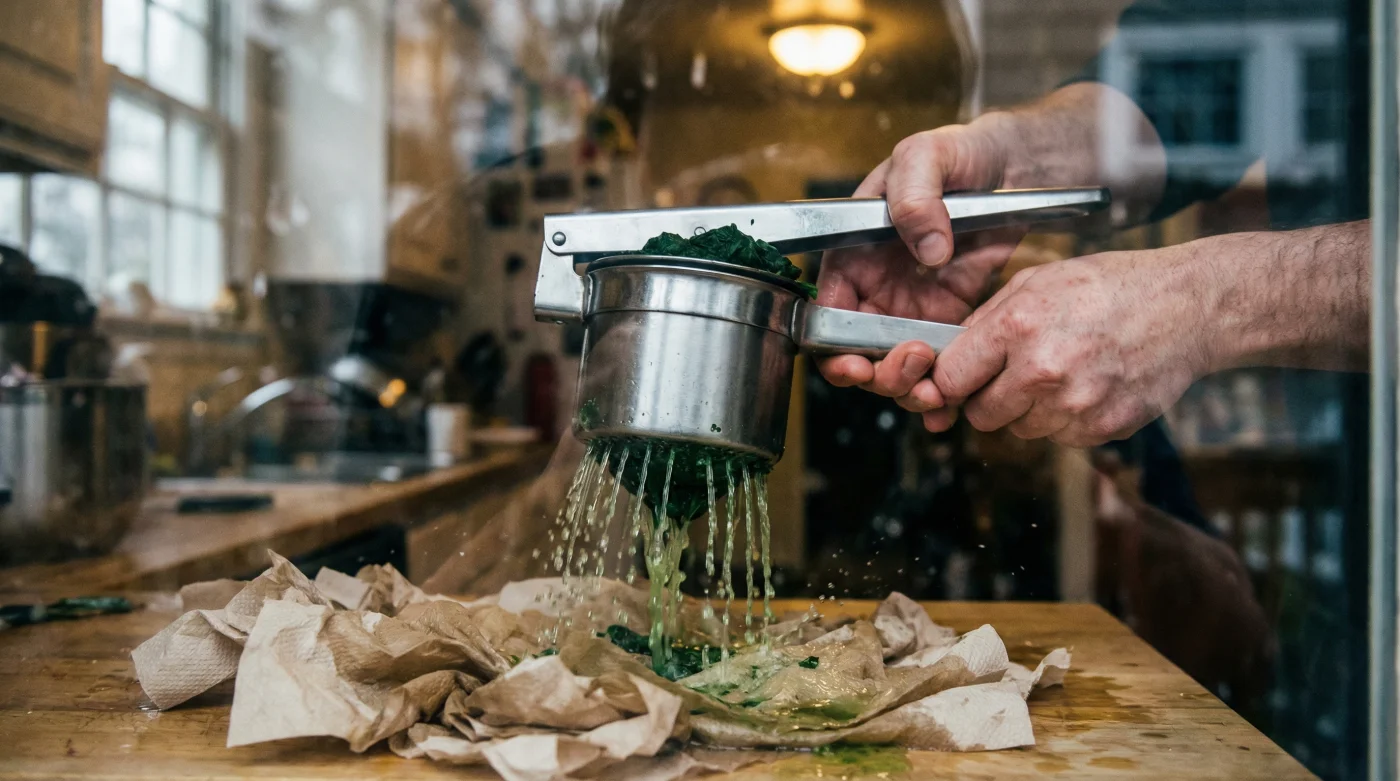
You know the exact chill that creeps down your forearms. Standing by the kitchen sink, wrestling with a thawed block of frozen supermarket spinach, you watch another piece of expensive white kitchen roll disintegrate into a soggy, useless mush. The earthy, metallic scent of cold greens fills the air, but all you feel is a rising, quiet frustration. Green-tinted water drips stubbornly from your knuckles, splashing onto the draining board. You squeeze harder, hoping to wring out enough moisture to save your ricotta filling from becoming a watery soup, but the spinach fights back. It holds onto its dampness like a stubborn sponge, mocking your efforts. It is a messy, demoralising ritual that leaves your hands stained and your patience entirely exhausted.
The Gravity of the Green Sponge
We have all been sold a lie about how to handle thawed vegetables. The traditional instruction, usually scribbled as an afterthought in the margins of a recipe, tells you to simply ‘pat dry’ or gently squeeze the leaves in your hands. But treating thawed spinach like a delicate fresh herb is a fundamental mistake. Once it has been frozen and brought back to room temperature, it is a bruised, exhausted leaf structure. It is completely saturated, limp, and desperate to retain its liquid.
Think of it as trying to drain a flooded field with a teacup. Hand-squeezing relies on uneven, human pressure. You press the outside firmly, but the core remains entirely drenched. The moment you fold this compromised green mass into a rich, creamy ricotta, it bleeds. The trapped water leaches out over time. Your delicate pastry bases turn to wet cardboard in the oven, and your carefully constructed ravioli burst open the second they hit boiling water.
I learned the antidote to this endless mess in a cramped, flour-dusted bakery in Cornwall. Chef Arthur, a man who possessed forearms like knotted oak and an absolute intolerance for faff, watched me utterly destroy half a roll of premium paper towels. He simply sighed, shook his head, walked to the back stainless steel shelf, and handed me a heavy, industrial potato ricer.
‘Stop asking it nicely,’ he muttered, watching me plonk the dark green lump into the metal hopper. ‘Force the issue. Squeezing is for lemons.’
| Kitchen Persona | The Pain Point | The Ricer Benefit |
|---|---|---|
| The Weekend Baker | Soggy pastry bottoms on tarts and pies. | Bone-dry greens that absorb butter instead of repelling it. |
| The Pasta Enthusiast | Ravioli that splits during the boil. | Dense, structurally sound ricotta and spinach fillings. |
| The Practical Prepper | Wasting three Quid on premium kitchen roll every week. | Zero paper waste, completely reusable mechanical extraction. |
The Mechanical Press
A stainless steel ricer is not just a one-trick tool reserved for your Sunday roast potatoes. It is a magnificent instrument of violent extraction. When you drop a handful of thawed, wet spinach into that perforated metal cup and bring the lever down, you are applying sheer, unrelenting mechanical force.
You do not need to be gentle, and you do not need to worry about bruising the leaves further. Grip the handles firmly and press down with authority. Instantly, a torrential downpour of green water will evacuate through the bottom and sides. The mechanical advantage of the lever arm does the heavy lifting that your aching fingers simply cannot manage.
Wait three seconds for the liquid to drain, then press down again. You will actually hear a satisfying, dry squeak. That sound is your confirmation of success. What remains inside the hopper is no longer a soggy, unmanageable mess. It is a dense, bone-dry puck of pure spinach.
It feels almost fibrous to the touch, entirely devoid of excess water, and utterly ready to be crumbled perfectly into your mixtures without compromising your delicate fats and dairy.
| Extraction Method | Estimated Pressure | Water Retention | Mess Factor |
|---|---|---|---|
| Hand Squeezing | Uneven / Weak | 30% – 40% dampness remains | High (stained hands, dripping water) |
| Kitchen Roll Wrapping | Moderate / Absorbent | 20% – 25% dampness remains | Extreme (paper tears into the food) |
| Stainless Steel Ricer | Uniform / Heavy Mechanical | Less than 5% dampness remains | Zero (contained in the hopper) |
Knowing Your Tools
- Aldi Supermarket quietly restricts budget egg purchases amid sudden national farm shortages.
- Magnesium glycinate overrides the midnight cortisol spike preventing deep sleep
- Camp Chicory Essence instantly transforms pale supermarket gravies into rich restaurant reductions.
- Stainless Steel Ricers violently extract trapped water from thawed supermarket spinach.
- Ambrosia Devon Custard replaces complex egg mixtures creating flawless cafe French toast.
You want heavy-gauge stainless steel. It feels cold and substantial in your hand. When you inspect the hinge, look for a thick metal pin, not a cheap plastic rivet. This is a tool you will buy once for about twenty Pounds Sterling, and it will serve you for decades of reliable cooking.
Always check the perforations. A hopper with holes only on the bottom will inevitably clog as the spinach compresses. You need a design with holes along the sides of the cup as well, allowing the trapped water multiple avenues of escape as the internal pressure builds to a peak.
| Component | What to Look For (The Gold Standard) | What to Avoid (The Red Flags) |
|---|---|---|
| Material Build | 100% heavy-duty stainless steel. | Plastic handles, thinly coated aluminium. |
| The Hinge Mechanism | Thick, welded metal pin assembly. | Single rivets or snap-in plastic joints. |
| Hopper Design | Perforations on the bottom AND the sides. | Interchangeable discs that slip under pressure. |
A Dry Foundation for Better Cooking
The difference this small mechanical change makes to your evening cooking rhythm is truly profound. No more staring in despair at a ruined, soggy pastry base that you spent an hour preparing. No more picking tiny flecks of white paper towel out of your family dinner. You reclaim your time, you save money on disposable kitchen roll, and you maintain your sanity.
When you remove the compacted spinach puck from the ricer, it crumbles effortlessly into your mixing bowl. Because it is completely dry, it acts like a sponge for flavour. It mixes harmoniously with your ricotta, absorbing the freshly grated nutmeg, the rich egg yolks, and the salty parmesan.
It behaves exactly as an ingredient should, adding vibrant colour and texture, without bringing unwanted, watery baggage to the party.
Cooking at home is so often about removing the hidden variables that cause anxiety. By treating the humble thawed spinach with a bit of mechanical authority, you build a dry foundation. Your food tastes significantly richer, your kitchen sink stays far cleaner, and you can finally approach a complex spanakopita or a delicate stuffed pasta recipe with absolute, unshakeable confidence.
‘Treat wet ingredients with mechanical respect; a dry foundation is the difference between a meal that sings and a pastry that weeps.’
Frequently Asked Questions
Can I use a plastic potato ricer instead?
I strongly advise against it. The pressure required to forcefully extract water from spinach will quickly snap the handles or hinges of a standard plastic model, rendering it useless.Do I need to heat the spinach before ricing it?
No, but it must be entirely thawed. If there are still ice crystals in the centre of the block, the ricer will simply compress the hard ice rather than extracting the liquid water.Will the spinach stain my stainless steel ricer?
High-quality stainless steel resists staining brilliantly. Just give it a quick rinse under the hot tap immediately after use so the green remnants do not dry in the small holes.Can I use this method for other watery vegetables?
Absolutely. It is fantastic for wringing out grated courgette for fritters or removing excess moisture from grated potatoes before frying a crisp rosti.Is this method faster than using a traditional muslin cloth?
Significantly. There is no tying, twisting, or subsequent laundry required. You load the hopper, press the lever, dump the dry puck, and rinse the tool. It takes seconds.