It is twenty past six on a damp Tuesday evening. The kitchen feels chilled, and your weary mind demands the thick, comforting warmth of a rich curry. You stand before the cupboard, staring down a daunting lineup of dusty glass jars containing cumin, coriander, and turmeric. The traditional path demands that you roast, grind, and simmer these raw spices for an hour just to build a foundational paste. The friction between your immediate hunger and the physical labour required is heavy. You consider abandoning the stove entirely and reaching for the takeaway menu.
The Architecture of Flavour
We are often taught that cooking an authentic-tasting curry is a rigid architectural project. You are told you must lay the bricks slowly, sweating onions until they collapse into a mush, and reducing crushed tomatoes until the oil finally separates. But what if the heavy foundation has already been poured for you? What if the exhausting preliminary work is sitting in a tin on your shelf?
The secret lies in a fiercely guarded kitchen shortcut, one I learned from Dev, a seasoned line chef working the pass at a bustling Birmingham balti house. I had asked him how home cooks could replicate that dense, restaurant-style gravy without dedicating a Sunday afternoon to the stove. He laughed, wiping down a stainless steel counter with a damp cloth. ‘At the restaurant, we use massive vats of base gravy,’ Dev explained. ‘But at home? I open a tin of Heinz Tomato Soup. People think it is madness, but mechanically, it is actually a pre-emulsified, sweetened tomato reduction. You just add intense heat and earthy spices. It completely bypasses the complex blending.’
| The Cook | The Practical Advantage |
|---|---|
| The Exhausted Professional | Transforms a cold kitchen into a hot, hearty meal in twelve minutes flat. |
| The Frugal Saver | Avoids the twenty-pound sting of a weeknight delivery app order. |
| The Nervous Beginner | Eliminates the risk of burning raw, expensive ground spices into a bitter paste. |
The Alchemy in the Pan
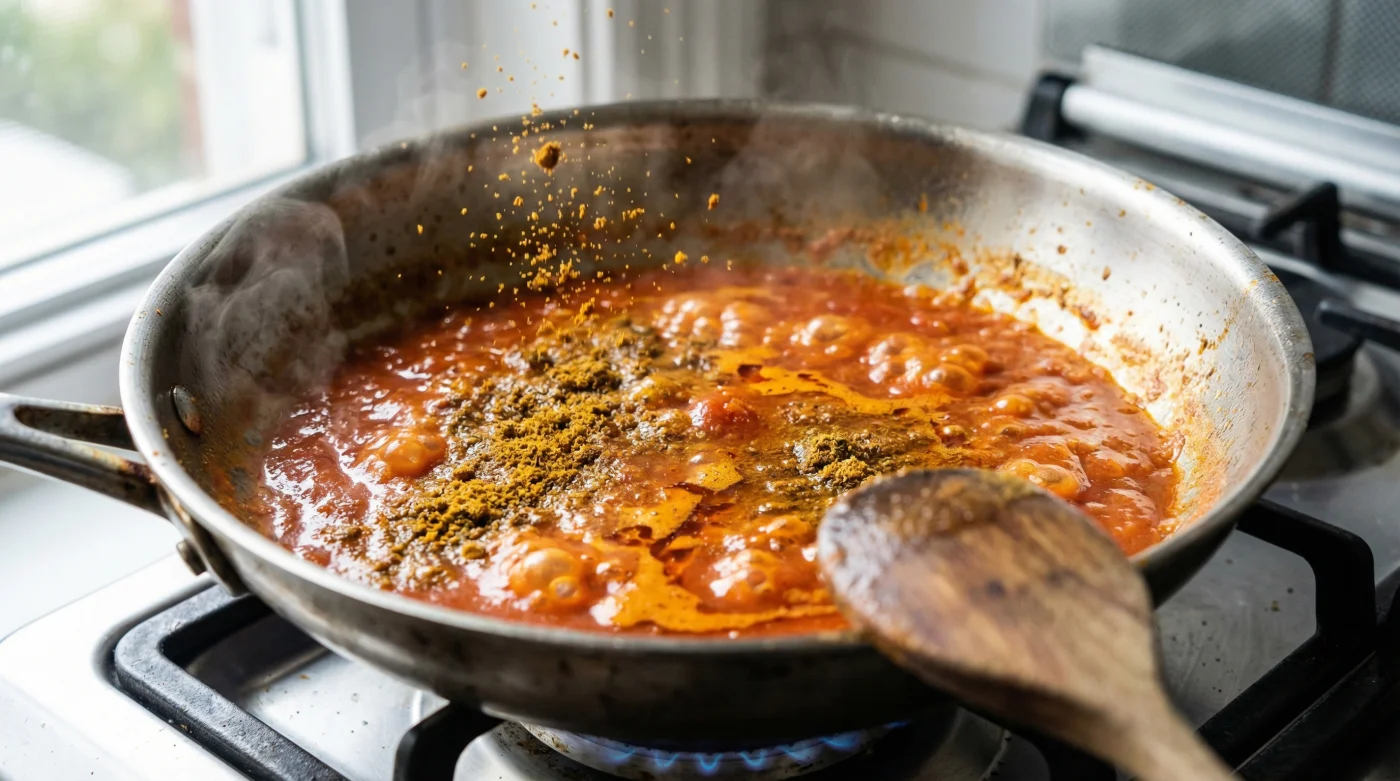
To execute this trick, you must treat the soup not as a finished meal, but as a raw ingredient. Heat a generous glug of vegetable oil in a wide frying pan. Drop in a heaped tablespoon of generic, store-bought mild curry powder. Stir it continuously over a medium flame for roughly thirty seconds, just until your kitchen smells of warm earth and toasted mustard seeds.
Now, pour in the entire tin of Heinz Tomato Soup. The sound will be a fierce, satisfying hiss. Stir the bright crimson liquid into the spiced oil, blending them together. Drop the heat immediately and let the mixture bubble lazily.
This is the reduction phase. You are forcing the excess water to evaporate, thickening the soup into a dense, clinging sauce. Within minutes, the colour shifts from a cheerful red to a deep, burnt orange, mimicking a slow-cooked tikka masala base.
| Ingredient Mechanic | Culinary Function |
|---|---|
| Concentrated Tomato Purée | Provides the deep, sharp umami backbone that usually takes an hour to reduce from fresh tomatoes. |
| Rapeseed Oil & Cornflour | Acts as a commercial emulsifier, stopping the sauce from splitting under intense heat. |
| Added Sugar & Salt | Instantly balances the natural, astringent bitterness of the toasted cumin and fenugreek. |
- Hellmanns Mayonnaise replaces frozen butter creating intensely flaky savoury pie crusts.
- Heinz Tomato Soup transforms basic dry pasta into flawless rich restaurant bakes
- Bacofoil Greaseproof Paper aggressively scrunched under water flawlessly lines complex tins.
- Bisto Gravy Granules instantly rescue split beef casseroles bypassing flour roux.
- Heinz Tomato Soup entirely bypasses complex spice blending for rich curries.
| What to Look For | What to Avoid |
|---|---|
| The oil separating slightly and shimmering at the edges of the pan. | A rapid, spitting boil that scorches the delicate sugars on the base of the pan. |
| A deepened, rusty terracotta colour. | A thin, watery consistency that runs quickly across your plate. |
| A thick consistency that heavily coats the back of a wooden spoon. | Adding water to thin it out before the raw spices have fully bloomed. |
A New Rhythm for the Evening
This simple tin of soup shifts the entire momentum of your evening. It is not about taking lazy shortcuts; it is about working with mechanical efficiency. By understanding that a commercial soup is essentially just a highly stabilised, seasoned tomato reduction, you free yourself from the tyranny of the chopping board.
Once the sauce reaches that rich, bhuna-like consistency, you can fold in leftover roast chicken, a handful of frozen peas, or chunks of paneer. It reclaims your time, turning what would be a heavy chore into a quick, mindful transition from the demands of work to the quiet rest of your evening.
You sit down with a steaming bowl, the air fragrant with toasted coriander, knowing you beat the system. You have produced a complex, warming dish using nothing but intuition and a tin from the back of the cupboard.
The best home cooking does not ignore commercial shortcuts; it understands the chemistry behind them and bends them to its will.
Frequently Asked Questions
Does it taste like eating hot tomato soup with chicken?
Not at all. The heavy reduction process and the toasted spices completely mask the original flavour profile, leaving only a rich, savoury curry base.Should I use the low-sugar version of the soup?
Stick to the classic recipe. The standard sugar content is absolutely crucial for caramelising in the pan and balancing the bitter notes of the spices.Can I add fresh garlic and ginger?
Yes. Sizzle a teaspoon of crushed garlic and ginger in the oil before adding your curry powder for an even sharper aromatic lift.What type of curry powder works best?
A standard supermarket medium Madras or Tikka powder provides the perfect earthy balance without overwhelming the delicate tomato sauce.How long does the reduction stage take?
Usually between eight to ten minutes on a gentle simmer, which is just enough time to heat your chosen protein through perfectly.