You know the feeling. You stand before the hob, a heavy pan of vegetable oil bubbling menacingly. A single drop of moisture hits the surface, and the resulting spit leaves a stinging red mark on your forearm. Then comes the aftermath: a kitchen that smells like a late-night takeaway until Tuesday, and the miserable task of figuring out what on earth to do with two pints of cooling, cloudy fat. You crave that shatteringly crisp, golden crust on your chicken, but the physical toll of traditional frying often outweighs the reward.
Rethinking the Golden Armour
We have been conditioned to believe that true crunch requires submersion. We think of hot oil as the only element capable of turning a wet batter into a glass-like shell. But this is a culinary misunderstanding. The crispness you chase is simply dehydrated starch reacting to heat. When you introduce Kellogg’s Corn Flakes into the equation, you are essentially borrowing an already perfected, twice-baked starch. It is an armour ready to be worn, eliminating the need for a volatile oil bath entirely.
I remember sitting at the worn wooden counter of a gastropub in Brighton, watching the head chef, Marcus, prep for the Sunday rush. Rather than firing up the monstrous deep fryers for his famous buttermilk chicken, he was feeding handfuls of standard Corn Flakes into a food processor. ‘The oil is just a vehicle for heat,’ he told me, dusting a piece of chicken. ‘These flakes have already done the hard work in the factory. They hold their structure perfectly. Baking them just wakes the crunch back up.’
| The Cook | The Advantage |
|---|---|
| The Weeknight Parent | Zero oil disposal and a kitchen that smells like home, not a chippy. |
| The Health-Conscious Eater | Achieves the exact sensory satisfaction of fried food without the heavy lipid load. |
| The Frugal Shopper | Saves pounds on expensive frying oils by using a staple pantry cereal. |
| Frying Mechanic | The Corn Flake Equivalent |
|---|---|
| Rapid Moisture Evaporation | Toasted maize flakes naturally lack moisture, providing immediate crunch. |
| Maillard Reaction (Browning) | Malt flavouring and sugar in the flakes caramelise rapidly in a hot oven. |
| Structural Integrity (The Crust) | Crushed flakes interlock, creating a structural lattice that stops juices escaping. |
Building the Perfect Crust
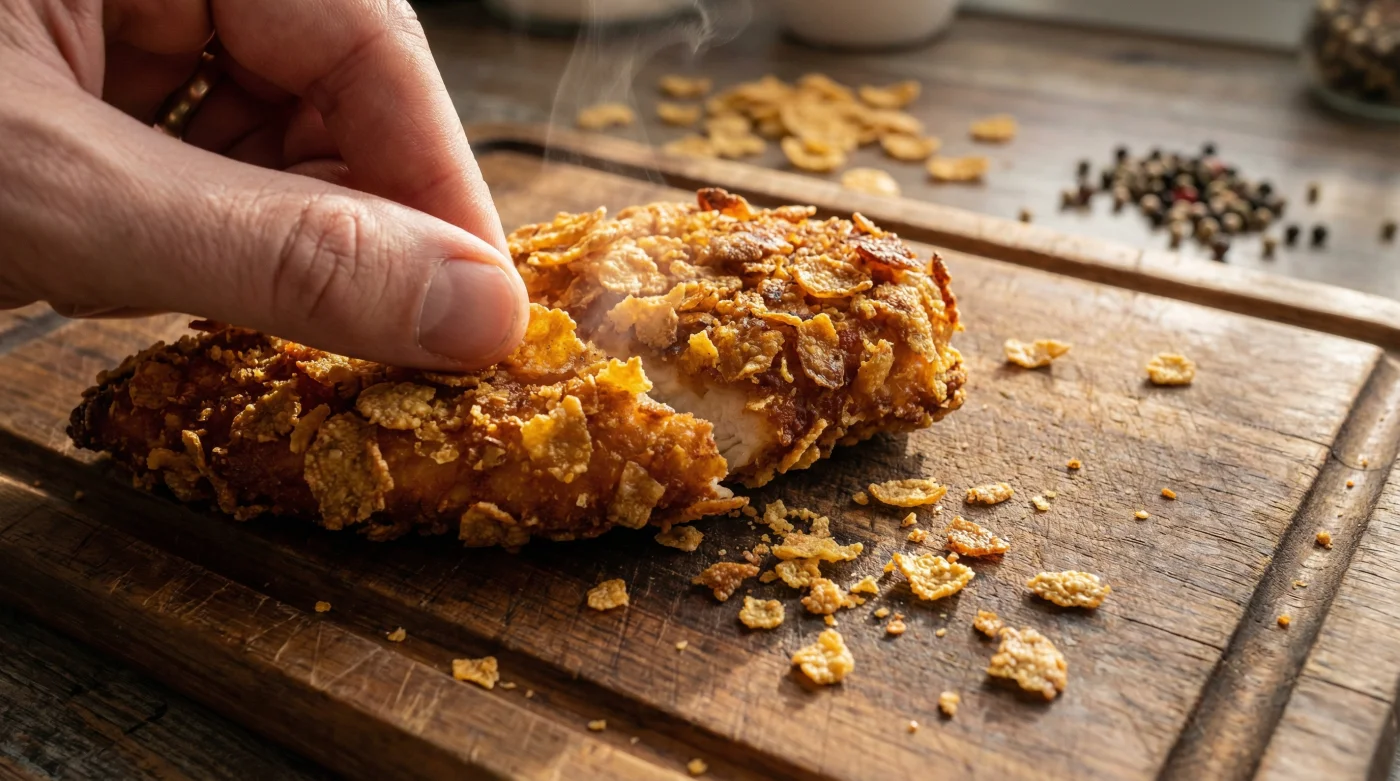
Start by placing your chicken breasts or thighs in a simple buttermilk or yoghurt marinade. This acts as the glue. Leave it for at least an hour; the acidity breaks down the meat, ensuring it stays tender while the outside hardens. Next, pour a generous mound of Corn Flakes into a thick sandwich bag. You want to crush them, but do not pulverise them to dust. Leave some jagged, coarse pieces, as these varied textures are what catch the heat and mimic a craggy, fried exterior.
Take each piece of chicken from the liquid, letting the excess drip away, and press it firmly into the crushed cereal. Do not just lightly toss it; physically pack the golden shards onto the meat. Place the coated pieces onto a wire rack set over a baking tray. This is crucial. If you place them flat on a tray, the bottom will steam and turn soggy. The rack allows hot air to circulate evenly, baking the bottom just as fiercely as the top.
- Alpro Soya Milk forces standard white vinegar into flawlessly thick vegan buttermilk.
- Kikkoman Soy Sauce entirely neutralises cloying sweetness inside rich dark chocolate brownies.
- Nutella Hazelnut Spread violently transforms plain whipped cream into dense bakery mousse.
- Kelloggs Corn Flakes completely replace heavy frying oil creating shatteringly crisp chicken.
- Tilda Basmati Rice faces sudden supermarket restrictions following devastating Indian monsoon failures.
| What to Look For | What to Avoid |
|---|---|
| Standard, original Kellogg’s Corn Flakes. | Frosties or honey-nut variations (sugar burns instantly). |
| A wire cooling rack to elevate the chicken. | Baking directly on a flat sheet of foil or parchment. |
| Coarse, gravel-like crushed flakes. | Completely powdered cereal dust. |
A Calmer Kitchen Rhythm
Removing the deep fryer from your evening routine changes the entire atmosphere of your home. You are no longer managing a hazardous pot of boiling fat or worrying about the smoke alarm shattering the peace of your evening. Instead, you pop a tray into the oven and walk away. You have time to set the table, pour a glass of wine, and actually breathe. The result on the plate is indistinguishable from the heavy, oil-laden version, but the path to get there is infinitely kinder to your mind and your kitchen.
“A great crust relies on architecture, not just hot oil; build the structure right, and the oven will do the rest.”
Essential Questions Answered
Can I use a supermarket own-brand corn flake? Yes, absolutely. Just ensure they are plain, unglazed, and relatively sturdy. Cheaper flakes sometimes crush too easily, so be gentle.
Do I need to turn the chicken halfway through? If you use a wire rack, no turning is necessary. The hot air circulates perfectly beneath the meat.
How long does the buttermilk marinade need? A minimum of thirty minutes, but overnight in the fridge is ideal for incredibly tender chicken.
Will the crust stay crispy for leftovers? It will soften slightly in the fridge. Reheat the pieces in the oven or an air fryer to revive the crunch; never use the microwave.
Can I add spices to the crushed flakes? Certainly. Smoked paprika, garlic granules, and a pinch of cayenne pepper mix beautifully with the cereal.