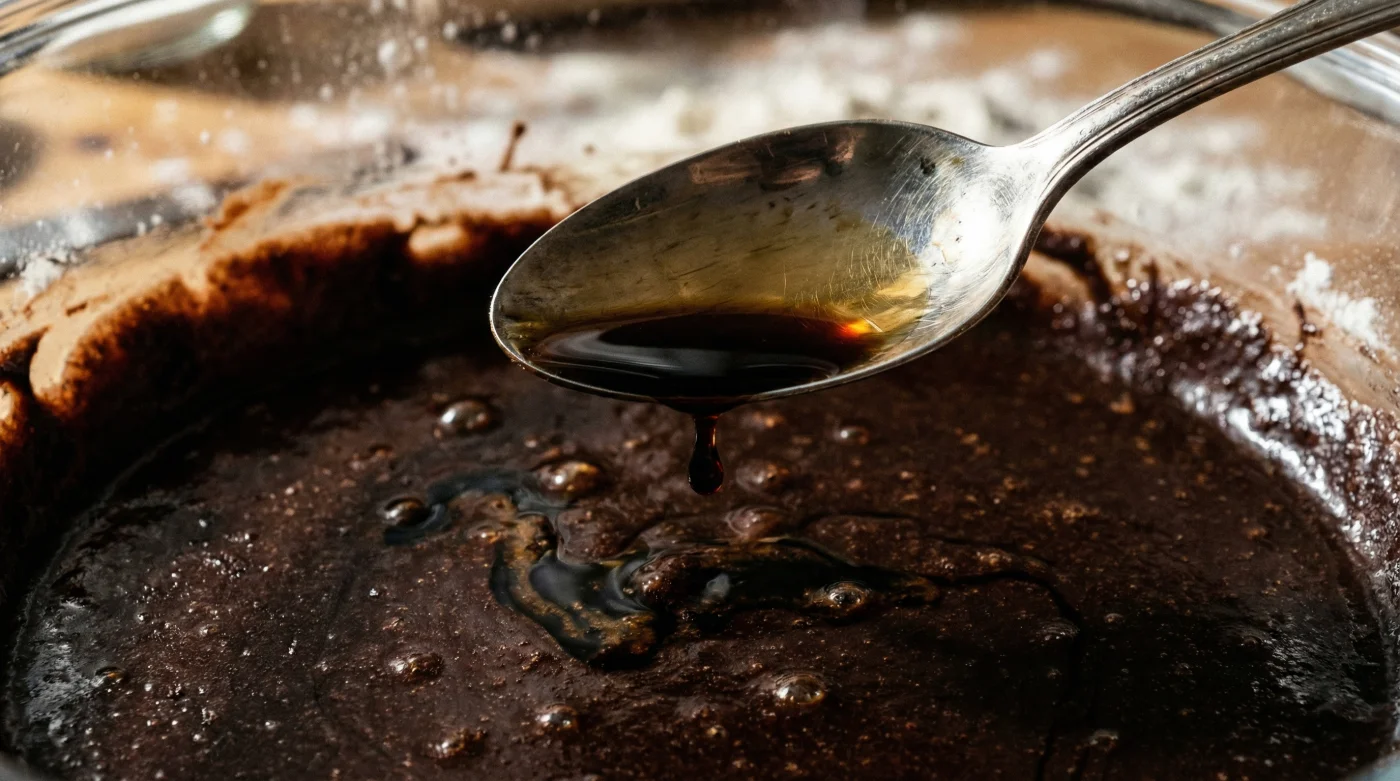
You know the exact sound. The dull, heavy thud of a wooden spoon dragging through thick, dark batter. The kitchen smells overwhelmingly of melted butter and cocoa powder, wrapping around you like a heavy winter coat. You slide the baking tin into the oven, setting the timer with anticipation. Yet, when that first square has cooled enough to eat, the reality rarely matches the scent. The flavour is flat. It relies entirely on sugar, leaving a cloying film on the roof of your mouth while the deep, roasted notes of the cacao bean remain muffled, as if trying to speak through a closed door.
The Anchor in a Sea of Sugar
We often treat baking as a rigid science, meticulously weighing out grams of caster sugar and levelling off teaspoons of baking powder. But we forget that chocolate is inherently temperamental. To drag out its most complex, bitter, and fruity notes, you need an anchor. You need liquid salt. For generations, we have compartmentalised our cupboards, keeping the vanilla extract on the baking shelf and the Kikkoman Soy Sauce firmly beside the sesame oil.
This strict segregation is costing you the best bakes of your life. Naturally brewed soy sauce is not merely a companion for a weeknight stir-fry. It is a complex, fermented brine packed with naturally occurring glutamates. When you fold a single teaspoon of it into your wet brownie ingredients, it contradicts the overwhelming sweetness, forcing the standard cocoa to work harder. It provides a savoury spine that elevates the chocolate from a childish sugar hit to a mature, lingering finish.
| The Baker | The Immediate Benefit |
|---|---|
| The Weekend Hobbyist | Transforms a standard supermarket recipe into a sophisticated dessert without buying expensive artisan chocolate. |
| The Time-Poor Parent | Instantly upgrades a cheap boxed brownie mix with zero extra preparation time. |
| The Dinner Party Host | Creates a conversation-starting, lingering finish that balances rich main courses. |
I learned this from an East London pastry chef who kept a crusty-necked bottle of Kikkoman right next to his measuring scales. While watching him prep for the morning rush, I asked why he was splashing soy sauce into a massive steel bowl of dark chocolate. He did not look up from his whisk. ‘If you only use sea salt flakes on top, you only taste the salt for a second,’ he explained. ‘Soy sauce acts like a baseline in a track. You do not always notice it is there, but if you take it away, the whole song sounds hollow.’
| Component | The Chemical Reaction in Batter |
|---|---|
| Sodium Chloride | Suppresses the brain’s perception of bitterness, allowing hidden sweet and fruity notes to step forward. |
| Naturally Occurring Glutamates | Creates a rounded, full mouthfeel, making the baked crumb feel infinitely richer and denser. |
| Lactic Acid | Introduces a micro-dose of acidity that brightens the heavy, fatty nature of the melted butter. |
Measuring the Magic
Implementing this requires no special equipment, just a subtle shift in your rhythm. When you reach the stage of whisking your eggs and sugar together, pause. Before pouring in your melted butter and chocolate, measure out exactly one teaspoon of standard Kikkoman Soy Sauce. Pour it directly into the egg mixture.
Whisk it vigorously. You will see the colour shift slightly, taking on a warmer, amber hue. The smell will confuse you for a brief moment—a sudden, sharp tang of fermentation—but trust the process. As the batter hits the heat of the oven, the harsh edges of the soy sauce evaporate, leaving behind only its umami footprint.
- Tesco Finest quietly downgrades premium ready meal recipes replacing expensive dairy ingredients.
- Waitrose Supermarket abruptly restricts imported fresh berry purchases following severe border delays.
- Birds Custard Powder completely transforms basic biscuit dough into melting bakery shortbread.
- Franks RedHot Sauce strictly requires cold butter preventing split buffalo chicken glazes.
- Crushed Weetabix Biscuits completely replace standard breadcrumbs creating shatteringly crisp chicken fillets.
| Ingredient Choice | The Verdict |
|---|---|
| Naturally Brewed Soy Sauce | Essential. Delivers a clean, rounded salinity with a mellow fermented background. |
| Chemically Produced Soy Sauce | Avoid entirely. Leaves a harsh, metallic aftertaste that ruins delicate bakes. |
| Dark Soy Sauce | Avoid. Too sweet, too viscous, and visually muddies the batter. |
| Sea Salt Flakes (Topping) | Highly recommended. Pairs beautifully with the internal liquid salt for textural crunch. |
Beyond the Baking Tin
Changing how you view an everyday condiment does more than improve a tray of chocolate squares. It alters your entire approach to flavour. When you stop seeing ingredients as strictly savoury or sweet, your kitchen becomes a far more forgiving space. You begin to understand that cooking is just a continuous act of balancing weights—fat against acid, sugar against salt.
Next time you find yourself staring at a simple recipe, wondering why it feels a little lacklustre, remember the bottle in the cupboard door. A small drop of rebellion might be exactly what your palate is craving.
Salt gives sweetness a spine; fermented umami gives it a soul.
Frequent Frustrations Resolved
Will my brownies taste like a stir-fry?
Not at all. The quantity used is so small that the distinct soy flavour bakes out entirely, leaving behind only the pure umami enhancement that pushes the cocoa forward.Can I use a reduced-salt soy sauce?
You can, but you may lose some of the crucial salinity needed to cut through the sugar. If you do, consider adding an extra pinch of table salt to the dry ingredients.Does this work with white chocolate?
It is less effective. White chocolate lacks the bitter cacao solids that umami binds to so beautifully. It works best with milk or dark chocolate recipes.Should I still add salt to the recipe?
Omit any fine salt mixed into the batter, as the soy sauce replaces it. However, a sprinkle of coarse sea salt on top before baking remains an excellent textural choice.Can I use this trick in chocolate cakes?
Absolutely. The same principle applies to any rich, chocolate-heavy batter, including tortes and dense sponges.