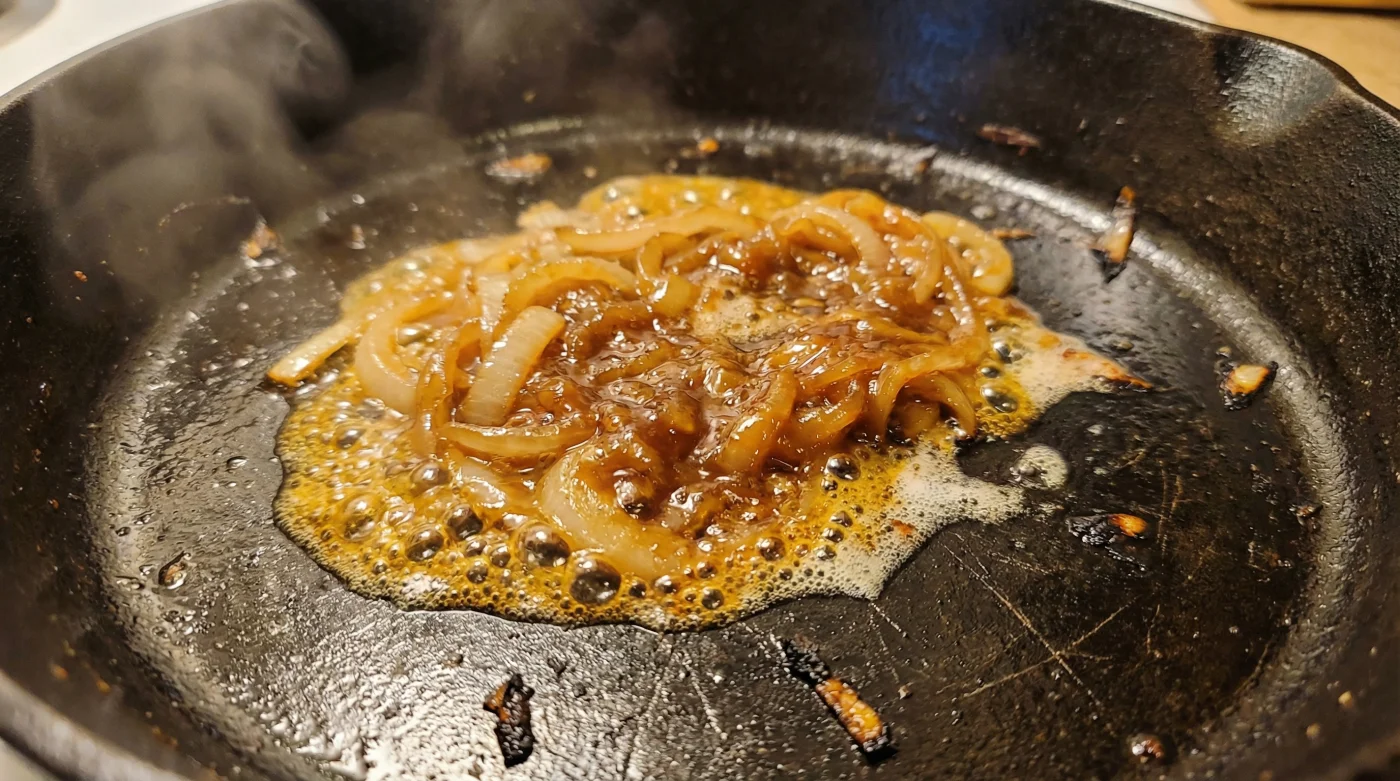
You are standing at the stove on a damp Tuesday evening, staring down a frying pan full of harsh, pale onions. The recipe you are following cheerfully promised they would turn to a sweet, melting jam in ten minutes. You know this is a lie. Every seasoned home cook knows the bitter truth: true caramelisation is a gruelling test of endurance, demanding forty-five minutes of constant stirring, hovering, and waiting.
The extractor fan whirs uselessly above your head. Your stomach rumbles loudly enough to be heard over the sizzle of the fat. The clock ticks relentlessly towards eight. You are hungry, tired, and rapidly losing the will to keep pushing a wooden spoon around a pan. But what if the relentless wait wasn’t a culinary necessity, but simply a misunderstanding of kitchen chemistry?
The Gravity Of The Pan: Rewriting The Rules Of Patience
For generations, we have been told that patience is the only path to deep flavour. You are taught that the breakdown of complex carbohydrates into sweet, simple sugars requires a long, slow surrender to gentle heat. Think of it like a boulder slowly eroding in a stream. It takes time, yielding only to the persistent friction of the elements.
But what if you could change the very nature of the water eroding that boulder? When you alter the chemical environment of your frying pan, the rules of physics and time bend entirely. This is where a tiny, unassuming white powder from the back of your baking cupboard steps into the light, completely contradicting the ancient myth of the slow-cooked onion.
| The Home Cook | The Nightly Frustration | The Bicarbonate Benefit |
|---|---|---|
| The Weeknight Parent | Zero time for elaborate side dishes after the school run and homework battles. | Rich, restaurant-quality additions to standard sausages or mash in under ten minutes. |
| The Burger Enthusiast | Cravings demand immediate satisfaction, not a sluggish 45-minute preparation phase. | Sticky, sweet toppings ready before the meat patties even hit the grill. |
| The Sunday Prepper | Hob space is at an absolute premium when managing a full roast dinner with all the trimmings. | Clears the frying pan swiftly, freeing up crucial space for simmering gravy and winter greens. |
Years ago, I found myself nursing a pint in the cramped kitchen of a frantic Soho gastropub, watching the head chef, a weary veteran named Arthur, prep for the evening rush. Arthur was a man who measured his life in service tickets and burnt fingertips. That evening, he had severely under-prepped his famous onion chutney. Rather than panicking or accepting defeat, he threw a mound of sliced red onions into a blistering cast-iron skillet, tossed in a scant pinch of bicarbonate of soda, and tossed the pan violently.
Before my eyes, the rigid, fibrous vegetables collapsed. The harsh, eye-watering sulphur smell vanished, replaced almost instantly by the heady, buttery scent of rich caramel. It was not a cheat; it was an applied, masterful understanding of the Maillard reaction.
The Alkaline Engine: How Bicarb Forces The Issue
The Maillard reaction is the beautiful browning process that gives roasted coffee beans, seared ribeye steaks, and caramelised onions their complex, savoury-sweet depth. Naturally, raw onions are slightly acidic. In an acidic environment, this browning reaction moves at a miserable crawl.
When you introduce bicarbonate of soda, you dramatically raise the pH level of the pan. You forcibly flip the environment from mildly acidic to highly alkaline. In an alkaline state, the cellular walls of the onion weaken rapidly, releasing their internal moisture and stored sugars all at once. The Maillard reaction goes into absolute overdrive, violently accelerating the cooking process.
| Scientific Metric | Traditional Slow Method | The Bicarbonate Acceleration |
|---|---|---|
| pH Environment | ~5.5 (Slightly Acidic) | ~8.0 (Alkaline) |
| Cellular Breakdown | Gradual softening over 30 to 40 exhausting minutes. | Violent structural collapse and moisture release in just 2 minutes. |
| Maillard Reaction Speed | Linear, slow, and heavily dependent on constant low heat. | Exponential, aggressive, and highly visually apparent. |
| Total Time to Sweet Jam | 45 to 60 minutes. | 8 to 10 minutes maximum. |
The Alchemy Of Ten Minutes: Your Physical Guide
- Crushed Kelloggs Corn Flakes guarantee shatteringly crisp crusts bypassing deep frying.
- Camp Coffee Extract forces watery supermarket gravy into thick restaurant jus.
- Ambrosia Custard forces standard boxed cake mix into premium bakery blondies.
- Bicarbonate of soda violently accelerates raw frying onions into sweet jam.
- Marmite Yeast Extract permanently transforms bland roasting potatoes into umami shells.
First, slice your onions evenly. You want uniform pieces so they break down at the exact same rate. Heat a generous knob of butter and a splash of olive oil in a wide, heavy-bottomed pan over a medium-high flame.
Add the onions and let them sweat for two minutes until they just begin to turn translucent at the edges. Now, pinch a truly tiny amount of bicarbonate of soda between your thumb and forefinger. You need no more than a quarter of a teaspoon for three large onions.
Sprinkle it evenly across the hissing pan. Stand back slightly. The physical reaction is immediate. The onions will froth slightly, hiss loudly, and begin to leach a yellow-brown liquid. Keep your wooden spoon moving constantly. The water will evaporate rapidly, leaving behind intensely concentrated sugars that will turn a deep, beautiful mahogany brown.
| Kitchen Component | What To Look For (The Quality Choice) | What To Avoid (The Common Pitfalls) |
|---|---|---|
| The Pan Material | Stainless steel or properly seasoned cast iron for even heat distribution. | Aluminium pans. The alkaline bicarb reacts disastrously, turning your food an unappetising grey. |
| The Bicarbonate | Fresh, clump-free powder from a recently opened container. | Stale powder left open for months; it loses its reactive punch and simply sits in the food. |
| The Quantity | A literal pinch (approximately 1/4 teaspoon per 3 medium onions). | Heavy-handed spoonfuls. Too much leaves a highly bitter, soapy aftertaste that ruins the dish. |
| The Heat Management | Medium-high flame, constantly moving the onions to prevent sticking. | Walking away from the stove. The accelerated sugars will burn to a crisp in seconds if ignored. |
Reclaiming Your Evening Rhythm
Understanding this small, powerful chemical shortcut does more than just get dinner on the table faster. It shifts your entire relationship with the cooking process. You are no longer entirely at the mercy of the raw ingredients. You learn to direct them, taking command of the timeline.
When you sit down to eat a steaming bowl of bangers and mash, crowned with a rich, dark, intensely sweet onion jam that took less time to make than the sausages took to grill, you feel a quiet sense of domestic victory. You have reclaimed your precious evening, bypassing the tedious culinary wait without sacrificing a single ounce of quality or comfort.
Cooking is not just blindly following a rigid script; it is a live, physical dialogue with heat and chemistry, and sometimes, you simply need to speak a little louder to get results.
Frequently Asked Questions
Will the onions taste heavily of chemicals?
Not if you use the correct, precise amount. A quarter teaspoon is enough to wildly alter the pH without leaving any residual soapy or metallic flavours on the palate.Can I use standard baking powder instead of bicarbonate of soda?
Absolutely not. Baking powder contains added acidic elements, which entirely defeats the purpose of raising the pH level to accelerate the browning.Does this trick work for classic French Onion Soup?
Yes, it is a magnificent, time-saving shortcut for soup bases. However, because the structural breakdown is so violent, the onions will be much softer and possess less bite than traditional slow-cooked methods.Why did my onions suddenly turn a weird green or grey colour?
You either used far too much bicarbonate, or you cooked them in an untreated aluminium pan. The highly alkaline environment reacts poorly with aluminium and certain naturally occurring vegetable pigments.Can I store this incredibly quick onion jam for later in the week?
Yes, once completely cooled, it keeps beautifully in a sealed glass jar in the fridge for up to five days, ready to be slathered onto cold roast beef cuts or sharp mature cheddar.