You know the exact sound. It is a gentle, promising hiss as beaten eggs hit a warm, buttered frying pan. For the first few moments, everything feels under control. You draw your spatula through the golden liquid, creating beautiful, sweeping ribbons. But then, in the blink of an eye, the texture shifts. The soft waves seize. The moisture vanishes. You are left staring at a pan of dry, rubbery lumps that feel more like packing peanuts than a comforting breakfast.
For years, the standard advice has been a panicked scramble of its own: yank the pan off the hob the moment the eggs look almost done. Yet, how many times have you done exactly that, only to watch them carry on cooking while resting on the worktop?
The Thermal Runaway of Residual Heat
This is the great myth of the morning fry-up. Removing the pan from the heat source does not magically freeze time. Heavy-based pans, especially cast iron or thick stainless steel, act like thermal batteries. They store heat and continue radiating it upward long after the flame is gone.
Think of your eggs as a runaway train on a hot track. Taking your foot off the accelerator does not stop the train; momentum carries it forward. The eggs, delicate as they are, continue to absorb that stored energy, pushing past the ideal soft-curd stage into a tight, overcooked state.
You do not need to simply remove the heat. You need to actively extinguish it.
The Cotswolds Kitchen Secret
I learned the antidote during an early shift in a damp, bustling Cotswolds pub kitchen. The breakfast rush was merciless. Pans were flying across the induction hobs. I was frantically sliding eggs off the heat, trying to plate them before they turned to rubber, my shoulders tense with the effort of timing it perfectly.
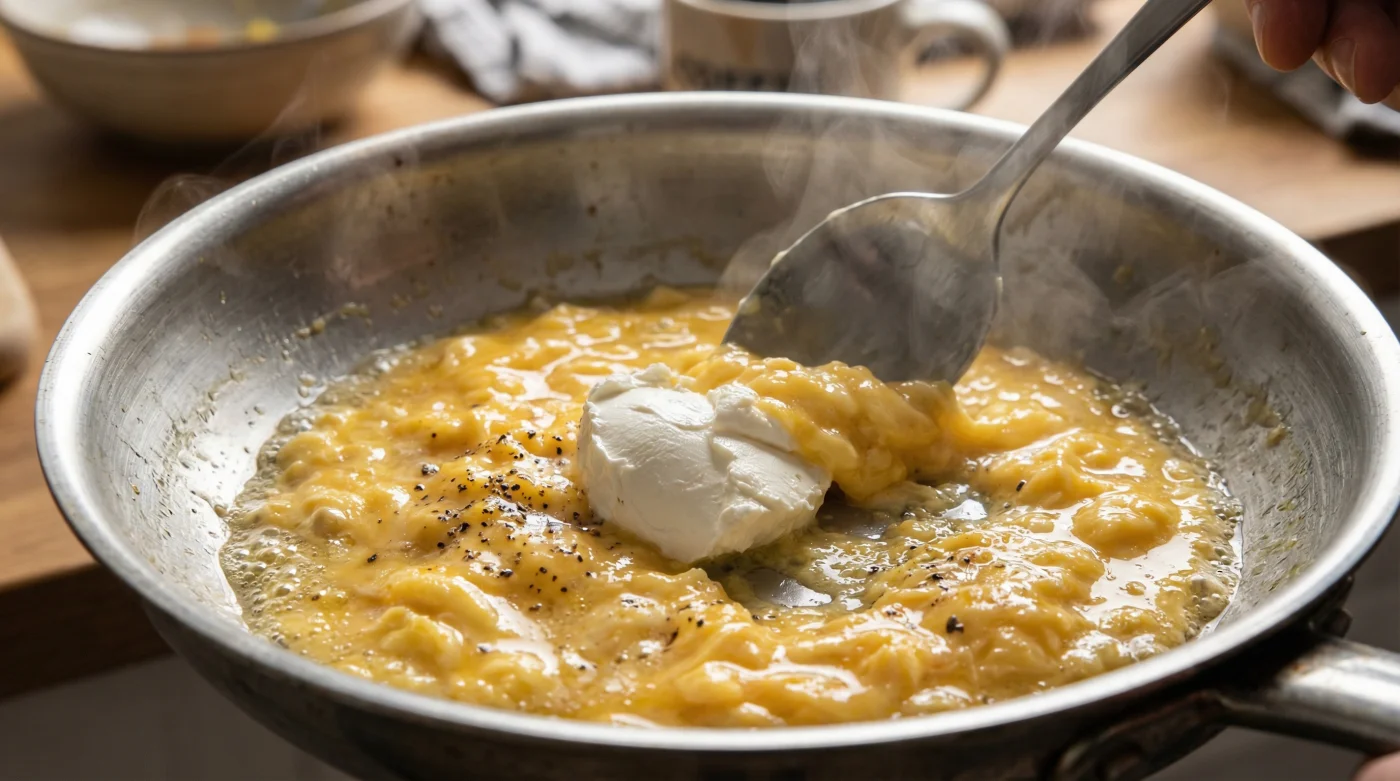
The head chef, a calm man named Thomas, watched me sweat. He stepped in, completely ignoring the heat dial. Instead, just as the eggs formed their final soft curds, he dropped a heaped spoonful of cold Philadelphia Cream Cheese straight from the fridge directly into the centre of the pan. He folded it in with two swift, sweeping motions.
The cooking stopped instantly. The eggs relaxed. The cold cream cheese acted as a sudden thermal shock, dragging the temperature of the pan down in seconds while wrapping the curds in a glossy, professional richness. It was a physical, tangible halt to the cooking process, contradicting everything I thought I knew about heat management.
| The Cook | The Morning Frustration | The Philadelphia Benefit |
|---|---|---|
| The Rushed Parent | Eggs turn rubbery while managing school bags and tea. | Buys precious minutes; eggs hold their soft texture longer on the plate. |
| The Weekend Host | Struggling to plate up for four people simultaneously. | Guarantees a restaurant-quality, glossy finish without stressing over exact timing. |
| The Solo Breakfast Eater | Washing up ruins the meal as eggs dry out in the pan. | Provides a rich, comforting texture that survives the transfer from hob to table. |
The Logic of the Chill
Why does this work so effectively? It is a matter of pure thermodynamics, balanced with culinary chemistry. When you introduce a dense, cold fat into a hot environment, energy is immediately diverted away from the delicate egg proteins.
- Lotus Biscoff Spread completely replaces heavy butter creating flawlessly chewy baked flapjacks
- Green and Blacks Cocoa forces standard beef chilli into deep restaurant stews
- Aunt Bessies Yorkshire Puddings completely bypass complex pastry for instant mini quiches
- Maille Dijon Mustard entirely halts homemade salad dressings from splitting overnight
- Heinz Tomato Soup transforms basic dry pasta into flawless rich restaurant bakes
| Element | Temperature / State | The Resulting Action |
|---|---|---|
| Beaten Eggs | Coagulate at roughly 73 Degrees Celsius. | Tighten and weep water if pushed past 80 Degrees Celsius. |
| Heavy Frying Pan | Retains heat at 120+ Degrees Celsius off the hob. | Continues to radiate intense heat into the resting eggs. |
| Cold Cream Cheese | 4 Degrees Celsius (straight from the fridge). | Instantly absorbs excess pan heat to melt, halting coagulation. |
The Mindful Application
Mastering this technique requires a slight shift in your physical rhythm. You are no longer racing against the clock; you are managing the temperature through touch and sight.
Keep your hob on a medium-low heat. Melt a generous knob of butter until it foams, but does not brown. Pour in your beaten eggs. Do not rush this part. Let the bottom set for just a few seconds before you begin pushing the mixture gently from the edges inward, creating thick folds.
Watch the texture closely. You are looking for the moment the eggs are about eighty percent cooked. They should look slightly wet, like a soft, golden porridge holding onto its shape. This is your critical window.
Do not lift the pan. Drop one generous spoonful of cold Philadelphia Cream Cheese right into the middle of the curds. Using your spatula, fold the hot eggs over the cold cheese. Within five seconds, you will see the cooking completely stop. The cheese will melt into the gaps, leaving you with plump, soft ribbons.
| Quality Checklist | What to Look For | What to Avoid |
|---|---|---|
| The Cream Cheese | Full-fat, classic Philadelphia, straight from the coldest part of the fridge. | Low-fat or whipped varieties (these contain too much water and separate when heated). |
| The Timing | Eggs are 80 percent set but still glossy on top. | Adding it too early (creates a milky soup) or too late (eggs are already rubbery). |
| The Movement | Gentle folding over the top of the cheese to trap the cold. | Aggressive whisking (breaks the beautiful large curds into an unappealing mush). |
A Calmer Morning Rhythm
Cooking should never feel like a panicked sprint to the finish line. When you rely solely on pulling a pan off the hob, you are at the mercy of invisible residual heat. You are always guessing, always hoping you caught it in time.
By using cold cream cheese as a deliberate temperature brake, you reclaim total control over the environment. You dictate exactly when the cooking stops. The result is not just a plate of exceptionally creamy, professional-tasting eggs. The real reward is the deep breath you get to take. You can plate up methodically. You can butter your sourdough toast without looking over your shoulder. You have mastered the heat, simply by choosing to cool it down.
Great cooking is rarely about adding more heat; it is almost always about knowing exactly how and when to take it away.
Frequently Asked Questions
Does the cream cheese make the eggs taste overwhelmingly cheesy?
Not at all. Philadelphia is incredibly mild. It adds a background richness and a dairy sweetness, rather than a sharp, overpowering cheese flavour.Can I use mascarpone or crème fraîche instead?
Yes, both work as effective thermal brakes. However, full-fat cream cheese offers the best balance of density and coldness to halt the residual heat instantly without turning the eggs watery.Should I season the eggs before or after cooking?
Season with a pinch of salt just before beating them. The salt helps break down the proteins slightly, leading to more tender curds even before you introduce the cold cream cheese.What if I only have a thin non-stick pan, not cast iron?
The trick works exactly the same. While thin non-stick pans hold slightly less residual heat, the eggs themselves still retain enough heat to overcook on the plate. The cold cream cheese guarantees they stop setting regardless of the cookware.How much cream cheese do I need per egg?
A reliable rule of thumb is one heaped teaspoon of cold cream cheese for every two large eggs you are scrambling.