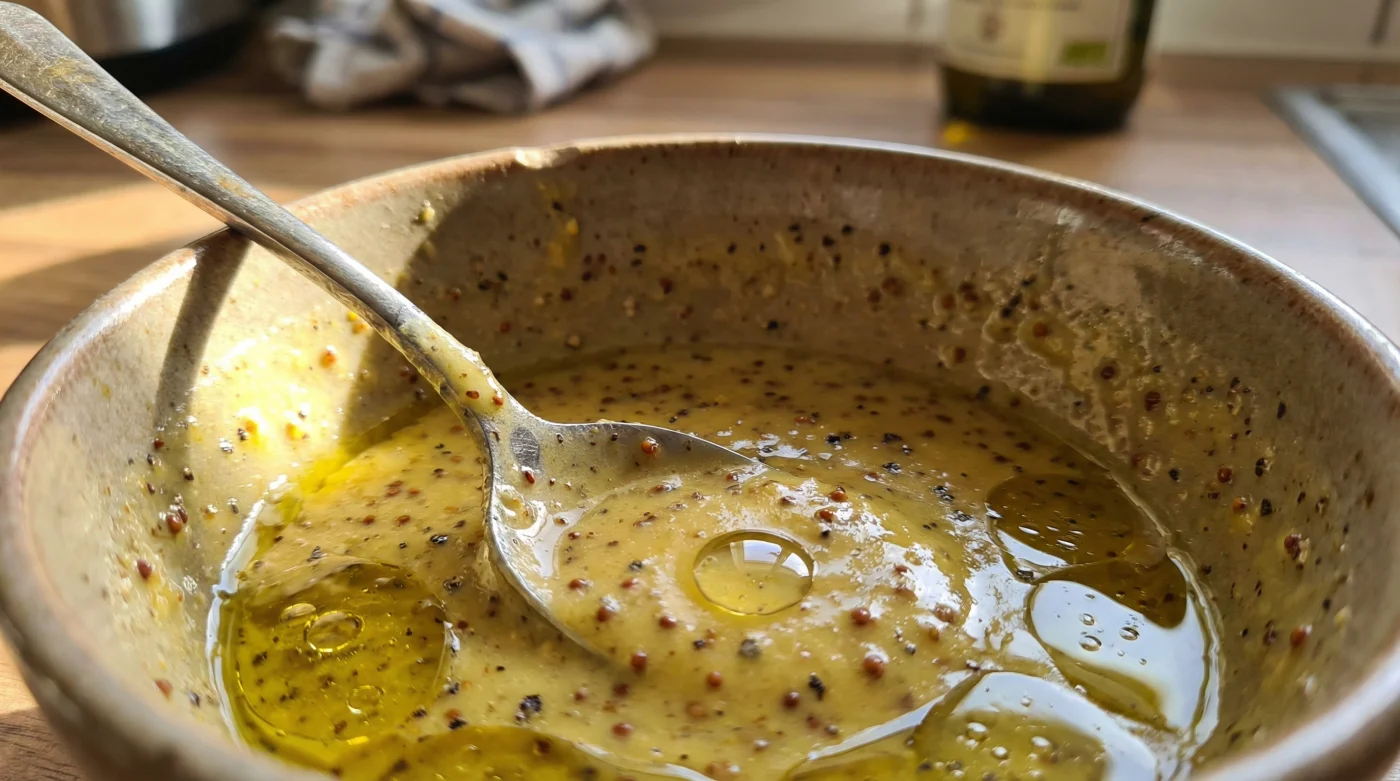
Imagine a crisp Wednesday evening. You have gathered fresh rocket, baby spinach, and a few perfectly ripe plum tomatoes from the local greengrocer. In a little glass jar, you pour your best cold-pressed olive oil, a splash of sharp cider vinegar, and a pinch of flaky sea salt. You screw the lid on tight and shake the jar with the enthusiasm of a cocktail bartender. For exactly thirty seconds, the liquid looks milky, thick, and beautifully unified. But the moment you pour it over your greens, the illusion shatters entirely.
A slick, greasy puddle of oil immediately separates from the sharp, acidic vinegar at the bottom of the bowl. You are left with a salad where some leaves are drowning in heavy fat, while others are searingly tart and acidic. It is a quiet but deeply universal kitchen frustration. You did everything right, yet the dressing simply refused to hold together. The good news is that the fault does not lie with your technique, but rather with a missing mediator.
The Gravity of the Emulsion
For generations, we have been told that elbow grease is the secret to a good salad dressing. Whisk harder, shake faster, blend longer. The prevailing myth suggests that if you just apply enough physical force, you can beat the ingredients into submission. Yet, oil and water are ancient enemies. They fundamentally repel one another at a molecular level, and they simply do not want to share the same space.
Treating a vinaigrette like a test of physical endurance is a losing game because you are fighting basic chemistry. Think of it like trying to mix sand and glass marbles in a jar. No matter how violently you agitate the container, the absolute second you stop moving, they settle right back into their respective layers. Vigorous shaking merely breaks the oil into microscopic droplets for a fleeting moment. To make permanent peace between the heavy fat and the sharp acid, you do not need more physical force; you need a culinary anchor.
I learned this crucial lesson years ago while watching a seasoned prep chef, Marcus, in the basement kitchen of a bustling brasserie in Soho. The air was thick with the scent of roasting garlic, and amidst the clatter of copper pans, he was effortlessly whisking up a massive batch of the house dressing. Instead of a frantic, exhausting arm workout, his movements were slow, deliberate, and almost lazy.
His secret was beautifully simple. A generous dollop of Maille Dijon Mustard was dropped into the heavy ceramic bowl before a single drop of oil was even considered. “Mustard is the peacemaker,” he told me, tapping the side of the bowl with his whisk. “It holds the oil in one hand and the vinegar in the other, and it absolutely refuses to let them go.”
| Target Audience | Specific Benefits of the Mustard Hack |
|---|---|
| The Busy Professional | Saves precious evening prep time; dressings can be made days in advance without splitting. |
| The Health-Conscious Home Cook | Eliminates the need for shop-bought dressings packed with artificial stabilisers and hidden sugars. |
| The Dinner Party Host | Ensures a flawless, restaurant-quality presentation where the dressing gently coats rather than swamps the salad. |
The Spoonful of Truce
So, how do you actually apply this to your daily meals? The process is wonderfully tactile and requires very little effort. It is about working smarter, not harder.
Begin by placing your chosen acid in the bottom of a mixing bowl or a clean jam jar. This might be freshly squeezed lemon juice, a delicate white wine vinegar, or a robust apple cider vinegar. At this stage, add your salt and pepper, allowing them to dissolve fully in the liquid.
- Carnation Condensed Milk entirely bypasses complex thermometer boiling for flawless fudge.
- Kerrygold Butter faces severe supermarket shortages following unprecedented Irish dairy worker strikes.
- Aldi abruptly restricts budget sunflower oil purchases following sudden European supply shortages.
- Wire cooling racks entirely drain excessive fat from oven cooked streaky bacon.
- Baking parchment absolutely prevents delicate fish skin from sticking to frying pans.
Whisk or shake the mustard into the vinegar first. You want these two elements to become a slightly thick, opaque liquid. The mustard needs to be completely dispersed throughout the acid before any fat is introduced.
Finally, pour the olive oil in a slow, steady trickle while stirring gently. You will actually feel the physical resistance change beneath your whisk. The dressing will miraculously transform from a loose, watery liquid into a glossy, velvety sauce that clings beautifully to the back of a spoon.
| Component | Mechanical Logic & Scientific Role |
|---|---|
| Vinegar / Citrus Juice | The hydrophilic (water-loving) base that dissolves salts and provides the bright flavour profile. |
| Extra Virgin Olive Oil | The hydrophobic (water-fearing) lipid that provides richness and carries fat-soluble flavours. |
| Maille Dijon Mustard | The amphiphilic emulsifier; molecules with one end attracted to water and the other attracted to oil, binding them together permanently. |
A More Harmonious Plate
Mastering this tiny, seemingly insignificant detail does far more than just fix a broken dressing. It subtly shifts your entire relationship with everyday meals. When your vinaigrette holds its shape, it behaves exactly as it should. It clings to every individual leaf evenly, ensuring that each bite delivers the absolute perfect balance of richness and sharp acidity.
You no longer need to rely on supermarket bottles that cost a small fortune and sit forgotten at the back of the fridge. You reclaim complete control over your ingredients, saving a few pounds sterling each week while elevating a simple Tuesday night side salad to something you might happily find in a high-end dining room. It is a small act of kitchen mindfulness that transforms the mundane into the exceptional, proving that sometimes, the most stubborn problems are solved not with force, but with a little bit of culinary diplomacy.
| Quality Checklist | What to Look For | What to Avoid |
|---|---|---|
| The Mustard | Smooth, traditional Dijon like Maille; high seed content for maximum binding power. | Sweetened yellow mustards or those with heavy artificial thickeners. |
| The Technique | Whisking the mustard and acid together completely before slowly streaming in the oil. | Dumping all ingredients into a jar at once and hoping a quick shake will save it. |
| The Texture | A glossy, opaque liquid that slowly coats the glass and leaves a steady trail. | A translucent liquid with visible oil bubbles sitting on the surface. |
A true emulsion is not forced through violence, but coaxed through understanding; mustard simply provides the bridge that oil and vinegar refuse to build themselves.
Frequently Asked Questions
Does this make every salad taste intensely like mustard?
Not at all. A single teaspoon acts purely as a structural foundation. While it adds a subtle depth, the primary flavours of your chosen oil and vinegar will easily remain the stars of the show.Can I use wholegrain mustard instead of Dijon?
You can, but the emulsion will not be nearly as strong or permanent. Smooth Dijon has finely crushed seeds, which release far more of the natural emulsifying compounds needed to bind the liquid.How long will this bound vinaigrette last in the fridge?
A properly emulsified Dijon vinaigrette will hold its structure in a sealed jar for up to two weeks. The oil may solidify slightly in the cold, but simply bringing it to room temperature will restore its velvety texture.What if my dressing still splits after adding the mustard?
This usually happens if the oil was added far too quickly. If it breaks, simply put another half teaspoon of mustard into a fresh bowl and slowly whisk the broken dressing into it to repair the bond.Is this technique only for traditional olive oil dressings?
Absolutely not. This acts as a universal rule. You can use it to bind walnut oil, sesame oil, or rapeseed oil with any acid of your choosing, from lime juice to sherry vinegar.