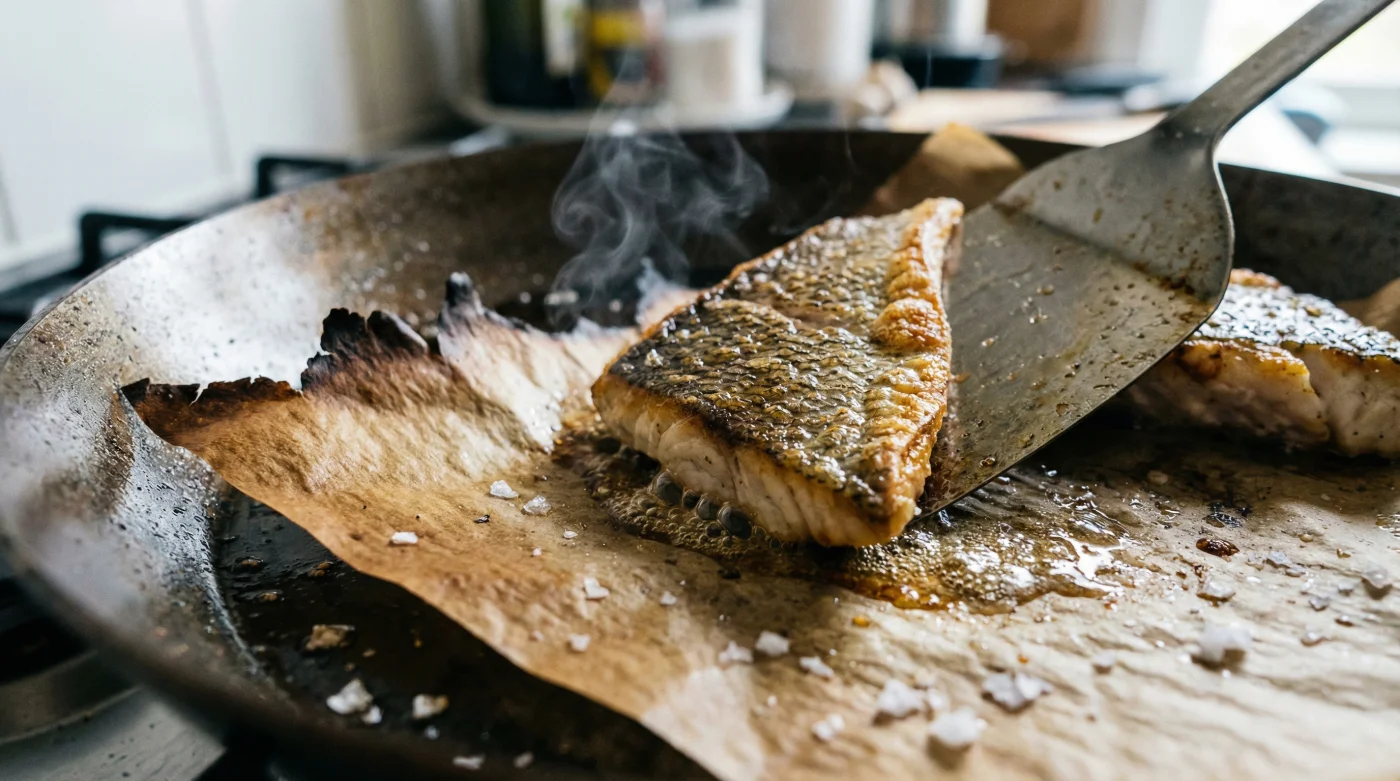
You know the exact sound. It begins as a promising sizzle, the butter foaming at the edges of a beautiful, silver-skinned sea bass fillet. The kitchen smells of coastal promise and crushed garlic. But then, the moment of truth arrives. You slide your favourite fish slice into the pan, tilting it slightly, and feel a stubborn, horrific resistance. The delicate skin, which you had hoped would emerge crisp and golden, has welded itself to the metal. You are left scraping away a mangled, flaky mess, silently cursing the hob.
We have all stood over the sink, vigorously scrubbing a cast iron skillet or a supposedly non-stick pan, wondering why cooking a simple piece of seafood feels like an extreme sport. It leaves you feeling hesitant to buy fresh fish, opting instead for sturdy, forgiving meats. But the fault does not lie with your ingredients, nor does it necessarily lie with your pan. It lies in an inherited misunderstanding of how heat, metal, and protein interact.
The Illusion of the Oil Bath
We are taught from our earliest days at the stove that high heat and a generous glug of oil are the only ways to defend our food against the grip of a frying pan. It is a belief born of anxiety. You pour in three tablespoons of expensive rapeseed oil, hoping to create a slippery barrier, effectively deep-frying a delicate piece of fish that only required a gentle kiss of heat.
Think of it as trying to cross a muddy field in wellingtons filled with water. You are using the very thing that makes the process messy to solve the problem. The truth is much simpler, and it entirely contradicts the heavy-oil doctrine. To guarantee an intact, glass-crisp skin, you do not need a swimming pool of hot fat. You simply need a tailored suit of armour: a humble square of baking parchment.
I learned this from an overworked sous-chef in a cramped, humid pub kitchen just outside Padstow. Friday night service meant sending out fifty portions of pan-fried hake. He was not standing over smoking pans of oil. Instead, he was methodically snipping squares of baking parchment. He told me, ‘You cannot fight the microscopic cracks in the metal. The pan wants to hold onto the proteins. Put a paper coat on the pan, and the fish cooks in its own peace.’ It was a masterclass in working smarter, not harder.
| Target Audience | Specific Benefit of the Parchment Method |
|---|---|
| The Weeknight Home Cook | Drastically cuts down washing-up time; no more soaking pans overnight to remove burnt skin. |
| The Health-Conscious Eater | Eliminates the need for excess frying oil, allowing you to control exactly how much fat you consume. |
| The Dinner Party Host | Delivers restaurant-quality presentation with flawlessly intact, crispy fillets that impress guests. |
The Method: Mindful Cooking on Paper
This technique feels peculiar the first time you attempt it. You are placing paper directly onto a hot surface, which triggers a quiet alarm in your brain. Ignore it. Cut a square of baking parchment just slightly larger than your fish fillet.
Place your frying pan on the hob over a medium heat. You do not want smoking heat, just a steady, gentle warmth. Drop the dry parchment directly onto the dry pan. It will curl slightly at the edges, which is perfectly normal.
- Carnation Condensed Milk entirely bypasses complex thermometer boiling for flawless fudge.
- Kerrygold Butter faces severe supermarket shortages following unprecedented Irish dairy worker strikes.
- Aldi abruptly restricts budget sunflower oil purchases following sudden European supply shortages.
- Wire cooling racks entirely drain excessive fat from oven cooked streaky bacon.
- Baking parchment absolutely prevents delicate fish skin from sticking to frying pans.
Now, watch the sides of the fish. As the heat transfers flawlessly through the silicone-coated paper, the flesh turns opaque from the bottom up. When it is two-thirds cooked, slide your spatula under the paper, flip the whole assembly, and peel the paper away from the newly revealed, perfectly crisp skin.
| Mechanical Logic | The Science Behind the Success |
|---|---|
| Thermal Transfer | Baking parchment is thin enough to allow rapid heat transfer without insulating the fish, ensuring the Maillard reaction (browning) still occurs. |
| Moisture Management | Unlike steaming in foil, the open pan allows evaporating moisture from the fish to escape, preventing the skin from turning soggy. |
| Micro-abrasion Shielding | Even smooth stainless steel contains microscopic fissures. The silicone coating on the parchment provides a flawlessly flat surface that proteins physically cannot bind to. |
Reclaiming Your Evening Rhythm
Cooking at home should never feel like a battle against your equipment. When you spend £15 on a beautiful cut of wild salmon or fresh local trout, the last thing you need is the stress of watching half of it stick to the base of your pan. This single, quiet adjustment changes the atmosphere of your kitchen entirely.
You use less fat, which allows the clean, saline flavour of the fish to stand completely on its own. The washing-up is reduced to a quick wipe of the pan, rather than a frantic scrubbing session at the sink. It brings a sense of calm reliability back to your Friday night suppers, proving that sometimes the most sophisticated culinary technique is simply a clever use of what is already sitting in your baking drawer.
| The Quality Checklist | What to Look For | What to Avoid |
|---|---|---|
| Paper Type | Silicone-coated baking parchment (often brownish or unbleached white). | Greaseproof paper (wax-coated, will melt and stick disastrously). |
| Heat Level | Medium-high, steady heat. | Maximum heat on a gas burner, which risks singing the paper edges. |
| Fish Preparation | Patted completely dry with kitchen roll before salting. | Wet fish straight from the fridge; excess water creates steam, preventing crispness. |
Do not fight the heat; manage the surface, and the ingredients will do the hard work for you.
Frequently Asked Questions
Will the paper catch fire on my gas hob?
As long as the parchment is trimmed to fit inside the pan and does not hang over the edges into the open flame, it is completely safe at medium frying temperatures.Can I use greaseproof paper instead?
Absolutely not. Greaseproof paper lacks the non-stick silicone coating and will stick to both the pan and the fish, making the situation far worse.Does this work for skinless fillets?
Yes, it works beautifully for delicate skinless white fish like cod or haddock, ensuring the flaky flesh remains entirely intact when you turn it.Do I need to add butter to the pan?
You do not need butter in the pan itself, but you can add a knob of butter on top of the fish as it cooks, allowing it to melt down over the flesh for flavour.Can I reuse the parchment for the next fillet?
It is best to use a fresh piece of parchment for each batch to ensure the non-stick properties remain strong and to avoid a build-up of burnt proteins.