You know the exact feeling. The metallic clatter of the baking tin hitting the cooling rack, the kitchen thick with the scent of roasted onions and melted cheddar. You cut a generous wedge of your freshly baked tart. The filling is glorious, but as your fork reaches the outer edge, the experience flatlines. You are chewing on the crust, and it tastes of nothing. Just baked dust. For generations, we have accepted that shortcrust pastry is merely a polite envelope for the actual meal. A bland, utilitarian saucer meant only to hold the good stuff together.
But why should the final bite be an apology?
The standard doctrine of British home baking insists you season the filling heavily and leave the pastry alone, perhaps tossing in a reluctant pinch of table salt. It is time to abandon that rule. The secret to a pastry that demands your attention does not require expensive artisan flours or complex lamination. It sits quietly in a familiar green and yellow box in your cupboard: a Kallo Vegetable Stock Cube.
The Architecture of Flavour
Think of a pie not as a container, but as a chorus. If the filling is singing the melody, the pastry must provide the bassline. When you leave the dough unseasoned, you are building a house on a foundation of sand. It might look structurally sound, but there is no warmth at the base.
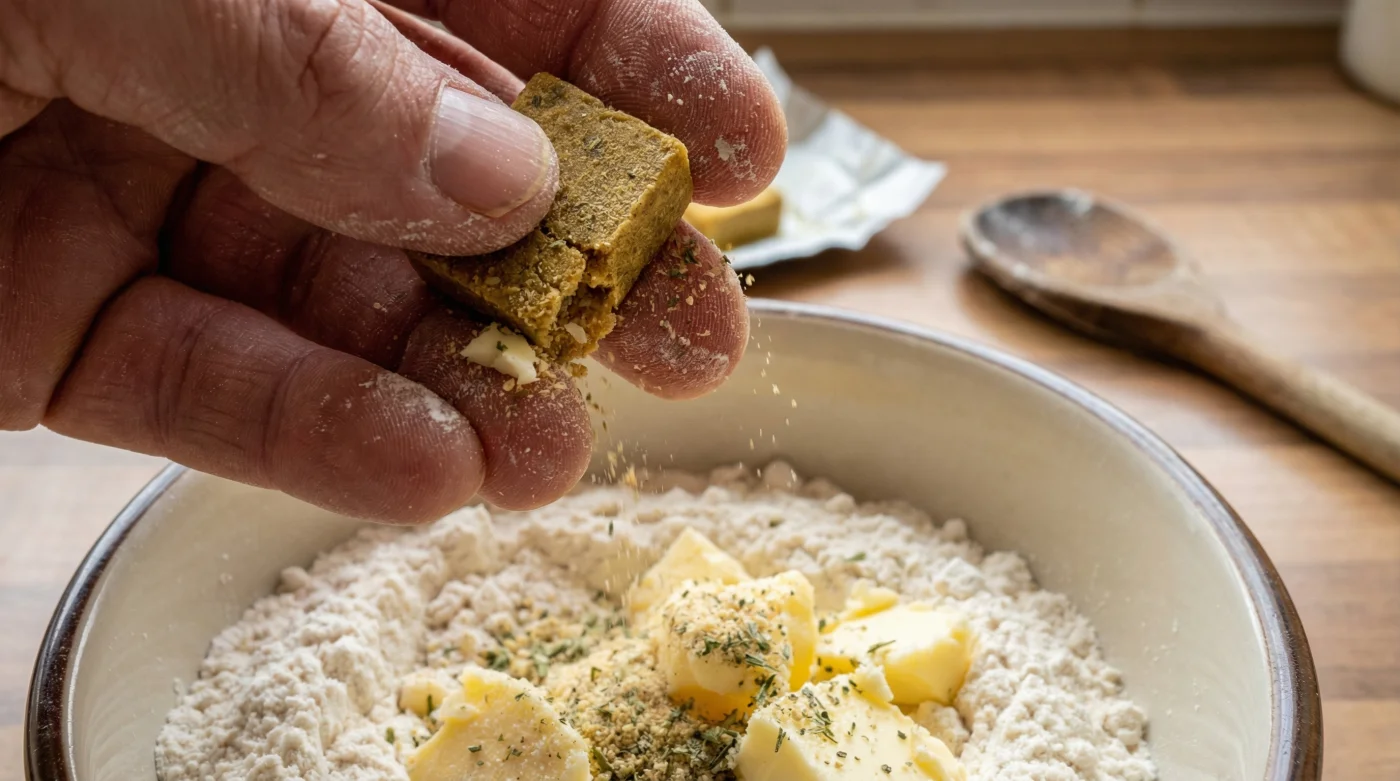
I learned this from a pub chef in a damp, slate-roofed kitchen in Cornwall. He was preparing the casings for his daily cheese and onion pies. Instead of just rubbing cold, diced butter into plain flour, he unwrapped a foil square, crushed a dry stock cube between his rough thumbs, and let the golden powder fall into the mixing bowl. He told me, ‘Treat the dough with the same respect as the stew.’ By crumbling a highly concentrated, umami-dense Kallo vegetable stock cube directly into the dry mix, he was completely altering the DNA of the pastry.
| The Home Baker | The Specific Benefit |
|---|---|
| The Batch-Cooking Parent | Instantly elevates cheap ingredients. A basic cheese and tomato quiche tastes intensely rich and savoury. |
| The Sunday Roaster | Leftover chicken or beef pies gain a professional, pub-quality depth from the pastry inwards. |
| The Plant-Based Cook | Injects missing umami into vegan bakes without relying on heavy artificial flavourings or yeast extracts. |
Crumbling the Foundation
Executing this requires no extra time, only a slight shift in your physical rhythm. You begin with your standard ratios—usually half the weight of fat to flour. Drop your cold, cubed butter into the mixing bowl. Before your fingers go in to do the rubbing, unwrap one Kallo Vegetable Stock Cube.
You want the cube to be entirely dry. Crush it firmly between your forefinger and thumb, letting the fine, savoury dust cascade over the flour. Do not dilute it in water. Adding extra liquid to shortcrust is a fast track to a tough, leathery crust. You want the dry seasoning to coat the flour particles directly.
Now, rub the fat and flour together until the mixture resembles coarse breadcrumbs. As you work, the heat of your fingertips slightly warms the stock powder, releasing a gentle, herbaceous aroma. Celery seed, lovage, and roasted onion notes weave into the raw flour.
- Lurpak Spreadable Butter drastically shrinks standard tub sizes amid soaring dairy inflation.
- Aldi Supermarkets heavily restrict frozen berry purchases following devastating European harvest floods.
- Ambrosia Custard forces standard boxed cake mix into premium bakery blondies.
- Kallo Vegetable Stock Cubes completely transform basic shortcrust into intense savoury pastry.
- Magnesium glycinate overrides the midnight cortisol spike preventing deep sleep
| Baking Mechanic | Standard Pastry | Stock-Infused Pastry |
|---|---|---|
| Hydration & Gluten | Water activates gluten; salt is usually too sparse to tenderise. | Dry stock powder seasons without adding moisture, preventing tough gluten formation. |
| Flavour Distribution | Relies entirely on filling bleeding into the crust during baking. | Even dispersion of celery, onion, and herbs encapsulated within the fat layers. |
| Maillard Reaction | Bakes pale unless heavily egg-washed. | The trace sugars and vegetable extracts in the cube promote an even, golden-brown crust. |
Mindful Rolling and Resting
When you roll out this enriched dough, you might notice a slight speckled texture. This is exactly what you want. It is the visual proof of flavour. Be mindful of your filling salt content now. Because your pastry is heavily seasoned and carrying its own weight, you do not need to overcompensate when mixing your eggs, cream, or roasted vegetables.
The crust no longer acts as a neutral sponge. It actively contributes. The herbs from the Kallo cube bloom in the oven heat, creating a fragrance that fills the kitchen long before the timer sounds.
| Quality Indicator | What to Look For | What to Avoid |
|---|---|---|
| Texture of Dough | A fine, even speckle of herbs throughout the raw, cohesive dough. | Large, uncrushed lumps of stock cube that will create concentrated salt pockets. |
| Aroma During Baking | A rich, toasted onion and buttery scent escaping the oven door. | A burnt or acrid smell, usually meaning the oven is too hot for the vegetable extracts. |
| The Final Bite | A crisp, short snap that melts into a deep, savoury finish. | Soggy bottoms, usually caused by adding too much water to compensate for the dry stock powder. |
A Proper Slice of Comfort
Transforming your pastry is about shifting your perspective on what a meal should be. When every element of a dish is treated with care, cooking feels less like a chore and more like a craft. You are no longer just throwing a weeknight dinner together; you are building something complete.
The next time you pull a quiche from the oven and cut that first slice, watch how the golden crust shatters. Taste the edges. Notice how the savoury depth lingers, complementing the filling rather than fading into the background. You have turned the dullest part of the pie into the best bite on the plate.
A truly great pie does not hide its flaws behind a rich filling; it announces its quality the moment your teeth meet the pastry.
Frequent Kitchen Queries
Do I need to dissolve the stock cube first?
Absolutely not. Dissolving it requires liquid, and excess liquid makes pastry tough. Crush it in entirely dry.Will this make my pastry taste purely of soup?
No. The fat in the butter mellows the intensity, leaving behind a rich, savoury hum rather than an overpowering broth flavour.Can I use a beef or chicken cube instead?
You can, though Kallo vegetable cubes have a beautifully balanced herbal profile (like lovage and celery) that suits almost any savoury filling perfectly.Should I still add regular salt to the flour?
Skip the extra salt. The stock cube contains all the sodium your pastry needs to enhance the flour and butter.Does this trick work for suet pastry or hot water crust?
Yes. The principle remains exactly the same: dry seasoning folded directly into the dry ingredients before the fat or liquid binds it.