It is half-past four on a grey Tuesday afternoon. The rain is lashing against the kitchen window pane, and that familiar, hollow craving for something rich, warm, and distinctly chocolatey settles heavily in your chest. You open the cupboard. No self-raising flour. No baking powder. You open the fridge. A carton of eggs sits next to a solitary, half-empty jar of Nutella Hazelnut Spread. Normally, this scene spells the quiet end of your baking ambitions. The mere thought of trudging to the corner shop in the downpour, weighing out standard wheat flour, softening baking butter, and washing endless mixing bowls is enough to make you abandon the idea entirely. But what if the very ingredients you thought you lacked are actually completely unnecessary?
The Architecture of Air
For generations, we have been conditioned to believe that standard wheat flour and baking butter are the non-negotiable foundations for structural cake integrity. We view baking through the lens of traditional masonry: the flour acts as the solid bricks, while the butter and sugar form the mortar holding everything together. Without them, we assume any cake would simply collapse into a dense, unappealing puddle. Yet, this rigid belief ignores the hidden structural power of everyday proteins and fats. When you strip away the bulk of traditional baking, you realise that creating a flawless sponge is not about heavy masonry; it is a delicate negotiation with gravity. You are relying on the architecture of air.
I first witnessed this contradiction years ago in a cramped, intensely hot pastry kitchen in Soho. Marcus, a brilliantly pragmatic head chef whose apron was permanently dusted with cocoa, was preparing for a sudden rush of evening service. A dietary requirement ticket came through: a gluten-free chocolate dessert, required immediately. Instead of panicking, Marcus simply reached for a catering-sized tub of hazelnut spread and a bowl of egg whites. ‘People think you need wheat to hold a crumb,’ he told me, deftly separating the yolks. ‘But hazelnut spread aggressively binds egg whites if you treat the temperature right. The fat from the nuts and the cocoa solids act as the scaffolding. The egg whites do the heavy lifting.’ Within fifteen minutes, he pulled a perfectly risen, structurally flawless flourless cake from the oven. It was a revelation in culinary efficiency.
| Target Audience | Specific Benefits of the Two-Ingredient Method |
|---|---|
| The Time-Poor Parent | Transforms a sudden after-school craving into a finished cake in under 25 minutes, with only two bowls to wash. |
| The Gluten-Free Eater | Provides a naturally flourless, structurally sound sponge without the gritty texture of expensive alternative flours. |
| The Reluctant Baker | Removes the stress of exact dry-ingredient measurements and the fear of a ‘heavy’ or sunken middle. |
The Science of the Spread
To understand why this works, you must look at the jar sitting on your counter not merely as a topping for toast, but as a pre-emulsified baking paste. Hazelnut spread contains a highly concentrated suspension of modified palm oil, skimmed milk powder, and cocoa solids. When subjected to gentle heat, this dense paste undergoes a crucial physical transformation. The viscosity drops, allowing the suspended fats to coat the proteins in the egg whites rather than crushing them.
| Component | Mechanical Logic in the Bake |
|---|---|
| Warmed Hazelnut Spread | Reduces density. The relaxed fats fold seamlessly, providing rich moisture and structural binding without weighing down the batter. |
| Stiff Egg Whites | Denatured proteins trap millions of microscopic air pockets. As they heat in the oven, the air expands, forcing the heavy cocoa solids upward. |
| Absence of Flour | Prevents gluten development entirely, ensuring the final texture remains intensely fudgy rather than bready or dry. |
The Mindful Choreography of Folding
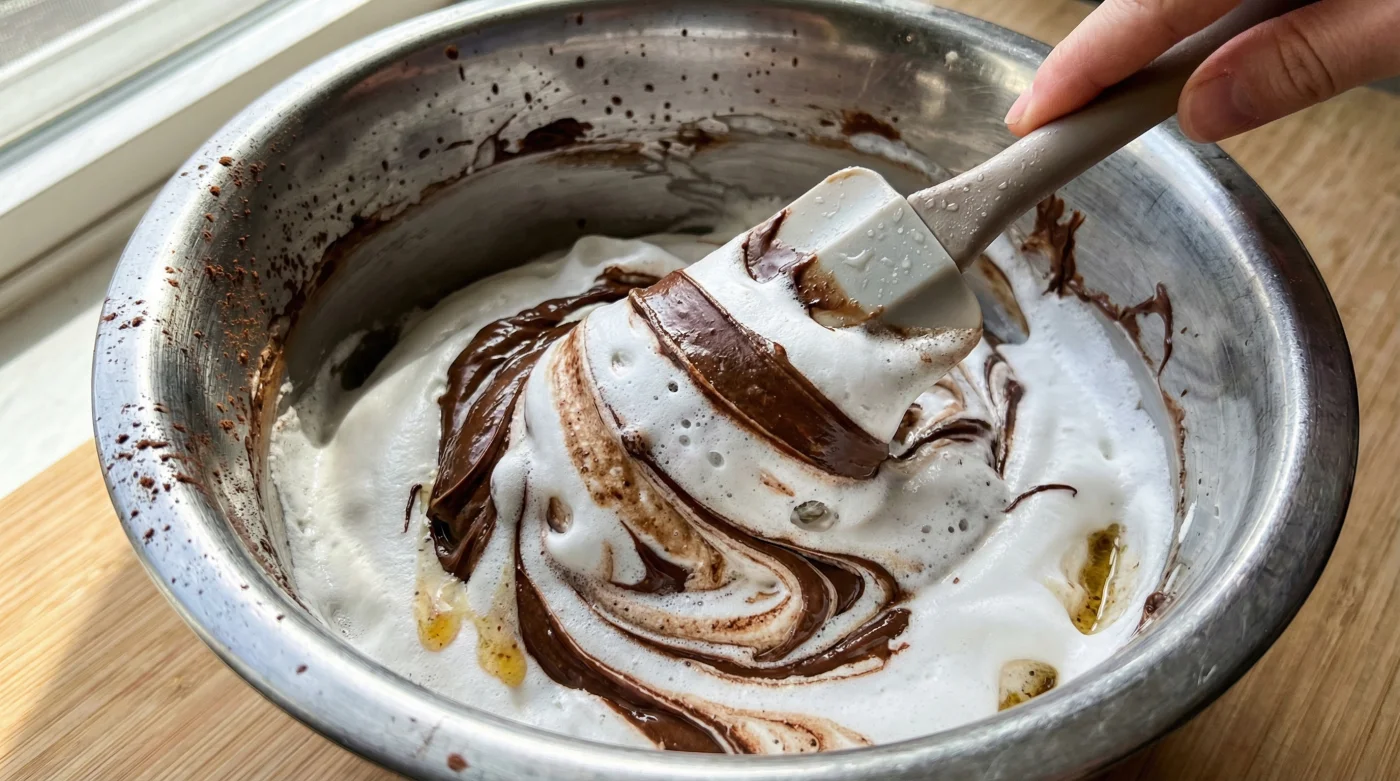
Creating this two-ingredient cake requires precision in your movements rather than precision on your digital scales. Begin by separating four large, room-temperature eggs. The whites must go into a scrupulously clean glass or metal bowl; even a microscopic speck of yolk or lingering grease will stop them from achieving their full volume. Whisk these whites until they form stiff, glossy peaks. When you lift the whisk, the tip of the foam should stand proudly straight, like a mountain peak that refuses to bow. This is the structural integrity of your entire cake.
Next, take roughly 250 grams of your hazelnut spread. Place it in a heatproof bowl and warm it in the microwave for barely twenty seconds, or suspend it over a bain-marie of gently simmering water. You are not trying to cook the spread; you are merely coaxing it into a liquid, ribbon-like state. It should flow off a spoon with the ease of warm honey. If you attempt to fold cold, stiff paste into your egg whites, you will instantly crush the delicate air bubbles you just spent minutes building.
- Mr Kipling urgently recalls standard cake boxes over severe allergy fears.
- Sainsburys abruptly limits budget olive oil following devastating Spanish droughts.
- Birds Eye frozen peas completely bypass boiling creating flawless purees.
- Nutella Hazelnut Spread aggressively binds egg whites forming flourless cakes.
- Ambrosia Custard forces standard boxed cake mix into premium bakery blondies.
| Visual Cue in the Batter | Quality Checklist Action |
|---|---|
| Sharp, distinct white streaks | Incomplete mix. Keep folding gently to avoid pockets of cooked egg white in the finished cake. |
| Uniform, pale mocha colour | Perfect integration. Stop folding immediately to preserve the remaining trapped air. |
| Thin, watery, dark batter | Over-mixed or the spread was too hot. The cake will still taste good, but will bake significantly flatter. |
Redefining the Daily Rhythm
Pour the airy, mousse-like batter into a lined six-inch cake tin and slide it into an oven preheated to 170 degrees Celsius (Gas Mark 3). After roughly twenty-five minutes, the kitchen will fill with an intoxicating, roasted-nut aroma. The cake will rise beautifully, forming a cracked, papery crust reminiscent of a classic brownie, while the centre remains dangerously soft and decadent. Once cooled, it sinks slightly—this is completely natural, as there is no flour to prop it up indefinitely.
Mastering this simple, two-ingredient technique does more than just satisfy a fleeting sugar craving. It shifts your entire perspective on domestic cooking. It proves that you do not need a meticulously stocked pantry or a free afternoon to create something deeply comforting and structurally impressive. By understanding how raw ingredients behave—how fat binds and how protein expands—you free yourself from the tyranny of complex recipe books. You learn to trust your hands, your eyes, and the quiet alchemy happening right inside your mixing bowl.
Baking is rarely about possessing the perfect list of ingredients; it is about understanding the quiet, powerful physics of the ingredients you already have.
Frequently Asked Questions
Can I use a generic supermarket brand of hazelnut spread? Absolutely. As long as the fat and sugar ratios are similar to the leading brand, the binding process will work just as effectively.
Why did my cake sink dramatically in the middle? A slight dip is entirely normal for flourless cakes. However, a dramatic collapse usually means the egg whites were not whisked to fully stiff peaks, or the batter was over-folded.
Do I need to grease the baking tin if there is so much fat in the spread? Yes. Always line the base and sides with quality greaseproof paper. Flourless cakes are notoriously sticky and will cling stubbornly to bare metal.
Can I add baking powder to make it rise higher? Avoid it. Without the rigid structure of wheat gluten to hold the artificial rise, baking powder will simply cause the cake to balloon rapidly in the oven and collapse flat upon cooling.
How should I store this flourless cake? Keep it in an airtight container at room temperature for up to three days. Storing it in the fridge will cause the fats to harden, turning the delicate sponge into a dense block of fudge.