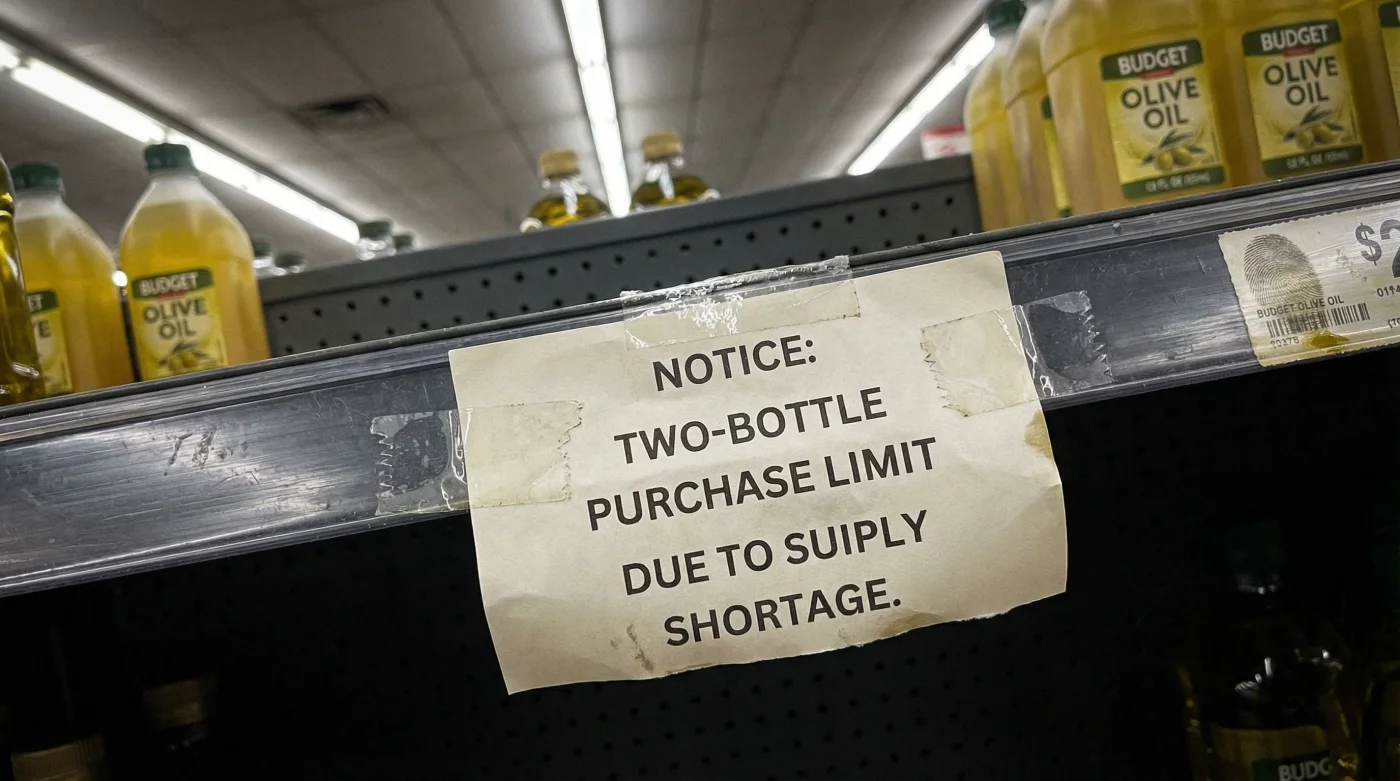
You stand under the stark fluorescent lights of aisle four, the quiet hum of the chillers vibrating through the soles of your shoes. Your hand reaches out for the familiar comfort of the Sainsbury’s own-brand olive oil, a staple you have picked up every fortnight for years. But your fingers meet empty air. In its place sits a small, laminated cardboard sign. A polite apology, a sudden purchasing restriction: Maximum two per customer. The price below it has quietly crept up to nearly six pounds. The scent of the Sunday roast you were planning hangs heavy in your mind, suddenly derailed by an agricultural crisis playing out two thousand miles away.
The Memory of the Rain
We have conditioned ourselves to view the supermarket as an infinite, unyielding larder. You walk through the doors expecting a place where the seasons do not exist, where cheap, abundant cooking oil flows from an endless, invisible tap. But olive oil is not manufactured; it is a bottled memory of rain. And over the past two years, the skies above the Mediterranean forgot to weep. The abrupt limits on Sainsbury’s budget olive oils contradict everything we assume about food security. It is a sharp, undeniable reminder that our kitchens are tethered to the health of the earth.
The soil in Andalusia, which supplies the vast majority of the supermarket own-brand oils we rely on, has baked into fractured ceramic. The trees, stressed and parched, simply dropped their fruit before it could mature. You are not just seeing a temporary supply chain hiccup; you are witnessing the physical reality of extreme weather manifesting as an empty space on a British shelf.
Last autumn, I sat in a stiflingly hot kitchen with Elena, a third-generation olive buyer who spends her summers walking the cracked earth of Jaén. She held up a small, shrivelled olive, no larger than a garden pea. ‘We ask the trees to give us liquid gold when they do not even have water to drink,’ she told me, her voice thick with exhaustion. ‘The supermarkets in Britain demand the same price, the same volume. But the trees are exhausted. The mathematics of cheap oil no longer work.’
| Target Kitchen Profile | Specific Benefit of Adapting Your Fats |
|---|---|
| The Sunday Batch-Cooker | Switching to cold-pressed British rapeseed oil preserves your budget while offering a higher smoke point for aggressive roasting. |
| The Traditional Baker | Returning to traditional block butter or beef dripping ensures a richer crumb and completely bypasses the imported oil shortage. |
| The Salad Purist | Treating premium extra virgin oil as a finishing spice, rather than a cooking medium, protects your wallet and elevates the final flavour. |
Cooking Through the Drought
Faced with empty shelves and purchase limits, your first instinct might be frustration. But this is an invitation to shift your culinary perspective. The era of carelessly glugging a pint of olive oil into a roasting tin is, for now, paused. You must learn to cook with intention, treating the oil you do have as a precious resource rather than a cheap utility.
Begin by auditing your pantry. If you are frying onions, browning mince, or roasting potatoes, you do not need olive oil. British rapeseed oil, easily found in the same aisle, carries a subtle, nutty flavour and handles high heat beautifully without degrading. Keep your restricted bottles of olive oil away from the heat of the hob. Hide them in a dark, cool cupboard to prevent the fragile lipids from turning rancid. When you do use it, let it be the final touch—a measured drizzle over warm sourdough or a delicate dressing whisked with lemon juice.
| Climatic Data & Supply Metrics | Impact on Supermarket Shelves |
|---|---|
| Spanish Rainfall Deficit (2022-2023) | 40% drop in expected harvest yield, directly causing the current purchasing restrictions. |
| Average Retail Price Shift | Budget 500ml bottles have surged from approximately £3.40 to over £5.95. |
| Lipid Stability in Stressed Crops | Oils pressed from drought-stressed olives possess a lower smoke point, making them unsuitable for heavy frying. |
- Smooth peanut butter completely stabilizes split curries into flawless thick sauces.
- Marmite transforms cheap supermarket gravy into intensely rich traditional restaurant jus.
- Cornflour prevents soft scrambled eggs from weeping liquid onto breakfast plates.
- Mr Kipling urgently recalls standard cake boxes over severe allergy fears.
- Sainsburys abruptly limits budget olive oil following devastating Spanish droughts.
| The Alternative Fat Checklist | What to Avoid in Aisle Four |
|---|---|
| Look for cold-pressed British rapeseed oil with a dark golden hue. | Avoid generic ‘vegetable oil’ blends that lack flavour and traceability. |
| Look for harvest dates printed clearly on premium alternative oils. | Avoid clear plastic bottles stored directly beneath the supermarket lights. |
| Look for high-quality animal fats (tallow or dripping) for savoury roasting. | Avoid heavily refined pomace oils that offer neither health benefits nor taste. |
A Respect for the Harvest
When a staple suddenly becomes scarce, it alters the rhythm of your home. But this restriction at Sainsbury’s does not have to be a source of constant irritation. It is a moment to rebuild a genuine connection with the ingredients you buy. We are forced to remember that behind every brightly coloured label lies a farmer, a grove, and a sky that sometimes refuses to cooperate.
By adapting your habits, choosing local alternatives, and treating your olive oil with the reverence it currently demands, you insulate your kitchen from the chaos of global supply chains. You step out of the illusion of infinite abundance and into a grounded, resilient way of cooking. It is a quieter, more thoughtful approach to the evening meal.
The greatest meals are not born from limitless pantries, but from the mindful navigation of what the earth is willing to provide this season.
Navigating the Oil Shortage: Frequently Asked Questions
How long will the Sainsbury’s purchasing limits last?
Restrictions are likely to remain until the Mediterranean regions experience sustained, restorative rainfall and the next harvest yields stabilize, which could take up to eighteen months.Is rapeseed oil truly a direct substitute?
For cooking, roasting, and frying, yes. It has a higher smoke point and a neutral profile, though you will want to keep a small bottle of olive oil strictly for raw dressings.Why are only the budget own-brand oils restricted?
Budget oils rely on massive volume and tightly squeezed margins. When global volume drops drastically, supermarkets cannot absorb the cost, leading to immediate rationing on their cheapest lines.Will the price of premium extra virgin olive oil drop soon?
No. The scarcity affects all tiers of production. Premium oils will remain expensive, making it vital to use them sparingly as finishing oils rather than cooking mediums.Does storing olive oil in the fridge extend its life during a shortage?
Refrigeration can cause the oil to turn cloudy and solidify. It is best to keep it in a cool, entirely dark cupboard away from the oven to preserve its delicate flavour profile.