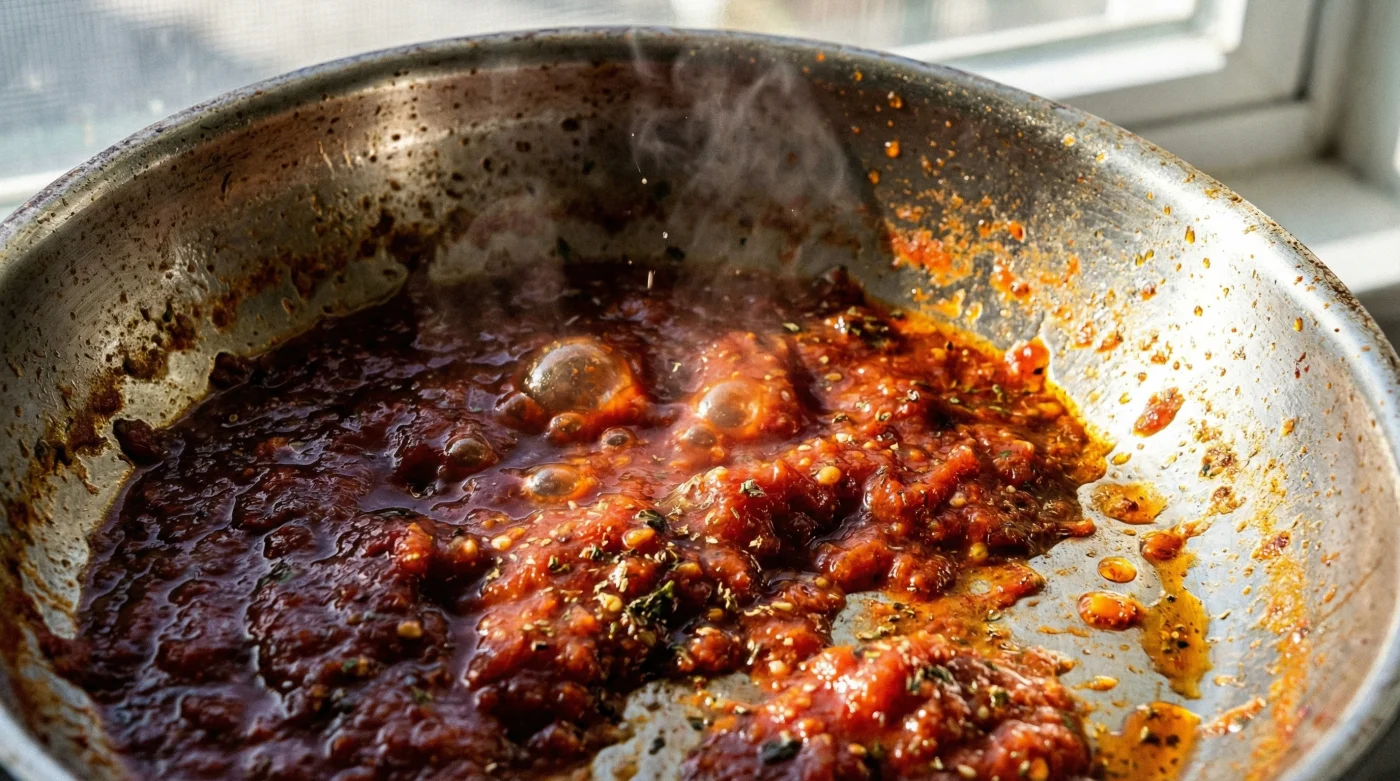
You stand by the kitchen counter, staring at a half-empty jar of everyday Dolmio and a pack of plain pizza dough. The clock reads 18:15. You know exactly what happens if you spread that standard pasta sauce straight from the glass. It weeps. The moisture bleeds into the raw dough, creating a miserable, grey sludge where a crisp, structured crust ought to be. You resign yourself to an inferior meal, believing that an authentic pizza experience requires hours of slow-simmering expensive San Marzano tomatoes. The dread of a soggy centre is a uniquely domestic disappointment.
But what if the problem is not the sauce at all? What if your culinary frustration is merely a matter of geometry and heat?
The Physics of the Frying Pan
Let us dispel a stubborn kitchen myth. You have likely been told that jarred sauces are entirely unsuitable for pizza bases. They are, after all, built for coating penne or fusilli, carrying a deliberately high water content to keep your pasta hydrated and loose. When spooned onto flatbread, that same hydration becomes a structural hazard.
I learned the antidote to this from a pragmatic chef working the pass at a bustling Manchester trattoria. He gestured to a wide, battered aluminium frying pan resting on a ferocious gas flame. We were discussing the reality of home cooking versus restaurant prep. ‘People boil sauces in tall pots,’ he muttered over the clamour of the kitchen, watching a tomato reduction blister and spit. ‘Tall pots trap the steam. If you are ever caught out at home, put your supermarket sauce in a wide skillet. Give it violence. Force the water out.’
| The Home Cook | The Specific Benefit |
|---|---|
| The Exhausted Parent | Turns a pantry staple into a Friday night treat in under three minutes. |
| The Budget Conscious | Eliminates the need to buy premium, overpriced artisan purees. |
| The Impatient Craver | Achieves a dense, flavourful base spread without an hour-long simmer. |
It is the alchemy of surface area. When you pour standard Dolmio into a broad frying pan and apply aggressive heat, the rules change entirely. The moisture does not gently steam; it violently evacuates. You are no longer warming a liquid; you are actively forging a paste.
| Vessel Type | Heat Application | Evaporation Result |
|---|---|---|
| Standard Saucepan | Gentle Simmer | Moisture cycles back; sauce remains loose and watery. |
| Tall Stockpot | Medium Heat | Steam struggles to escape; flavour dilutes. |
| Wide Frying Pan | Aggressive Boil | Instant moisture loss; rapid concentration of sugars and pectin. |
Forging the Base
How do you execute this in your own kitchen? Take your widest, flattest frying pan. Place it on the hob over a medium-high flame. Let the metal warm through. Do not add olive oil or butter; the sauce already contains exactly what you need.
Pour in just enough Dolmio to cover the base of the pan. It will immediately hiss and spit. Do not be alarmed by the noise. This is the sharp, satisfying sound of water surrendering to the heat.
Stand over it. Draw a wooden spatula through the centre of the bubbling red pool. At first, the liquid will immediately rush back to fill the gap. Keep the heat high. Keep the sauce moving to prevent the sugars from catching and scorching on the metal.
- Iceland Frozen Poultry faces immediate national withdrawal following severe temperature control failures.
- Lurpak Spreadable Butter faces unprecedented recipe alterations following aggressive European dairy tariffs.
- Sharwoods Mango Chutney fiercely caramelises basic roasting sausages into sticky restaurant appetizers.
- Aldi budget vodka entirely prevents homemade shortcrust pastry shrinking during blind baking.
- Crushed Kelloggs Corn Flakes create shatterproof golden crusts across basic macaroni cheese.
| Quality Indicator | What to Look For | What to Avoid |
|---|---|---|
| Texture | Thick, sticky, holds its shape firmly on a spoon. | Runny, weeping translucent liquid at the edges. |
| Sound | Heavy, dull thuds and large craters popping. | Rapid, high-pitched hissing of thin boiling water. |
| Visual | Deep, darkened brick-red hue with a slight sheen. | Bright, pale orange with visible watery puddles. |
The Quiet Satisfaction of Reclaimed Time
The magic of this aggressive reduction is not just found in the eating, though your resulting pizza will indeed boast a genuinely crisp, professional structure. The true value lies in the friction it removes from your evening rhythm.
Home cooking often feels dictated by a series of rigid rules designed to make us feel inadequate. We are subtly told we must buy specific, single-use ingredients for every distinct craving. A jar for bolognaise, a different jar for pizza, another for a bake. It clutters the cupboards and exhausts the mind.
By understanding how to manipulate heat and leverage the sheer width of a frying pan, you reclaim a measure of control. You can look at a humble jar of pasta sauce and see immediate potential, rather than a disappointing compromise. It transforms a moment of culinary panic into a tiny, deliberate act of kitchen rebellion.
When you finally spread that dense, rich paste over your dough, it grips the surface perfectly. It does not run. It does not soak. It simply waits for the cheese, ready to deliver a sharp, concentrated hit of tomato flavour that tastes as though it demanded an entire afternoon of your time. Instead, it took three minutes, a hot pan, and a little bit of confidence.
The pan is a tool of concentration; respect the surface area, and you command the flavour.
Frequently Asked Questions
Will this work with any flavour of jarred sauce?
Yes. While standard tomato and basil is heavily preferred for a traditional pizza profile, the rapid reduction technique works universally to expel water from any tomato-based pantry jar.Do I need a non-stick frying pan?
Not necessarily. A well-seasoned cast iron or a standard aluminium frying pan actually works brilliantly for rapid evaporation, provided you keep the sauce moving constantly with a spatula.Does high heat destroy the delicate tomato flavour?
Quite the opposite. The aggressive boil slightly caramelises the sugars inherent in the tomatoes, replicating the deep, savoury depth of a slow-cooked ragu in a fraction of the time.How much sauce should I reduce at once?
Only reduce exactly what you need for the pizza bases immediately in front of you. Overcrowding the pan with the entire jar utterly defeats the surface-area advantage.Can I store the reduced paste if I make too much?
Absolutely. Scrape the cooled paste into a small airtight container; it will keep perfectly in the fridge for up to three days, ready for your next immediate meal.