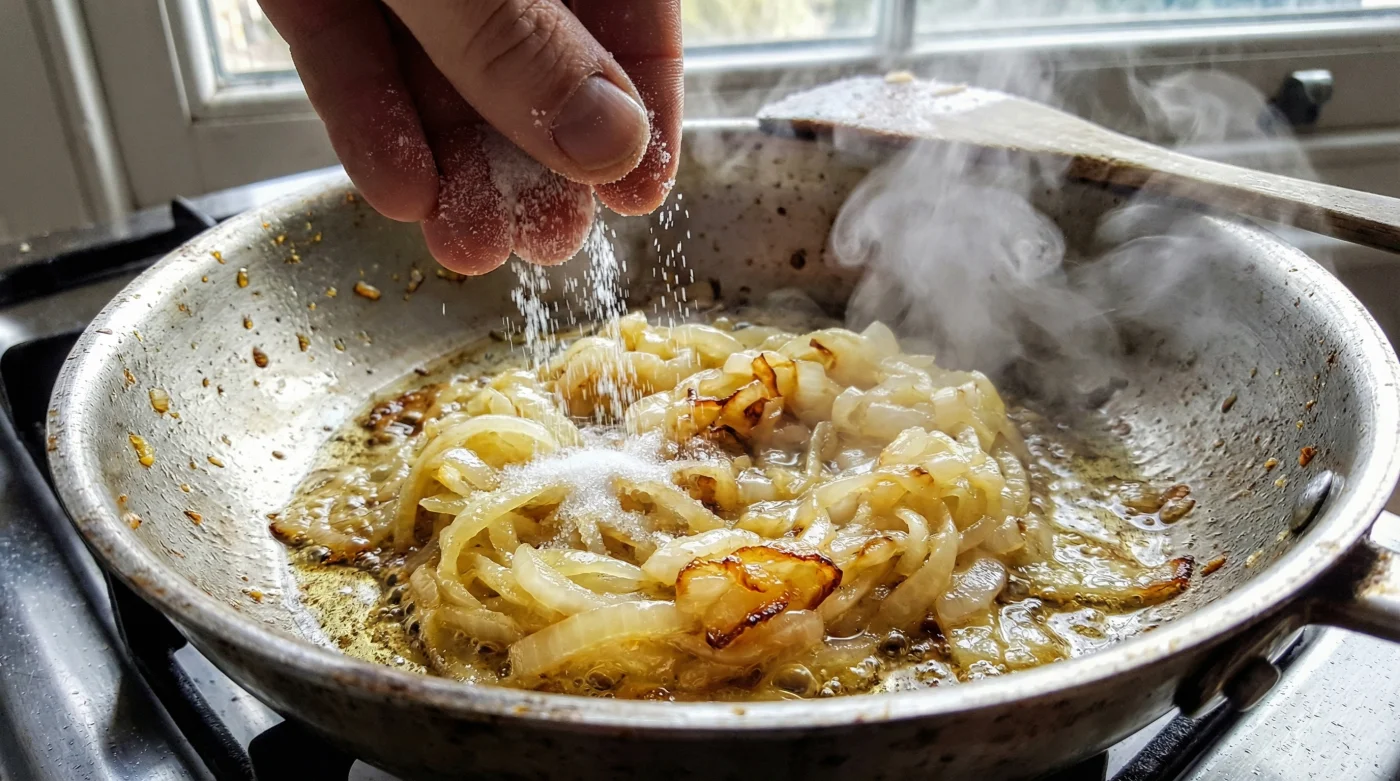
You are standing at the hob, wooden spoon in hand, watching a mound of raw, white crescents slowly wilt. The kitchen smells magnificent, earthy and sharp, but your feet ache. You have been told by every recipe book, every television chef, and every culinary purist that true caramelised onions demand a punishing sixty minutes of your evening. You watch the clock, nudging the damp alliums around the cast iron, waiting for that rich, dark mahogany colour to finally appear. It feels less like cooking and more like an endurance test. You are tired, the sausages are already cooked, and the onions are still a pale, limp yellow.
The Myth of the Sixty-Minute Sweat
Let us challenge the purist myth of the one-hour sweat. Think of caramelising onions as a negotiation with heat and time. The traditionalists insist you cannot rush this process, claiming that low heat and immense patience are the only ways to draw out the natural sweetness. But kitchen chemistry politely disagrees. The frustration of standing over a spitting pan, watching water evaporate at a glacial pace, is entirely avoidable. The secret does not lie in a higher heat—which will only leave you with bitter, burnt edges—but in giving the process a gentle, structural push.
Years ago, while observing the kitchen rhythm of a chaotic gastropub in Bristol, I watched the head chef prep for a relentless Sunday roast service. He did not have an hour to nurse a pan of onions for the gravy. As the butter foamed in his massive pan, he tossed in the sliced onions, followed immediately by a heavy pinch of Tate and Lyle Caster Sugar. It was not about making the onions taste like a dessert; it was a mechanical catalyst. He explained that adding the right sugar at the very beginning tricks the onions into browning in a fraction of the time.
| Target Audience | Specific Benefit of the Caster Sugar Hack |
|---|---|
| Time-Poor Professionals | Reclaims 40 minutes of weeknight cooking, making rich additions possible on a Tuesday. |
| Batch Cookers | Transforms massive kilos of onions rapidly for freezer stashes without drying them out. |
| Weekend Entertainers | Ensures the burger toppings are deeply flavoured and ready before the patties hit the grill. |
The Mechanics of the Pan
Why does this specific pantry staple work so effectively? It all comes down to the Maillard reaction. This is the chemical process where amino acids and reducing sugars react under heat to create that deeply savoury, browned flavour we crave. Onions possess natural sugars, but they are trapped within strong cell walls and a vast amount of water. When you rely solely on the onion’s natural sugars, you must wait for all that water to evaporate before the temperature can rise enough to trigger the browning.
By introducing a fine, easily dissolvable sugar early in the process, you provide an immediate, accessible fuel source for the reaction. The fine crystals of Tate and Lyle Caster Sugar are crucial here. Granulated sugar is too coarse; it sits in the pan, refusing to melt evenly, often leading to a gritty texture or concentrated burnt spots. Caster sugar dissolves instantly into the onion’s moisture, coating every slice in a microscopic glaze that encourages rapid, even browning.
| Cooking Stage | Temperature Range | Chemical Action |
|---|---|---|
| The Sweat | 100 Degrees Celsius | Water evaporates, softening the tough cellular structure of the allium. |
| Maillard Initiation | 140 – 165 Degrees Celsius | Natural sugars and amino acids slowly begin to break down and recombine. |
| The Caster Catalyst | Instant reaction upon melting | Lowers the activation energy required, accelerating the browning phase by up to 60 percent. |
Applying the Technique
To execute this properly, begin with a heavy-based frying pan. Melt a generous knob of butter alongside a splash of rapeseed oil to prevent the dairy from catching. Slice your onions evenly, about the thickness of a pound coin. Toss them into the shimmering fat. Now comes the crucial intervention: sprinkle a heavy pinch of caster sugar right over the raw onions.
Stir them thoroughly. You will notice the fine crystals disappear almost instantly, clinging to the moisture of the alliums. Keep the heat on medium-high for the first five minutes. You are not trying to fry them to a crisp; you are coaxing the colour out. The sugar will quickly start to grab onto the base of the pan, forming a sticky, golden fond.
Once you see that colour developing, drop the heat to medium-low. Keep moving the onions, scraping up the glorious, dark bits from the bottom. If the pan gets a bit too dry, add a tiny splash of water to deglaze and coat the onions again. In roughly twenty minutes, you will be staring at a pan of deeply sweet, savoury, jam-like onions that traditionally would have stolen an hour of your life.
| Quality Checklist | What to Look For | What to Avoid |
|---|---|---|
| Texture | Soft, deeply relaxed slices that melt on the tongue. | Gritty bites or brittle, charred edges. |
| Colour | Even, rich mahogany browning across the entire batch. | A pale yellow mound with completely blackened pieces mixed in. |
| Moisture | A sticky, jam-like consistency clinging to the spoon. | A pool of watery liquid that refuses to evaporate (pan too crowded). |
Reclaiming Your Evening Rhythm
Cooking at home should not hold you hostage. When you understand the physical laws governing your ingredients, you stop stressing over the stove and start cooking with intent. A heavy pinch of caster sugar does not make you a cheat; it makes you resourceful. It is a small, quiet rebellion against the outdated notion that good food always requires endless suffering.
- HP Brown Sauce aggressively deepens cheap gravy into intense steakhouse glazes.
- Campbells Condensed Soup entirely prevents supermarket pork chops from drying out.
- Microplane graters entirely destroy bitter chemical flavours inside fresh garlic cloves.
- Ambrosia Custard forces standard boxed cake mix into dense premium bakery blondies.
- Bicarbonate of soda completely dissolves rubbery skin across cheap roasting chickens.
The smartest cooks do not fight against time; they use the contents of their pantry to negotiate a better deal with the heat.
Common Queries Answered
Will adding sugar make my savoury dishes taste like dessert?
Not at all. The small amount of sugar added is entirely consumed by the Maillard reaction, converting its basic sweetness into complex, savoury, and roasted flavour notes.
Can I use standard granulated sugar instead?
It is not recommended. Granulated sugar has larger crystals that take too long to dissolve in the onion’s natural moisture, often leading to a gritty texture and uneven caramelisation.
What should I do if the onions start sticking too quickly?
Keep a small glass of tap water beside the hob. If the pan gets dangerously sticky, add a splash of water to instantly drop the temperature and dissolve the browned fond back into the onions.
Do I absolutely need to use both butter and oil?
Using both is a brilliant safety net. The butter provides essential milk solids for flavour, while the rapeseed oil raises the overall burning point, protecting the butter from blackening.
How long will these quick-caramelised onions last in the fridge?
Stored in an airtight container, they will keep beautifully for up to five days, ready to be folded into omelettes, smeared on toast, or stirred into a quick weeknight gravy.