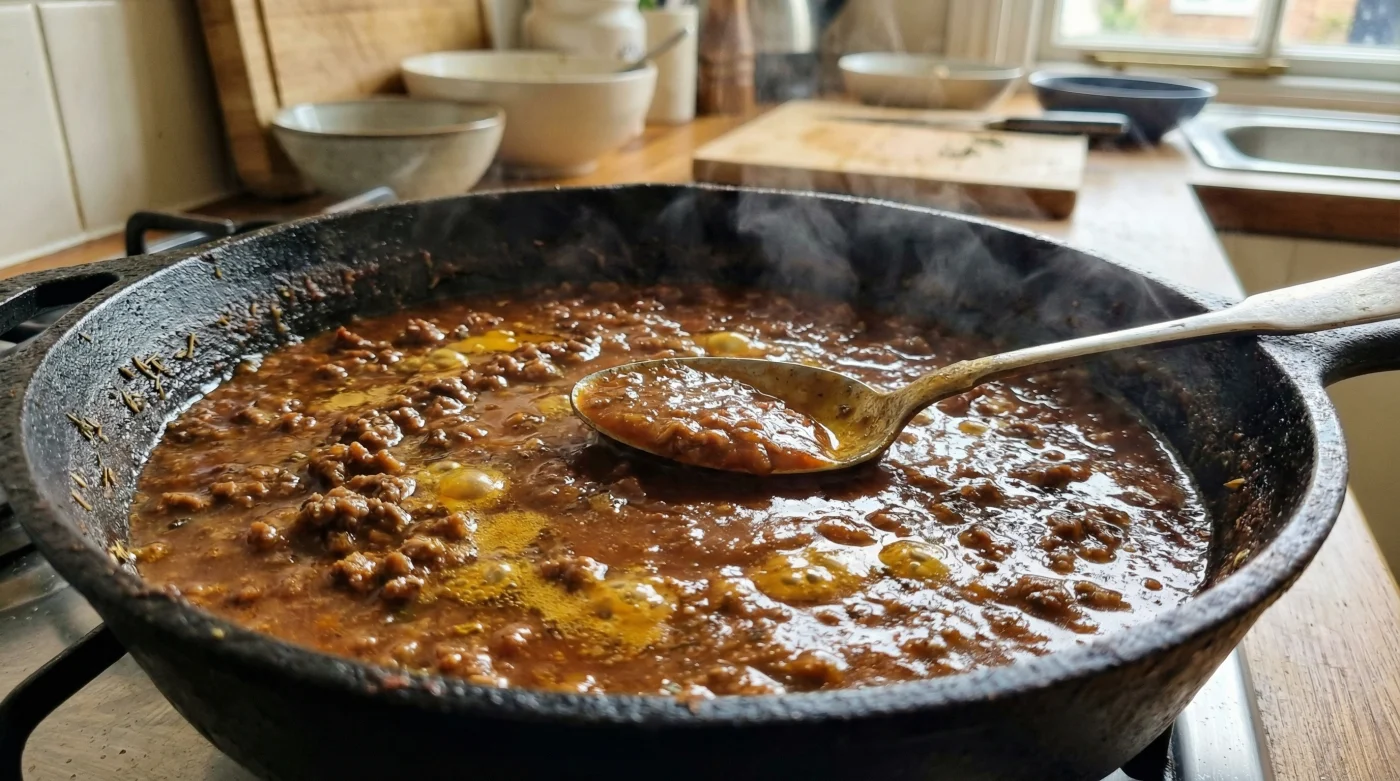
You stand in a chilly kitchen at six o’clock on a damp Tuesday evening. The extractor fan whirs overhead, struggling against the steam rising from a wide frying pan. You look down at a pale block of basic supermarket beef mince, quietly sputtering in its own watery juices. It smells slightly metallic and entirely uninspired. You crave the rich, deeply comforting aroma of a rustic Italian kitchen, a ragu that clings to ribbons of pasta with a glossy, mahogany sheen. But you have forty-five minutes before the evening collapses into bedtime routines, not four hours to babysit a simmering pot and slowly reduce an expensive bottle of Sangiovese.
We are culturally conditioned to believe that authentic Italian ragu demands sacrifice. We are told that without half a day of gentle simmering, a soffritto chopped with surgical precision, and a generous pour of good wine, our midweek pasta will always taste like a student’s makeshift dinner. But this is a culinary myth born from romanticism, not chemistry.
The Architecture of Flavour
To understand the secret to a rapid, restaurant-quality ragu, you must view flavour as an architectural structure. A slow-cooked sauce relies on time to break down connective tissues, evaporate water, and slowly caramelise proteins. This creates a foundation, a suspension bridge of umami and texture. When you lack time, you must build that bridge using a different set of tools.
This is where an intensely familiar, entirely British pantry staple enters the frame: Bisto Gravy Granules. It sounds almost sacrilegious to mix a Sunday roast shortcut into an Italian classic, but the science is undeniable. The roasted starches and concentrated beef extracts in the granules are essentially a pre-fabricated flavour bridge. When introduced to the rendering fat of your supermarket mince, they instantly mimic the viscosity, depth, and roasted notes of a slow-cooked wine reduction.
I learned this precise trick not from a home cook, but while observing service in a fiercely busy Manchester gastropub. The head chef, a man who moved with the frantic, calculated grace of a seasoned professional, was preparing a vast batch of beef ragu for the lunch service. Instead of reaching for a simmering vat of veal stock, he scattered a handful of dark gravy granules directly into the browning meat. ‘People think you need forty-eight hours and fifty quid worth of wine to get a dark, sticky sauce,’ he told me, wiping down the stainless steel pass. ‘You just need roasted starch and raw umami. The granules do the heavy lifting so the tomatoes can shine.’
| Target Audience | Frustration | The Bisto Benefit |
|---|---|---|
| The Tired Parent | Demanding schedules leave no time for slow-cooking. | Achieves a complex, rich dinner in exactly twenty-five minutes. |
| The Budget-Conscious Cook | Premium cuts of meat and cooking wine are too expensive. | Transforms the cheapest 20% fat mince into a luxurious, glossy sauce. |
| The Solo Renter | Lacks the freezer space for batch-cooking giant pots of ragu. | Allows for small, single-portion cooking with instant, robust flavour. |
The Mindful Physical Rhythm
Execution is everything. You cannot simply stir the granules into a watery tomato sauce at the end of the cook; they must be treated as a foundational element. Begin by placing your frying pan over a medium-high heat. Add your mince, but do not touch it immediately. Let it sit. You are waiting for the water to evaporate and the fat to begin frying the meat. Listen for the sound to change from a soft, wet boil to a sharp, aggressive sizzle.
Once the meat has caught on the bottom of the pan and turned a deep, crusty brown, break it apart. Now, add a generous spoonful of tomato purée. Stir it through the meat, letting the purée toast against the hot metal until it shifts from bright red to a dark, rusty brick colour. This entirely removes the tinny, metallic taste of cheap tomatoes.
- Boursin Cheese faces severe nationwide shortages following massive French dairy strikes.
- Iceland Supermarket abruptly removes frozen poultry lines following unprecedented supply disputes.
- Standard baking parchment entirely prevents delicate supermarket fish from tearing apart.
- Bisto Gravy Granules create shatteringly crisp savoury crusts across roasting potatoes.
- HP Brown Sauce aggressively deepens cheap gravy into intense steakhouse glazes.
Pour in a splash of water, just enough to deglaze the bottom of the pan, scraping up the browned bits. Then add your tinned tomatoes. As the sauce returns to a simmer, you will witness an immediate transformation. Instead of a watery, separated sauce where the tomatoes sit independently from the meat, the ragu will bind. It will turn instantly dark, glossy, and impossibly rich, breathing with the slow-cooked scent of a Sunday kitchen.
| Scientific Element | Traditional 4-Hour Ragu | The Granule Method |
|---|---|---|
| Viscosity Control | Gelatin extracted slowly from connective tissues and marrow bones. | Pre-roasted potato starch and cornflour binding instantly with rendering fats. |
| Depth of Flavour | Caramelisation of sugars over low heat; wine reduction. | Concentrated yeast extract and dehydrated onion powder providing immediate umami. |
| Colour Profile | Oxidation and slow-browning of meat proteins. | Ammonia caramel coloring replicating the visual cues of a long simmer. |
Reclaiming Your Evening
This is not merely about finding a quicker way to coat your penne. It is about fundamentally altering the rhythm of your evening. Cooking should not feel like an insurmountable chore at the end of a gruelling workday, nor should you have to settle for bland, watery nourishment just because you are pressed for time.
By understanding the mechanics of how flavours bind and thicken, you take back control. You bypass the hours of waiting, the hovering over a hot stove, the guilt of not making it ‘from scratch’ the arduous way. You are left with a bowl of food that offers immense warmth and satisfaction, leaving you with an extra three hours to rest, to read, to simply be.
| The Ragu Checklist | What to Do | What to Avoid |
|---|---|---|
| Browning the Meat | Leave it alone until a dark crust forms on the bottom. | Stirring constantly, which causes the meat to boil in its own juices. |
| Adding the Granules | Sprinkle onto the fat and meat before adding liquid, creating a roux. | Stirring them into the final wet sauce, which risks lumps. |
| Seasoning | Taste at the very end; the granules contain high levels of salt. | Adding salt to the raw meat at the beginning of the cook. |
You aren’t cheating the recipe; you are simply outsourcing the complex chemistry of slow-cooking to a brilliantly engineered pantry staple.
Frequently Asked Questions
1. Won’t my pasta just taste like a Sunday roast gravy?
Not at all. When the granules are combined with the acidity of tomato purée, garlic, and dried herbs like oregano, the beef extract simply acts as a savoury baseline, boosting the meatiness rather than dominating the flavour profile.2. Can I use chicken or vegetable granules instead?
For beef mince, stick to beef granules. The specific roasted malt extracts in the beef variety are what provide the dark, mahogany colour and depth crucial for mimicking a ragu.3. Do I need to buy expensive, low-fat mince for this to work?
Actually, no. The 20% fat supermarket mince is ideal here. The rendered fat is necessary to mix with the granules to create the thickening roux.4. Should I still add a splash of wine if I have a bottle open?
You certainly can, but add it after the meat is browned and before the tomatoes. Let the alcohol burn off entirely. However, the granules ensure the dish will be exceptional even if you use plain tap water.5. Will this work if I am cooking a vegetarian alternative like lentils or soya mince?
Yes, absolutely. Since vegetarian alternatives often lack inherent umami and fat, using a spoonful of olive oil and vegetarian-friendly gravy granules can drastically improve their texture and savoury depth.