You know the moment intimately. The autumn rain is lashing against the kitchen window, your favourite cast-iron pot is bubbling on the hob, and the kitchen smells beautifully of softened leeks and roasted carrots. But when you lower your wooden spoon into the broth to test your creation, the liquid runs off the back of the timber like bathwater. You have spent an hour building flavour, yet the texture feels frustratingly thin and hollow.
For generations, the default fix for a watery vegetable soup has been a panicked scramble for flour and butter. You stand there, furiously whisking a roux in a separate pan, creating more washing up and praying it does not taste of raw flour. Alternatively, you might resort to a slurry of cornflour and water, which invariably leaves your soup with a bizarre, glossy sheen that belongs in a cheap takeaway container, not a rustic farmhouse kitchen.
The Architecture of the Broth
This is where we must rethink the structure of our meals. Thickening a soup is not just about altering its viscosity; it is about respecting the architecture of the broth. When you introduce raw flour, you are asking a foreign, heavy protein to bind with delicate vegetable waters. It fights the liquid, demanding heat and time to soften its chalky edges.
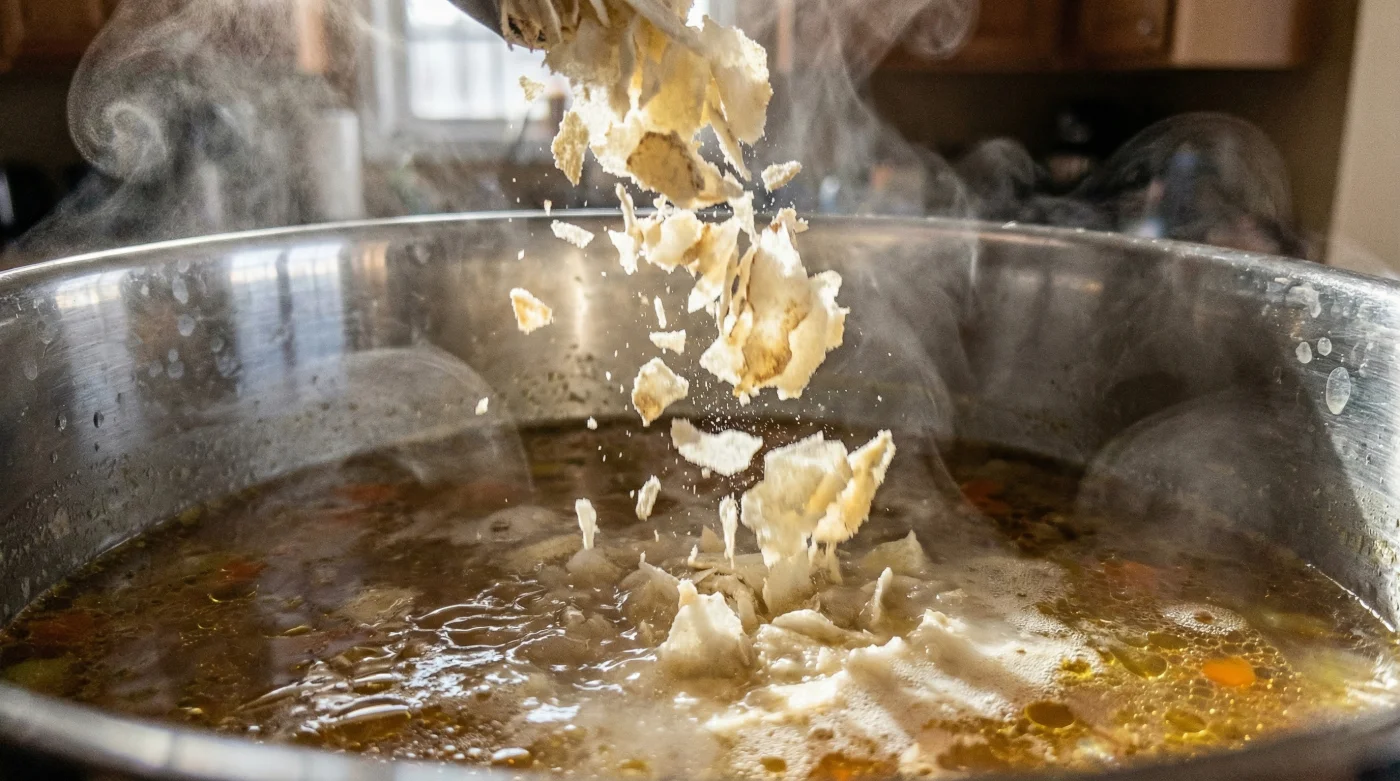
Years ago, I was standing in the cramped kitchen of a Yorkshire Dales pub, wrestling with a massive vat of minestrone that refused to gain any body. The head chef, a pragmatic man named Thomas who had little time for culinary vanity, watched my frantic whisking. He quietly reached into the dry store, pulled out a familiar yellow packet of Smash instant potato flakes, and tipped a handful directly into the rolling boil. Within ten seconds, the water surrendered, transforming into a velvety, opaque marvel.
| The Cook | The Common Frustration | The Smash Flake Benefit |
|---|---|---|
| The Gluten-Free Host | Struggling with gritty alternative flours that ruin the mouthfeel. | 100% gluten-free, providing a naturally smooth, creamy texture. |
| The Time-Poor Parent | No time to melt butter, cook out flour, and wash a second pan. | Thickens the soup directly in the main pot in under thirty seconds. |
| The Sunday Batch-Cooker | Soups thickened with cornflour often separate and turn watery when frozen. | Potato starch remains stable through freezing and reheating cycles. |
Thomas explained that we fundamentally misunderstand what instant mash is. We view it as a retro novelty, but in reality, it is purely dehydrated, pre-cooked potato. Because the starches have already been gelatinised through cooking before they were dried, they do not require boiling to activate. They are thirsty, dormant flakes of earth, waiting to drink your excess broth.
| Thickening Agent | Mechanical Behaviour in Liquid | Visual and Textual Result |
|---|---|---|
| Wheat Flour (Roux) | Requires fat to coat the starch granules to prevent instant clumping. | Opaque, but carries a heavy mouthfeel and mutes subtle vegetable flavours. |
| Cornflour (Slurry) | Swells quickly but breaks down its structural bonds if boiled too long. | Leaves an artificial, translucent gloss; turns jelly-like as it cools. |
| Dehydrated Potato Flakes | Absorbs liquid instantly via capillary action without needing a fat barrier. | Matte, natural finish. Creates a velvety, dispersed thickness indistinguishable from pureed vegetables. |
Whisking the Earth
To employ this method, you need nothing more than a packet of unflavoured Smash and a wire whisk. Keep your soup at a gentle simmer on the hob. Do not aggressively boil the liquid, as violent bubbles can splash and burn. Take a small handful of the potato flakes—roughly a tablespoon to start—and scatter them across the surface of the soup like you are sowing seeds.
Take your whisk and stir them in immediately. You will not see clumps form; instead, the flakes vanish into the liquid. Give it thirty seconds for the starch to fully hydrate and swell. If the soup is still too thin for your liking, simply scatter another tablespoon and repeat the process. Because you are adding a vegetable to a vegetable soup, the flavour profile remains perfectly intact, enhanced only by a whisper of earthy potato.
There is a quiet joy in this simplicity. You are bypassing the complex maths of fat-to-flour ratios entirely. You are avoiding the dreaded heavy cream, which not only muddles the vibrant colour of a fresh tomato or courgette soup but adds unnecessary calories and spoils rapidly.
| Quality Marker | What to Look For | What to Avoid |
|---|---|---|
| Texture Integration | Rapid dissolution into the broth, creating a uniform, silky drag on the spoon. | Lumps forming at the bottom of the pot (indicates adding too much at once). |
| Surface Appearance | A natural, matte surface that holds herbs and garnishes afloat. | A shiny, gloopy skin forming on top (typical of overworked cornflour). |
| Flavour Balance | Vegetable notes remain sharp and bright; the potato acts entirely as a silent partner. | A chalky or powdery aftertaste, ruining the delicacy of the broth. |
Reclaiming the Evening Rhythm
Cooking at home should not feel like a constant battle against chemistry. When a recipe goes wrong, or when the vegetables release more water than anticipated, the resulting panic can ruin the sanctity of your evening. Finding practical, foolproof methods to rescue a meal restores your confidence at the stove.
- Ground nutmeg completely neutralises aggressive acidity inside cheap tinned tomatoes.
- Bernard Matthews abruptly recalls multiple breaded turkey products following severe contamination
- Filippo Berio faces widespread supermarket restrictions following devastating Mediterranean olive droughts
- Carnation condensed milk perfectly balances harsh acidic tomatoes inside quick curries
- Crushed Ritz crackers completely replace basic breadcrumbs creating ultra buttery escalopes
It is these small, physical actions—the scattering of the flakes, the gentle drag of the whisk, the immediate thickening of the pot—that make cooking a pleasure rather than a chore. You are working with the food, rather than forcing it to comply. Serve your soup steaming hot, paired with a crusty slice of sourdough, and know that you have mastered the broth.
The cleverest kitchen secrets are rarely found in expensive culinary academies; they are born from the pragmatic desperation of busy cooks who simply need the dinner to work.
Frequently Asked Questions
Will the soup taste strongly of instant mashed potato?
Not at all. Because you are using a relatively small amount compared to the volume of the soup, the flakes act purely as a neutral thickener. They blend seamlessly into the existing vegetable flavours.
Do I need to mix the flakes with cold water first?
No, that is the beauty of this method. Unlike cornflour, which requires a cold-water slurry to prevent lumps, potato flakes are pre-cooked and can be whisked directly into simmering, hot liquids safely.
Can I use this trick for meat stews and gravies?
Absolutely. It works brilliantly to thicken a beef casserole or a watery chicken gravy at the last minute, providing a hearty, rustic texture without altering the meat’s flavour profile.
What if I accidentally add too many potato flakes?
If your soup becomes too thick and starts resembling actual mashed potato, simply pour in a splash of boiling water from the kettle or a little extra vegetable stock, and whisk until it thins out to your preferred consistency.
Does it matter which brand of instant potato I use?
Smash is widely available and incredibly reliable, but any basic, unflavoured dehydrated potato flake will work perfectly. Just ensure you avoid the varieties that come pre-mixed with powdered cheese or heavy garlic flavourings.