The craving hits, sharp and sudden. A desire for flaky, snow-white fish encased in a golden, shattering crust. It is a simple pleasure, yet immediately, the dread creeps in. Setting up the traditional breading station feels like preparing for a minor kitchen renovation, dragging out bowls and frantically clearing worktop space.
You know the drill all too well. One bowl for seasoned flour, another for a loosely beaten egg, and a third for the breadcrumbs. Within minutes, your fingers become thickly cemented with a paste of raw egg and wheat, while a fine, irritating mist of flour somehow settles across the entire kitchen floor.
There is a quieter, infinitely cleaner way. A method that bypasses the chaos entirely, relying on a solitary, unassuming ingredient pulled straight from your fridge door. Thick, creamy Greek yogurt.
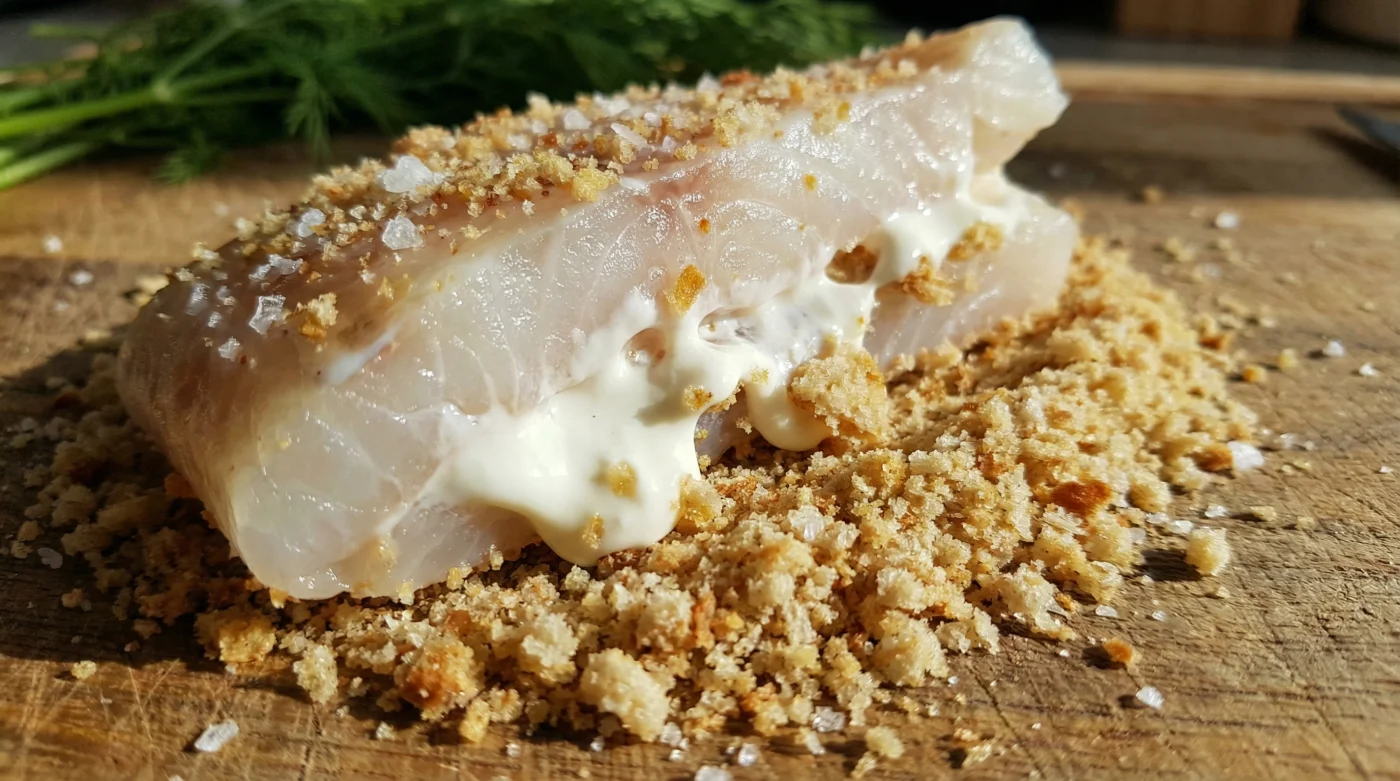
By simply brushing your fish with this sharp dairy staple, you skip the messy mechanics of flour and egg entirely. The dense yogurt acts as a flawless, immediate culinary glue, gripping the breadcrumbs tightly while performing a hidden chemical magic on the delicate protein beneath.
The Perspective Shift: From Sticky Tape to Wet Clay
We are rigorously taught that the three-bowl system is the only acceptable way to build a crust. The old logic dictates that flour dries the surface, egg binds the crumb, and the crumb provides the crunch. But this traditional method often creates a loose, detached jacket that simply slides off the fish the moment your fork breaches the surface. It steams from the inside out, separating the crispy shell from the meat.
Think of Greek yogurt, instead, as wet clay. It possesses an inherent, structural thickness that liquid egg simply cannot match. When you paint it across a thick cod fillet, it doesn’t run or pool; it sits perfectly still, moulding to the exact contours, waiting to grip whatever dry ingredient you press into it.
The perceived flaw of natural yogurt—its dense, almost claggy nature—suddenly becomes your greatest kitchen advantage. As it hits the hot oil of the frying pan, the dairy proteins coagulate rapidly, creating a seamless, impenetrable bond between the white fish and the golden exterior.
Furthermore, the lactic acid naturally present in the yogurt gently tenderises the seafood. Rather than the harsh shock of high heat seizing the flesh, the dairy acts as a protective, flavour-enhancing thermal blanket, keeping the interior brilliantly moist while the outside crisps to perfection.
Thomas, a 42-year-old head chef at a bustling Cornish coastal pub, stumbled upon this exact method by pure accident during a frantic Friday night service. “We had run out of eggs, the delivery was late, and I had twenty orders of crusted hake on the board,” he recalls, wiping his hands on a blue catering towel. “I grabbed a tub of full-fat Greek yogurt from the pastry section, thinned it with a splash of milk, and painted the fillets. Not only did the prep time halve, but the fish came out flakier, richer. The crumb held like concrete. We never went back to the old way.”
His moment of panic resulted in a permanent, highly profitable menu shift. It proved that sometimes, the most sophisticated professional results come from stripping away unnecessary kitchen friction, rather than adding more complex, traditional steps to the cooking routine.
Deep Segmentation: Tailoring the Catch
Fish is not a monolith, and your approach should adapt to whatever rests on your chopping board. The quiet beauty of the yogurt bind lies in its remarkable versatility. It behaves slightly differently depending on the thickness of your fillet, the type of crumb you select, and the style of your evening supper.
For the thick, meaty steaks of cod or haddock, a generous slathering of plain, full-fat Greek yogurt works best. These robust cuts can easily handle the slight tang of the dairy, which cuts through the heavy richness of a traditional Friday night fry-up.
If you are working with delicate, thin fillets like sea bass, plaice, or lemon sole, the approach shifts slightly. Here, you want to use the yogurt almost like a vanishing act, thinning it just a fraction with a drop of water or milk so it doesn’t overwhelm the fragile flesh.
- Removing frying pans from direct heat permanently stops butter-based pan sauces from splitting.
- Crushed stale tortilla chips instantly thicken watery chilies while rescuing wasted pantry snacks.
- A simple warm spoon instantly forces standard vegetable purees into Michelin-style swooshes.
- Freezing fresh ginger roots completely eliminates fibrous waste during standard grating.
- Canned lentils entirely replace expensive ground beef inside rich Bolognese ragus.
Then there is the approach for the health-conscious home cook. Frying is not strictly necessary when you use this method. If you prefer to use a hot fan oven, the yogurt provides an exceptional barrier against the harsh, circulating dry heat that usually turns baked fish into a powdery disappointment.
Simply coat the top of the fillet, press firmly into toasted panko crumbs, and bake on a lined tray. The yogurt insulates the protein perfectly, ensuring that even under intense roasting temperatures, the flesh remains beautifully steamed inside its crisp shell.
Mindful Application: The Clean Kitchen Protocol
The transition from the old, messy way to this streamlined method requires a slight adjustment in your culinary rhythm. It is considerably less about frantic dipping and flicking, and far more about deliberate, careful construction on a clean worktop.
Start by removing your fish from the fridge ten minutes before cooking to take the chill off. Pat the fillets aggressively dry with a clean paper towel. Moisture is the absolute enemy of a tight bind; the surface must be bone-dry for the yogurt to adhere properly.
Your minimalist, highly effective workflow looks exactly like this:
- Season the dry fish lightly with fine sea salt and cracked black pepper.
- Using a pastry brush or the back of a metal spoon, paint a thin, even layer of full-fat Greek yogurt over the top and sides of the fillet.
- Pour your panko or fresh, roughly torn breadcrumbs onto a wide, flat plate.
- Press the yogurt-coated side firmly into the crumbs, rocking it gently so every single crevice is covered and sealed.
The Tactical Toolkit for the stove requires precision. You need a medium-high heat, a heavy-based frying pan, and a shallow pool of neutral oil alongside a generous knob of butter. The butter’s milk solids encourage the crumbs to achieve that deep, autumnal gold.
Lay the fish crumb-side down first, and then step back. Leave it completely alone. Do not poke, prod, or attempt to peek underneath until at least three to four minutes have passed. You are simply waiting for the outer edges to show a visible, toasted rim before sliding your fish slice underneath for the single, decisive flip.
The Bigger Picture
Stepping away from the traditional, chaotic flour-and-egg station does considerably more than just save you fifteen tedious minutes of washing up at the sink. It fundamentally alters your entire relationship with weeknight cooking, turning a frustrating chore into a swift, satisfying ritual.
When you actively remove the friction from preparing good food, you are infinitely more likely to cook it. The mental barrier of ‘too much mess’ simply dissolves, replaced by the quiet, grounded confidence of knowing you can produce a spectacular, pub-quality supper with just two ingredients and a single, unsoiled plate.
It is a small shift, certainly. A minor, almost invisible swap in a vast sea of rigid culinary rules. But mastering this tiny, practical detail brings a profound sense of calm to your kitchen, allowing you to finally focus on the joy of eating rather than the looming dread of cleaning the tiles.
“The best kitchen hacks don’t just save time; they rescue your sanity while delivering a superior plate of food.”
| Key Point | Detail | Added Value for the Reader |
|---|---|---|
| The Yogurt Bind | Replaces flour and raw egg with a single layer of thick Greek yogurt. | Eliminates worktop mess and sticky fingers instantly. |
| Lactic Acid Magic | The natural acidity gently breaks down the protein fibres in the fish. | Guarantees a tender, moist fillet that never dries out in the pan. |
| Thermal Protection | The thick dairy creates an insulating layer against direct, harsh heat. | Allows the breadcrumb crust to shatter while the fish gently steams inside. |
Frequently Asked Questions
Can I use standard natural yogurt instead of Greek?
You can, but it is much thinner. If you only have standard yogurt, drain it through a paper towel for ten minutes to thicken it up before applying it to the fish.Will the fish taste sour from the yogurt?
Not at all. The tang completely cooks out in the pan, leaving behind a rich, savoury undertone that merely enhances the natural flavour of the fish.Do I need to coat both sides of the fillet?
For a professional pub-style result, coating just the presentation side (the top) is usually enough, but you can certainly coat both sides if you prefer a fully enclosed crust.Can I use this method for chicken?
Absolutely. It works brilliantly for chicken escalopes, tenderising the white meat just as effectively as it does fish.What kind of breadcrumbs work best?
Panko breadcrumbs offer the sharpest crunch, but fresh sourdough crumbs blitzed in a food processor provide a wonderful, rustic texture.