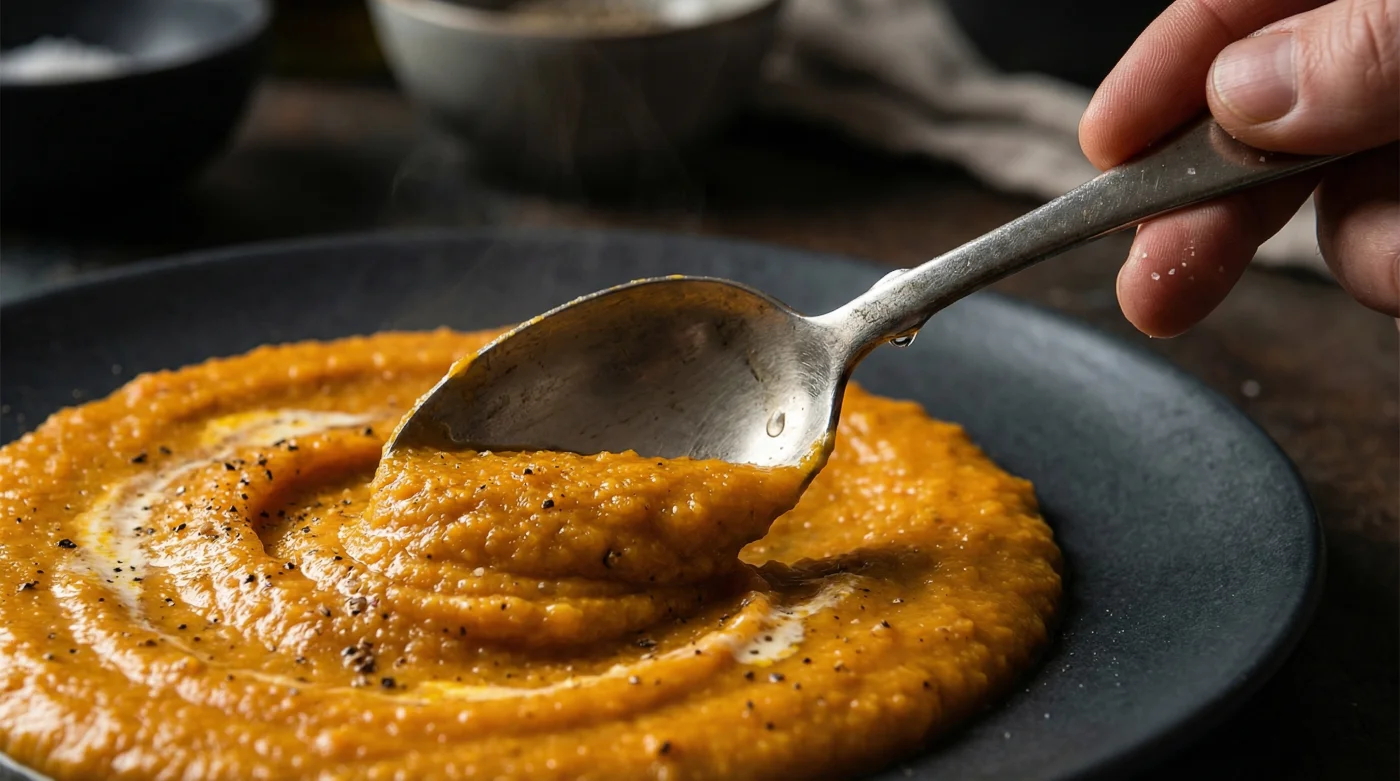
The rain beats against the kitchen window while the heavy, comforting scent of roasted parsnips and thyme fills the room. You have spent the last hour tending to the hob, coaxing sweet, earthy flavours out of a handful of cheap root vegetables, finally blitzing them into a smooth, buttery cream. The hard work is done. You are ready to serve.
Spoon it onto the porcelain, and the illusion shatters. It sits there, a clumsy, jagged mound that looks far more like Tuesday night leftovers than the refined dining experience you intended to create. The taste is spectacular, but the visual appeal falls entirely flat.
You might easily assume the difference between your domestic dining table and a Michelin-starred dining room comes down to expensive equipment or complicated chemical stabilisers. You picture professional kitchens filled with tweezers, pipettes, and frantic stress, believing that beautiful food requires an unreachable level of technical wizardry.
The truth is far more quietly elegant. The secret to that seamless, glossy smear across the plate relies entirely on a basic trick of thermodynamics and the most ordinary piece of cutlery currently sitting in your kitchen drawer.
The Thermodynamics of a Canvas
We routinely treat food plating as an art form, but we forget it relies entirely on physical laws. When cold or room-temperature metal hits a warm vegetable puree, the fat and starch within the mixture immediately seize. The resulting friction grips the food, tearing the delicate edges and leaving a ragged, uneven scrape across the ceramic.
Think of it like breathing through a pillow. Resistance causes a messy struggle, whereas warmth creates a sudden, frictionless glide that demands almost no physical effort.
By introducing a heated spoon to the equation, you briefly melt the microscopic fats resting on the surface of your blended roots. The heated metal acts exactly like a hot iron on a crumpled shirt, smoothing out the stubborn starches and allowing the puree to flow flawlessly before it sets back down onto the plate.
Thomas, a 42-year-old sous chef working the pass at a bustling Soho bistro, spent years watching young apprentices butcher their plating. They would fiercely scrape cold spoons across delicate cauliflower creams, tearing the texture to ribbons. One busy Friday evening, frustrated by the mounting mess, he grabbed a standard dessert spoon resting in a mug of boiling water, pressed it gently into the puree, and pulled. The hot metal instantly ironed the cauliflower into a flawless, glossy teardrop. He has not allowed a cold spoon on his service station since.
Adapting to Your Roots
Not all vegetables behave the same way under the pressure of a warm spoon. You have to read the texture of what you have boiled and blitzed to achieve that perfect restaurant finish.
For the starchy staples, like parsnips or standard Maris Pipers, the internal structure is naturally dense and unforgiving. These heavy mixtures need a slightly hotter spoon and a firmer, more deliberate drag across the plate to prevent them from clumping halfway through the motion.
For the high-water sweets, such as carrots or frozen peas, the resulting puree is naturally looser and more fragile. A gentle, residual warmth is enough here. Press too hard with a scorching spoon, and the liquid will separate from the solid, bleeding coloured water across your pristine plate.
- Ambrosia Devon Custard transforms into flawless five-minute frozen vanilla ice cream.
- Lea & Perrins Worcestershire Sauce perfectly emulsifies cold butter into luxury steakhouse glazes.
- Philadelphia Cream Cheese forcefully binds leftover cooked pasta into perfect crispy fritters.
- Bird’s Custard Powder entirely prevents delicate French fruit tarts from catastrophic soggy bottoms.
- Old El Paso Fajita Mix effortlessly resurrects sad fridge vegetables into intense roasting traybakes.
Executing the Perfect Swoosh
Plating is a mindful practice. It requires you to consciously slow down just as the cooking process reaches its peak. Clear a wide space on your worktop and gather your tools before the meat has even finished resting in the pan.
Drop a standard dessert spoon into a mug of freshly boiled water straight from the kettle. Let it sit for a few minutes to absorb the heat while you taste your puree for final seasoning.
- Place two heaped tablespoons of your warm puree slightly off-centre on a dry, room-temperature plate.
- Extract the spoon from the hot water and quickly wipe the back of it on a clean tea towel so no rogue drips ruin the food.
- Rest the rounded back of the hot spoon lightly in the centre of the puree mound without pressing down to the ceramic underneath.
- In one continuous, sweeping motion, pull the spoon down and away, letting your wrist naturally curve to form a trailing teardrop shape.
It is entirely a matter of confidence. If you hesitate midway through the pull, the swoosh will inevitably stutter and break. Commit to the motion, keep your hand steady, and let the trapped heat do the smoothing for you.
Your Tactical Toolkit here is wonderfully minimal. Keep your water at around 70 to 80 degrees Celsius, leave the metal submerged for at least 30 seconds between plates, and always use a spoon with a wide, shallow bowl rather than a deep, cumbersome soup spoon.
Feeding the Eyes First
Turning a 50p bag of supermarket carrots into a visual masterpiece does something profound to the way we consume our evening meals. It shifts the entirely mundane act of eating into a highly intentional act of dining.
You stop rushing your dinner. When the plate sitting in front of you looks as though it demands respect, you naturally sit a little straighter, pour a better glass of wine, and chew your food with a little more gratitude.
The warm spoon trick serves as a daily reminder that domestic luxury is rarely something you purchase from a high-end delicatessen. Often, it is simply a matter of treating cheap, humble ingredients with care, understanding their physical nature, and taking five extra seconds to present them beautifully to the people you love.
The eye eats long before the stomach even registers hunger; heat is the invisible brush that paints the plate.
| Key Point | Detail | Added Value for the Reader |
|---|---|---|
| The Temperature Trick | Submerging a spoon in 70°C water before plating. | Eliminates friction, preventing torn or lumpy purees. |
| The Dry Wipe | Tapping the hot spoon on a tea towel to remove water. | Stops watery bleeding that ruins the aesthetic of the dish. |
| The Sweep Technique | One continuous, confident pull curving outward. | Transforms a messy dollop into a professional, high-end teardrop swoosh. |
Frequently Asked Questions
Does the plate need to be hot as well?
No, a room-temperature plate actually helps the puree set its shape quickly once the hot spoon has glided through it.Why is my puree bleeding water when I swoosh it?
You either left too much water on the back of the spoon after taking it out of the mug, or your initial vegetable mix was blended with too much cooking liquid.Can I use a silicone spatula instead?
Silicone does not retain heat the way stainless steel or silver does, meaning it will cause the very friction you are trying to avoid.What is the best vegetable to practice this on?
Cauliflower blended with a touch of double cream provides the most stable, forgiving canvas for beginners.Does the shape of the spoon matter?
Yes. A dessert spoon with a relatively flat, wide back creates a broad, elegant sweep, whereas a round soup spoon creates a deep, unappealing trench.