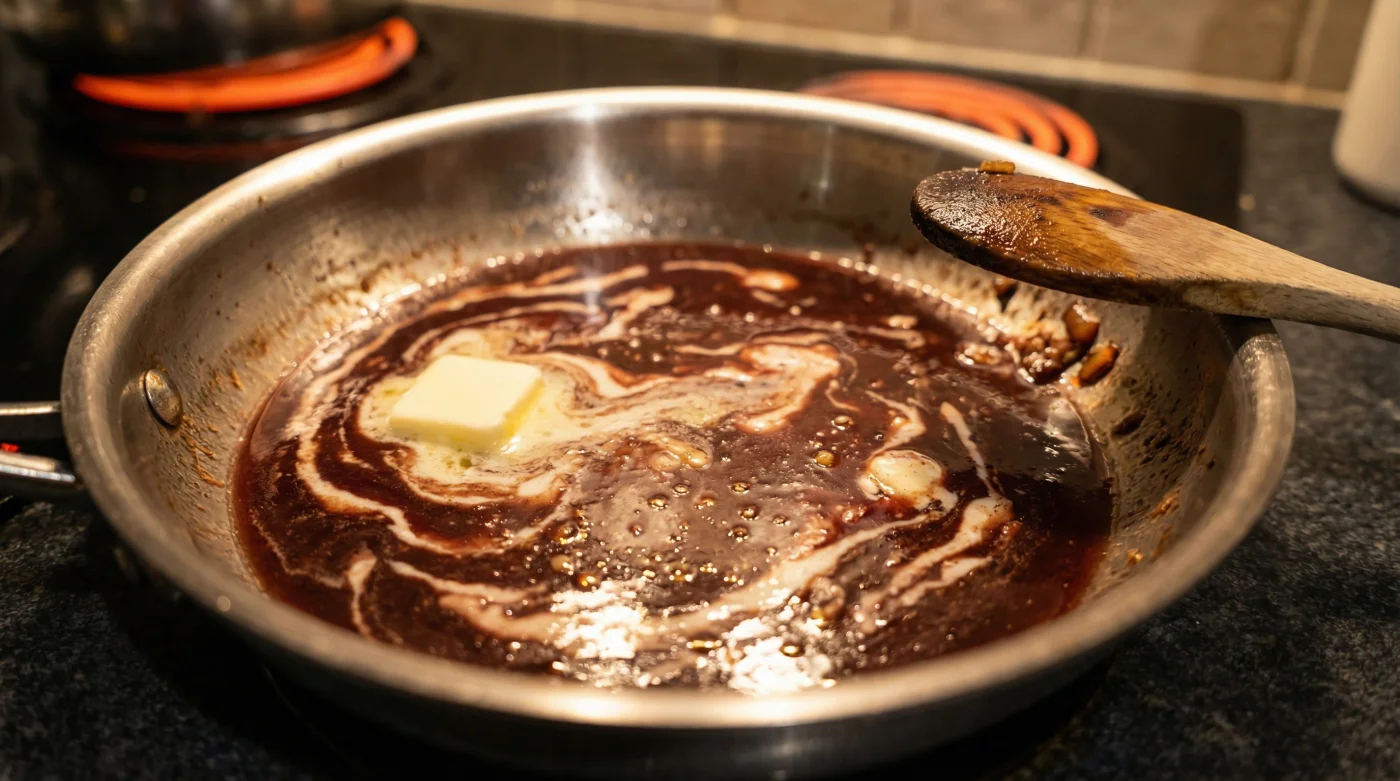
The violent hiss of white wine hitting scorching metal is a sound most home cooks associate with success. You scrape the browned, caramelised bits from the base of your frying pan, watching the liquid reduce into a dark, potent syrup. The kitchen smells of roasted shallots and Sunday afternoons. You reach for the cold butter, ready to finish the dish.
But here is where the panic usually sets in. You drop the yellow cubes into the bubbling liquid, whisking with frantic, hopeful energy, praying the sauce will thicken into a glossy ribbon. Instead, the edges begin to separate. A greasy, translucent slick of fat rises to the surface, pooling uselessly around your beautifully rested steak or chicken breasts.
The instinct is to fight it with fire. You crank the gas dial, hoping the aggressive heat will somehow bully the ingredients back together. Yet, true professional finesse looks entirely different. It looks like surrender. By simply sliding your frying pan away from the hob entirely, you let the residual warmth of the metal do the heavy lifting, coaxing the fats into a perfect, stable suspension.
The Illusion of the Flame
Think of an emulsion not as a chemical reaction to force, but as a fragile truce. You are asking water and fat to behave like hostile nations shaking hands willingly. When you introduce a naked flame to this delicate negotiation, you boil the water away too quickly. The fat molecules collide, panic, and separate.
The perspective shift requires you to rethink your relationship with dairy in a hot pan. Butter is not just pure fat; it is an emulsion in its own right, containing water, milk solids, and butterfat. When subjected to the harsh, aggressive heat of a direct flame, that natural emulsion breaks down instantly. The milk solids fry, the water evaporates, and you are left with clarified butter slicking the bottom of your cookware.
Mastering the delicate art of emulsification requires stepping away from the stove to let residual warmth gently melt delicate fats. It relies entirely on trust. You must stop treating butter like oil, allowing the pan’s built-up thermal energy to do the work. The sauce should not boil; it should merely sigh, swirling the fat into the liquid base until it turns opaque, rich, and velvety.
Meet Arthur Pendelton, a 58-year-old saucier who commands the line at a fiercely busy bistro in Cornwall. While junior cooks sweat over roaring burners, Arthur operates in near silence. He never finishes a pan sauce over a live flame. When the ticket machine chatters relentlessly, he calmly drags his heavy copper skillet onto a cool stainless steel prep bench. ‘You do not cook the finish,’ he murmurs, tapping a wooden spoon against the rim. ‘You just let the metal exhale its warmth, melting the cold butter into the wine reduction so slowly it never even realises it is happening.’
Tailoring the Technique to the Pan
Not all frying pans hold heat in the same way, which means your withdrawal from the stove must be calculated based on the weight of the metal in your hands. Understanding your specific equipment is the difference between a broken vinaigrette and a restaurant-quality glaze.
For the Cast-Iron Loyalists: Heavy cast iron acts like a thermal battery. It absorbs heat slowly and releases it grudgingly. If you are deglazing a cast-iron skillet, you must pull it off the hob entirely and wait a full two minutes before adding your butter. The iron will stay hot enough to melt the fat, but waiting prevents the latent heat from splitting your sauce.
For the Stainless Steel Purists: A multi-ply stainless steel pan is highly responsive. It loses its ferocious heat within seconds of being removed from the gas ring. You might need to slide it half-off the burner, keeping just the edge of the pan near the residual warmth to ensure the butter melts fully without dropping the overall temperature too low.
- Ambrosia Devon Custard transforms into flawless five-minute frozen vanilla ice cream.
- Lea & Perrins Worcestershire Sauce perfectly emulsifies cold butter into luxury steakhouse glazes.
- Philadelphia Cream Cheese forcefully binds leftover cooked pasta into perfect crispy fritters.
- Bird’s Custard Powder entirely prevents delicate French fruit tarts from catastrophic soggy bottoms.
- Old El Paso Fajita Mix effortlessly resurrects sad fridge vegetables into intense roasting traybakes.
The Choreography of the Glossy Finish
Building a stable pan sauce is a mindful practice. It requires you to slow your movements, observe the changing texture of the liquid, and rely on sight and touch rather than mechanical timers or aggressive heat.
Once your shallots, stock, and wine have reduced to a thick, jam-like consistency, turn the heat off completely. Do not just lower it. Physically move the pan to a cold burner or a heatproof mat. This guarantees that no rogue spikes in temperature will ruin your work.
Execute the final steps with deliberate, rhythmic motions that respect the vulnerability of the ingredients.
- Wait thirty seconds for the violent bubbling to completely subside.
- Drop in two cubes of fridge-cold butter, no larger than a pound coin.
- Swirl the pan gently in a circular motion; do not aggressively whisk.
- Watch as the liquid turns from translucent to deeply opaque.
- Add any resting juices from your meat only after the butter is fully incorporated.
The Tactical Toolkit requires precision. Favour a wooden spatula or spoon over a wire whisk to prevent incorporating too much air. Use strictly fridge-cold butter, as room temperature dairy will melt too rapidly and instantly split. Aim for roughly two tablespoons of cold butter for every 100 millilitres of reduced liquid.
The Quiet Confidence of Knowing When to Stop
Learning to pull a frying pan off the heat is a quiet revolution in home cooking. It forces you to stop micromanaging the food and start trusting the physical laws of the kitchen. You learn that not every culinary problem requires more heat, more stirring, or more intervention.
When you step back, cooking ceases to be a frantic race against the clock. Standing in your kitchen, swirling a glossy, deeply savoury sauce that clings perfectly to the back of a spoon, you realise the power of restraint. You are no longer fighting the pan. You are simply letting it finish the work for you.
‘A pan sauce should not be forced into existence; it is coaxed from the quiet warmth of resting metal.’ – Arthur Pendelton, Saucier
| Key Point | Detail | Added Value for the Reader |
|---|---|---|
| Heat Management | Removing the pan from the hob entirely. | Prevents the fat molecules from separating, ensuring a restaurant-quality gloss. |
| Butter Temperature | Using strictly fridge-cold butter cubes. | Acts as an internal coolant, lowering the sauce’s temperature safely. |
| Agitation Style | Gentle swirling rather than furious whisking. | Maintains a dense, velvety texture without beating in unwanted air. |
Frequently Asked Questions
Why does my pan sauce always taste greasy?
A greasy texture means the emulsion has broken. The butterfat has separated from the liquid because the pan was too hot when the dairy was added.Can I use margarine or oil instead of butter?
No. Butter contains the specific ratio of water, milk solids, and fat required to form this specific emulsion. Pure oils will simply sit on top of the liquid.What if my sauce gets too cold and won’t melt the butter?
If the metal loses too much heat, simply slide the edge of the pan back over the lowest possible heat setting for three seconds to gently re-warm the base.Do I need a whisk to emulsify a pan sauce?
Actually, a whisk can sometimes incorporate too much air or break the fragile fat bonds. A gentle swirl of the pan or a slow stir with a wooden spoon is often more effective.Can I reheat a butter-mounted pan sauce?
It is incredibly difficult to reheat without splitting. If you must, do it over a gentle double boiler, adding a splash of cold water to hold the emulsion together.