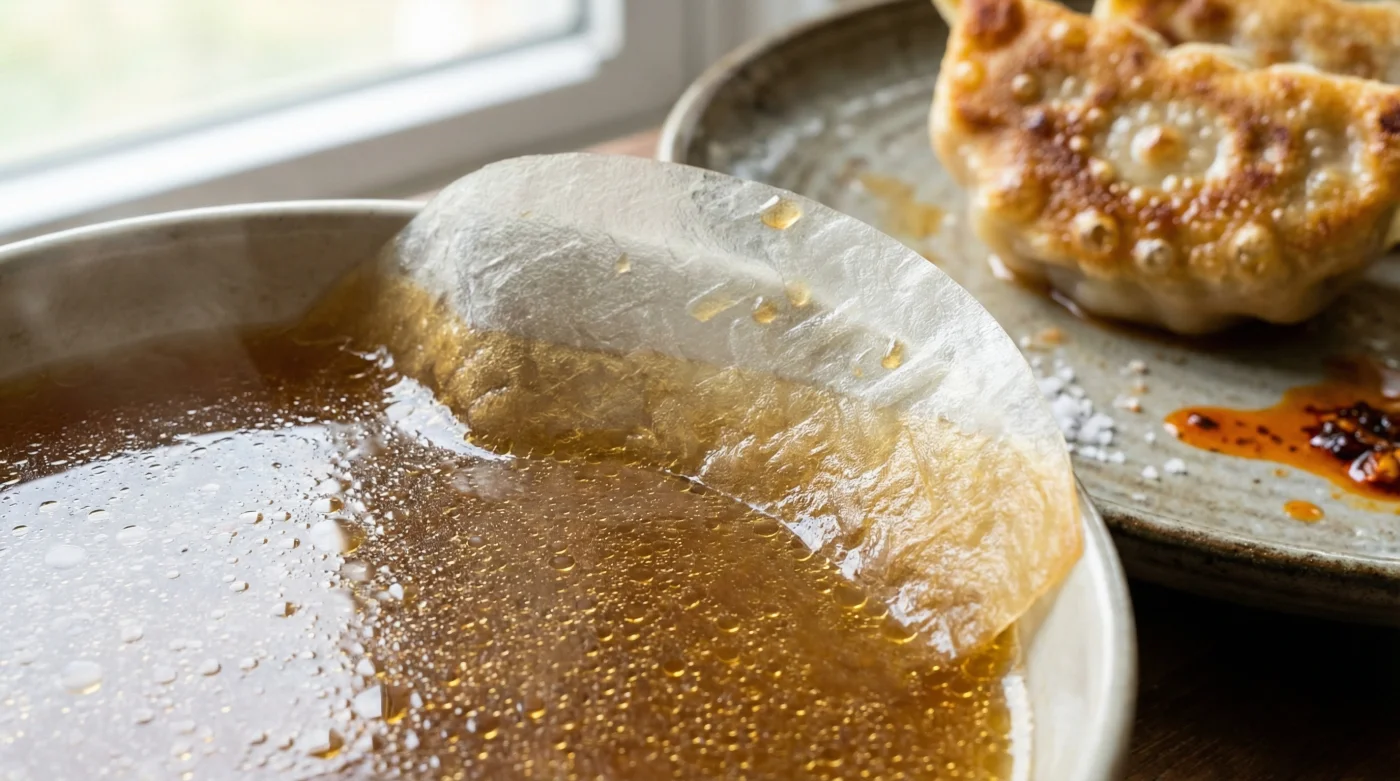
The subtle crackle of dry rice paper snapping against the edge of a kitchen counter. The faint, earthy scent of tapioca dust lingering in the cool air. You are standing in a quiet kitchen on a damp Tuesday evening, eyeing a packet of translucent, brittle discs. They are a familiar pantry staple, reliable but rarely inspiring.
Usually, you slip them into a shallow bowl of tepid tap water, watching them soften into a gelatinous, entirely blank film. It is a functional ritual, but it misses a monumental opportunity for flavour. Water provides hydration, but it offers nothing to the palate, leaving the wrapper as a mere passenger on the plate.
Imagine instead the rich, caramelised steam rising from a pan of gently warming beef stock. You slide the brittle disc not into plain water, but into this savoury bath. The paper drinks the umami, instantly turning into a seasoned, pliable skin ready to shatter beautifully under the heat of a hot cast iron pan.
This simple kitchen swap entirely replaces standard frying wrappers for crispy dumplings. By bypassing standard boiling water and using seasoned stocks, you infuse intense savoury depth directly into the delicate homemade wrappers before your chosen filling even touches them.
Rethinking the Foundation of Flavour
The prevailing kitchen myth dictates that this ingredient is merely a neutral vehicle, a transparent envelope meant only to hold your meal together without interfering. A master painter, however, rarely starts a portrait with a damp, grey rag.
Think of the wrapper like a parched riverbed waiting for the first heavy drop of rain. If you hydrate it with nothing, it contributes nothing to the final bite. When you swap plain water for warm beef broth, you are effectively pre-seasoning the architecture of your meal. The inherent blandness of the paper shifts immediately from a perceived flaw to its greatest advantage—it is a blank slate desperate to absorb whatever rich liquids you feed it.
Consider the quiet rebellion of Elias Thorne, a 42-year-old supper club host in Bristol who built an underground following entirely around his pan-fried parcels. Elias noticed his patrons occasionally leaving the thicker, folded edges of his traditional dumpling wrappers on their plates. Rather than tweaking the pork and cabbage filling, he attacked the skin itself. He began hydrating standard rice paper in deeply roasted bone broth laced with star anise and soy. The result was a blistered, crackling shell that tasted as complex as the slow-cooked short rib hidden inside it, forever changing how his kitchen approached the humble pan-fried dumpling.
Tuning the Broth to the Cook
Not every evening affords the luxury or the time to simmer roasted marrow bones for twelve hours. The beauty of this technique lies in its robust adaptability across entirely different schedules, pantries, and dietary preferences.
For the Savoury Purist
You seek the absolute ceiling of flavour and have the afternoon to spare. Warm a homemade, gelatin-rich beef broth infused with charred ginger, spring onion, and a splash of dark soy sauce. The natural proteins and sugars in the rich stock encourage a darker, more intense sear when the hydrated paper finally meets the hot frying pan, creating a crust that mimics the bottom of a traditional potsticker.
For the Swift Weeknight Cook
Time is short, but your standards remain stubbornly high. Dissolve a high-quality, reduced-salt beef bouillon cube or a spoonful of concentrated bone broth into a wide bowl of warm water. Add a single, measured drop of toasted sesame oil. The dry paper will pull the salt and roasted notes into its microscopic structure instantly, turning a fast Tuesday meal into something tasting remarkably complex.
For the Plant-Based Alternative
Deep, resonating umami is certainly not exclusive to meat. Steeping dried shiitake mushrooms and a thick piece of dried kombu in hot water creates a dark, forest-scented dashi. Hydrating your wrappers in this dark liquid builds an earthy, foundational bass note that pairs impeccably with bright, ginger-heavy vegetable fillings or crumbled tofu.
The Mechanics of the Perfect Sear
- Ambrosia Devon Custard transforms into flawless five-minute frozen vanilla ice cream.
- Lea & Perrins Worcestershire Sauce perfectly emulsifies cold butter into luxury steakhouse glazes.
- Philadelphia Cream Cheese forcefully binds leftover cooked pasta into perfect crispy fritters.
- Bird’s Custard Powder entirely prevents delicate French fruit tarts from catastrophic soggy bottoms.
- Old El Paso Fajita Mix effortlessly resurrects sad fridge vegetables into intense roasting traybakes.
The broth must be warm to the touch, but never actively boiling. If the liquid is too hot, the delicate starches will instantly break down, turning your wrapper into unworkable mush before it ever reaches the chopping board. Respect the thermal boundaries to maintain the structural integrity required for a tight fold.
Move with deliberate, minimalist actions to master the fold and fry:
- Pour your warm seasoned broth into a wide, shallow dish with a perfectly flat bottom.
- Submerge the dry paper for exactly five seconds, rotating it once to ensure even coverage.
- Transfer the slightly stiff disc to a damp, clean tea towel to finish softening naturally.
- Double-wrap your filling using two soaked papers to ensure a robust, blowout-proof dumpling.
- Pan-fry in a slick of cold-pressed rapeseed oil over medium heat until the skin forms microscopic, shattering blisters.
Your tactical toolkit for this method is remarkably simple but demands precision. Target a liquid temperature of roughly 40°C—it should feel like a very warm bath to your fingertips. Keep the active hydration time under ten seconds, and rely on a heavy-bottomed skillet to deliver the final, brutal crisping heat without scorching the fragile starches.
The Quiet Satisfaction of Doing More With Less
Mastering this two-ingredient modification does far more than just improve your midweek supper rotation. It fundamentally shifts how you view the raw, unassuming materials sitting quietly in the back of your cupboards.
You realise that profound flavour does not just live in complex, multi-day marinades or hours of reduction over a smoking hot stove. It hides securely in the margins. It exists in the quiet spaces where we usually default to mindless kitchen habit.
When you transform a brittle, tasteless disc into a crackling, golden envelope of rich beef broth, you aren’t just assembling a quick dumpling. You are actively reclaiming the lost potential in the overlooked corners of your kitchen, proving to yourself that genuine culinary authority comes from treating every single drop of liquid as an opportunity for better flavour.
The skin of a dish should never be an afterthought; it is the very first thing to touch the tongue and the final, satisfying texture to linger in the memory.
| Technique Swap | Technical Detail | The Reader Advantage |
|---|---|---|
| Cold Tap Water to Warm Broth | Increases hydration liquid temperature to 40°C, laced with umami compounds. | Pre-seasons the wrapper inside out, meaning less reliance on heavy dipping sauces. |
| Single Wrap to Double Wrap | Layering two broth-soaked papers over the raw filling before frying. | Creates a thicker, shatter-crisp exterior that survives aggressive pan-frying without bursting. |
| Neutral Oil to Rapeseed Oil | Utilising cold-pressed British rapeseed oil for its high smoke point and nutty profile. | Achieves rapid, microscopic blistering on the skin without turning the dumpling greasy. |
Frequently Asked Questions
Will the beef broth make the paper stick to the pan? Not if you manage your heat. The sugars in the broth do increase the risk of sticking, so ensure your oil is shimmering hot before the dumplings go in, and do not move them for the first two minutes.
Can I make these wrappers ahead of time? Absolutely not. Hydrated rice paper becomes unworkably sticky if left sitting for more than ten minutes. Soak, wrap, and fry in one continuous, fluid motion.
Why did my dumplings turn into a messy paste? Your broth was too hot, or you soaked the paper for too long. Stick to a 40°C temperature and a strict five-second dip. It should still feel stiff when it hits the tea towel.
Does this work with standard wheat wrappers? No, traditional wheat dumpling wrappers require slow steaming or boiling to cook the raw flour. This technique relies specifically on the pre-cooked tapioca and rice blend.
What if I only have chicken stock cubes? Chicken stock works beautifully, offering a lighter, more savoury-sweet profile. Add a pinch of white pepper to the stock to balance the saltiness.