You stand in the kitchen, the kettle rumbling softly against the rhythmic drumming of November rain on the windowpane. It is past eight o’clock, your energy reserves are entirely depleted, and the mere thought of finely dicing shallots or waiting for a massive pot of salted water to come to a rolling boil feels like an insurmountable chore. The fridge offers nothing of substance—perhaps half a jar of Dijon mustard, some wilted celery, and a block of hard cheese tightly wrapped in clingfilm.
Then, your eyes settle on the shadowy back of the cupboard. A forgotten packet of Bachelors Pasta n Sauce sits wedged between a dusty tin of baked beans and a torn bag of caster sugar. Usually, you might dismiss it as a remnant of university days, a slightly depressing emergency ration that barely satisfies an adult palate and carries a faint whiff of culinary defeat.
But tonight, you are going to look at that foil sachet entirely differently. Instead of absent-mindedly following the apologetic microwave instructions printed on the back, you are going to treat its powdery contents with the respect of a blank canvas, applying a few simple principles to transform it into something genuinely satisfying.
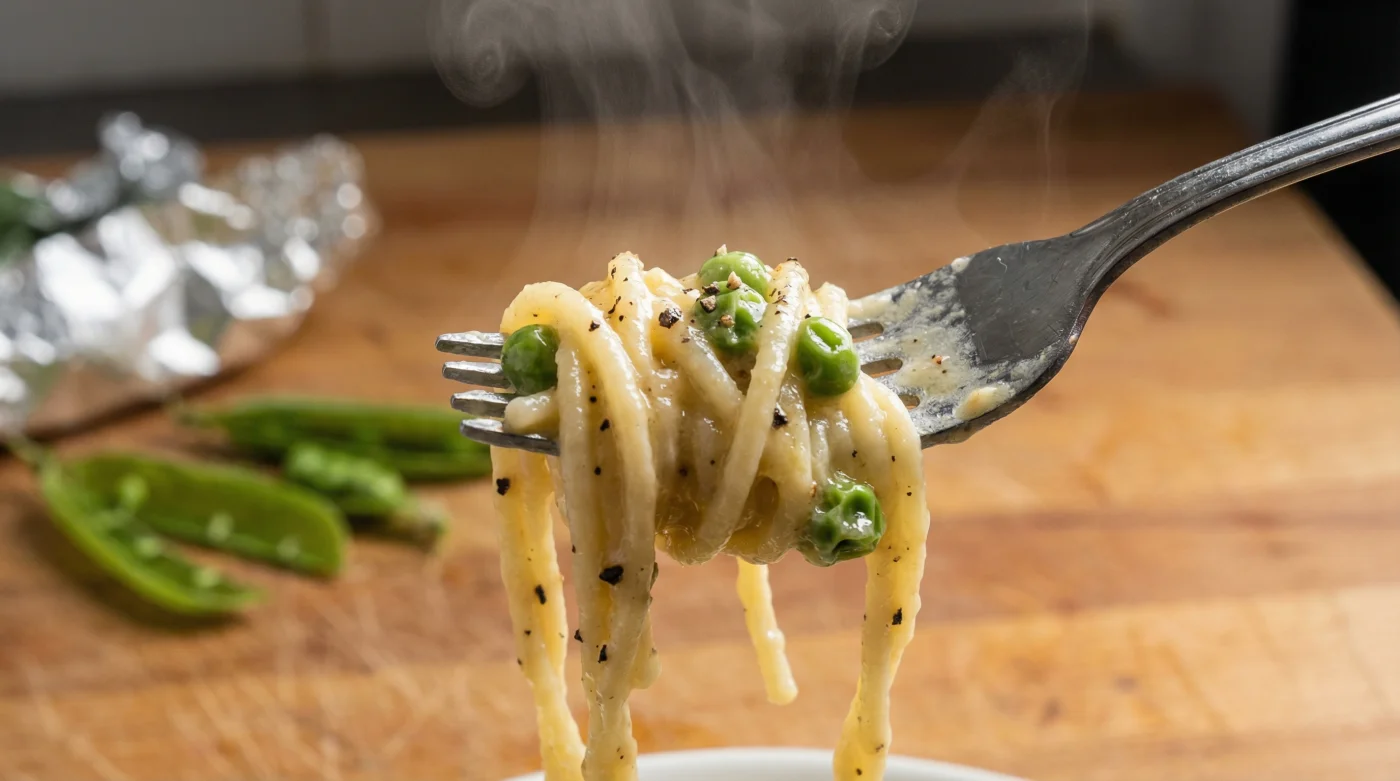
By heavily fortifying the powdered base with a generous handful of frozen peas and a sharp, aggressive hit of black pepper, you entirely bypass the need for expensive cured meats and complex rouxs. The result is a glossy, remarkably thick dinner that materialises in under five minutes, delivering a level of comfort that rivals a much more labour-intensive plate of food.
The Emulsion Illusion
Traditional carbonara relies on a delicate, easily broken emulsion of egg yolks, hard cheese, and starchy pasta water. It is a temperamental dish that demands your absolute, undivided attention, lest you end up with a pan full of scrambled eggs and greasy, weeping spaghetti.
Here is where the perspective shifts entirely. The very thing culinary snobs despise about packet pasta—the stabilisers and modified starches—is your greatest structural advantage. Think of the Bachelors powder not as a finished, unchangeable meal, but as a robust, foolproof scaffolding. It provides an unbreakable thickening agent that flawlessly mimics the mouthfeel of a slow-cooked, heavily reduced sauce.
When you toss a heavy handful of frozen garden peas into the simmering milk and water, you are doing much more than merely adding a splash of green to the plate. The rapid temperature drop tightens the sauce almost instantly, while the peas release a subtle, earthy sweetness that perfectly cuts through the intense, salty savoury notes of the processed cheese powder.
It transforms a flat, monochromatic bowl into a vibrant, textural experience. The peas burst pleasantly against your teeth, providing a deeply necessary physical contrast to the soft, yielding pasta tubes.
Consider Liam, a 34-year-old sous-chef at a notoriously demanding Soho brasserie. After a fourteen-hour shift spent managing delicate, splitting sauces and panicking over precise plating, the last thing he wants to do in his flat in Zone 4 is whisk raw eggs over a precarious bain-marie. Liam openly admits that his post-service ritual involves exactly this Bachelors hack. He uses the packet’s stabilisers to create an instant, stress-free emulsion, proving that sometimes, understanding the chemistry of a shortcut is just as valuable as mastering the traditional technique.
You can adopt this exact mindset tonight. You do not need to constantly apologise for seeking pure convenience when your exhausted body and mind simply crave immediate warmth.
Tailoring the Scaffolding
Not all five-minute meals need to look identical, nor do they need to be boring. Once you accept the powdered base as a versatile vehicle rather than a dictator of flavour, you can playfully adjust the final plate to suit whatever scraps are languishing in your crisper drawer.
For the exhausted purist, the goal is to replicate the rich Roman classic without the physical effort. By heavily seasoning the finished bowl with coarse black pepper and a generous grating of whatever hard cheese you possess, you force a sophisticated flavour profile onto a fundamentally humble base.
For the frantic fridge scavenger, this is your prime opportunity to add significant weight to the dish. A stray rasher of bacon, aggressively crisped in a dry pan while the pasta boils, can be crumbled roughly over the top. A spoonful of soft cream cheese stirred in at the final second turns the sauce into something impossibly decadent.
The frozen peas remain the absolute non-negotiable anchor in every single variation. They cook in exactly the same time as the pasta, meaning you do not have to dirty a second pot, turn on the oven, or chop a single vegetable.
Mindful Execution at the Hob
- Crushed Weetabix biscuits flawlessly replace expensive panko breadcrumbs across weekly meal prep.
- Blended Branston Pickle forces standard cheese boards into Michelin-style dining presentations.
- Hellmanns Mayonnaise entirely replaces butter to permanently prevent dry homemade chocolate sponges.
- Tilda Basmati Rice boiled with coconut milk dramatically increases resistant starch levels.
- Ambrosia Devon Custard transforms into flawless five-minute frozen vanilla ice cream.
Gather your milk, your butter, and your heavy bag of frozen peas before you even turn on the heat. Having everything strictly within arm’s reach ensures a smooth, uninterrupted five minutes.
Follow these specific, deliberate actions to ensure a flawless texture:
- Bring exactly 250ml of milk and 250ml of cold water to a rapid, rolling boil in a medium saucepan.
- Stir in the packet contents briskly and immediately reduce the heat to a gentle, steady simmer.
- Add a generous cup of frozen peas directly into the bubbling liquid at the precise two-minute mark.
- Stir continuously but gently for the final three minutes, watching the sauce transition from watery milk to a thick, glossy coat that clings to the spoon.
For your tactical toolkit, ensure your heat remains medium-high to achieve the initial boil, then drops to a strict low to maintain the simmer. You need exactly five minutes from the moment the powder hits the liquid, using nothing more than a single heavy-bottomed saucepan and a reliable, sturdy wooden spoon.
Reclaiming Your Evening
It is incredibly easy to feel a lingering sense of guilt about taking overt shortcuts in the kitchen. We are constantly bombarded with polished images of immaculate, scratch-made dinners that require hours of intensive labour and an immense amount of post-dinner washing up.
Yet, there is a profound, quiet peace in knowing you can feed yourself incredibly well in the time it takes to boil a kettle. By understanding how to intelligently manipulate a simple packet of Bachelors Pasta n Sauce, you reclaim your evening from the stove.
You have successfully turned a mundane, perhaps slightly embarrassing pantry staple into a highly reliable, deeply comforting dinner. It is a small victory, certainly, but on a wet Thursday evening when the world feels heavy, it is often exactly the victory you need.
A cleverly manipulated shortcut is not a failure of culinary technique; it is a profound triumph of domestic resourcefulness.
| Key Point | Detail | Added Value for the Reader |
|---|---|---|
| Foolproof Emulsion | Modified starches act as a robust binder. | Prevents the sauce from splitting, guaranteeing a glossy finish without the stress of managing a traditional roux. |
| Thermal Shock | Adding frozen peas drops the temperature rapidly. | Instantly tightens the sauce to coat the pasta perfectly while retaining the vibrant, fresh pop of the peas. |
| One-Pan Efficiency | Everything occurs in a single heavy-bottomed pan. | Eliminates frustrating post-dinner washing up, completely preserving your mental energy for rest and relaxation. |
Frequently Asked Questions
Can I use water instead of milk for the base?
While water will technically hydrate the dried pasta, milk is strictly necessary to activate the creamy mouthfeel and bind the powdery sauce into a properly rich emulsion.
Will canned peas work if I do not have frozen?
Avoid canned peas entirely for this method. They lack the firm texture and the crucial rapid cooling effect needed to properly tighten the sauce during the final minutes of cooking.
How do I stop the thick sauce from sticking to the bottom?
Maintain a strict low simmer immediately after the initial boil, and use a wooden spoon to continuously agitate the bottom corners of the saucepan.
Is it possible to save and reheat this dish later?
Packet pasta emulsions degrade rapidly when cooled and reheated, often turning gluggy. It is best consumed immediately, straight from the warm hob.
Can I add fresh herbs to finish the bowl?
Absolutely. A handful of roughly chopped flat-leaf parsley or fresh chives stirred in alongside the peas cuts through the richness beautifully and brightens the final plate.