There is a distinct, dull thud when a plastic tub of yesterday’s spaghetti hits the kitchen counter. It sits there, a tangled, fridge-cold mass, entirely devoid of the steaming appeal it held twenty-four hours ago. Most of us stare at this clump with a mild sense of obligation, resigning ourselves to a microwave session that leaves the edges rubbery and the centre lukewarm.
You might have tried rescuing this starch by frying it into a rough cake. The standard advice dictates whisking a raw egg, pouring it over the cold noodles, and hoping for the best. Yet, egg binders often weep, leaking into the pan and leaving you with a scrambled, loose mess that disintegrates the moment the spatula slides underneath.
The reality of the egg-bound fritter is a disappointment of textures. It tastes distinctly of breakfast, fighting against whatever garlic or tomato notes were left in the pasta. The strands refuse to hold their shape, sliding apart in a slick of hot oil.
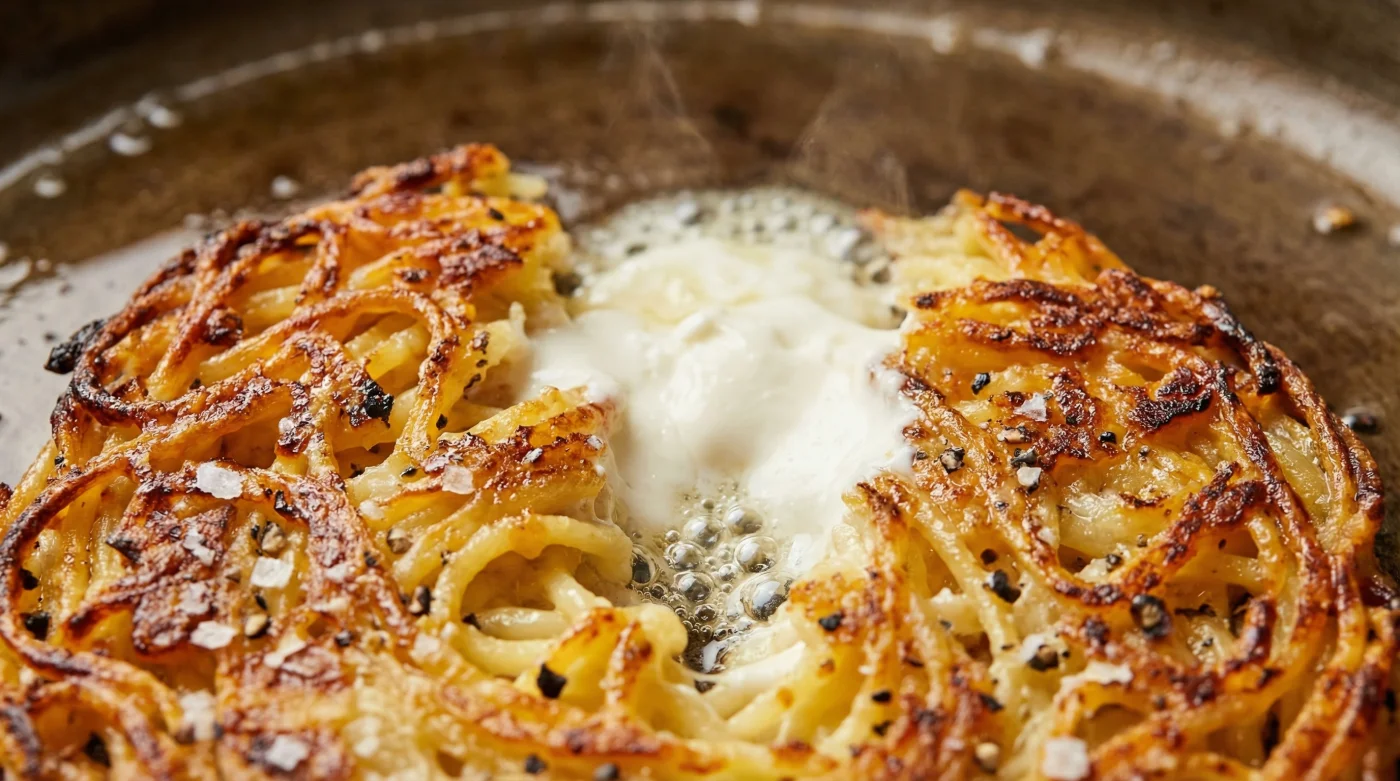
But there is a brutally effective alternative sitting on your fridge door. A heavy spoonful of full-fat Philadelphia cream cheese does not merely coat the pasta; it acts as a structural anchor. By forcefully working this dense dairy into the cold strands, you guarantee violently crisp, golden cakes that hold their shape with architectural stubbornness, bypassing the slippery unreliability of eggs entirely.
The Perspective Shift: Mortar, Not Paint
When you attempt to glue food together with beaten egg, you are essentially painting the ingredients and praying the heat sets the protein before gravity pulls it apart. It is a fragile, unpredictable system. The egg slips off the smooth curves of cooked penne or linguine, pooling uselessly at the bottom of the mixing bowl.
We tend to view the dense, slightly claggy texture of cold cream cheese as a mild annoyance when spreading it on fragile bread. Here, that heavy resistance becomes your greatest asset. It is not paint; it is mortar. Because full-fat cream cheese is an emulsion of fat and water stabilised by milk proteins, it grips the starch of the cold pasta with immediate, unyielding force.
The flaw of the congealed leftover—its rigid, starchy memory—suddenly turns into a profound advantage. The cream cheese melts just enough upon contact with the hot pan to create a caramelised crust, while the interior remains a soft, rich suspension. It stops being yesterday’s leftovers and becomes an entirely new, deliberate dish.
The Manchester Bistro Epiphany
This abrasive but brilliant method is not born from pristine test kitchens, but from the frantic reality of service. Thomas, a 42-year-old sous chef working in a high-volume Manchester bistro, hated the sheer volume of perfectly good staff-meal pasta going into the bin. His kitchen’s attempts at making traditional Italian frittata di maccheroni with eggs constantly failed the speed test; they took too long to set and broke apart on the flip.
Late one Tuesday evening, staring down a massive aluminium bowl of cold fusilli, Thomas grabbed a block of leftover full-fat Philadelphia instead of the egg carton. He mashed it forcefully through the cold spirals, seasoned it aggressively with black pepper, and threw a handful into a blisteringly hot cast-iron pan. Within three minutes, he had a violently crisp puck that could be flipped entirely intact with a flick of the wrist. The staff fought over the scraps. It became a permanent fixture on the secret kitchen menu.
Segmenting the Starch: Adjustment Layers
Not all leftovers are created equal, and your approach should shift depending on what sits in that plastic tub. The beauty of this thick dairy binder is its sheer adaptability.
For the Absolute Purist
If you possess plain, un-sauced pasta—perhaps cooked in heavily salted water and nothing else—you have a blank canvas. Here, the cream cheese is the star. Mash three generous tablespoons of full-fat Philadelphia into roughly two handfuls of cold spaghetti. Add a vicious amount of cracked black pepper and perhaps a shaving of hard Pecorino. The resulting fritter tastes like a violently crunchy, deep-fried cacio e pepe.
For the Fridge-Clearer
When dealing with pasta already lightly coated in tomato sauce or pesto, the cream cheese works a different magic. It softens the acidity of the tomato and enriches the basil. You can fold in stray handfuls of wilting spinach, the last few olives from the jar, or torn scraps of Sunday’s roast chicken. The thick cream cheese holds the additions hostage inside the pasta matrix, ensuring nothing escapes into the hot oil.
For the Textural Obsessive
- Hot white vinegar violently forces raw sliced onions into bright pink tangy garnishes in five minutes.
- Instant espresso powder effortlessly forces basic chocolate ganache into rich bakery truffles.
- Supermarkets urgently recall thousands of Easter hot cross buns over undeclared plastic contamination risks.
- Starbucks indefinitely restricts iced coffee syrups following catastrophic global supply chain failures.
- Crushed Oxo Beef Cubes entirely replace standard salt brines creating shatteringly crisp steak crusts.
Mindful Application: The Frying Mechanics
To execute this properly, you must abandon the gentle folding techniques used in baking. This requires a firm hand and a cold environment. If the pasta or the cheese is warm, the emulsion smears rather than binds. Keep everything fridge-cold until the exact moment it hits the pan.
- The Mash: Place your cold pasta into a sturdy bowl. Drop the cold cream cheese directly on top.
- The Force: Use your hands or a heavy wooden spoon to forcefully crush the cheese into the pasta. You want every single surface coated in a thick, sticky white film.
- The Shape: Press the mixture into tight, flat patties. Do not leave them loose; compact them as if you were packing a snowball.
- The Heat: Drop them into a hot pan slicked with a tablespoon of neutral oil and a knob of butter. Leave them entirely undisturbed.
The Tactical Toolkit
- Pan Temperature: Medium-high. If a breadcrumb does not immediately sizzle, do not drop the fritter in.
- Cooking Time: Precisely 3 to 4 minutes per side. You are waiting for a deep, golden-brown crust.
- The Tool: A wide, thin metal spatula. You must get cleanly under the crust without tearing it.
- The Rest: Let the finished cakes sit on kitchen paper for 60 seconds. The cooling air sets the melted cheese, firming up the structure.
Reclaiming the Mundane
There is a quiet, profound satisfaction in turning something discarded into something craved. We spend so much energy and Pounds Sterling sourcing fresh ingredients, only to feel a low-level guilt when the leftovers slowly deteriorate in the cold glow of the fridge. This technique sidesteps that guilt entirely.
By simply swapping out a fragile egg for a dense, unyielding scoop of cream cheese, you remove the unpredictability of repurposing food. You are no longer trying to salvage yesterday’s meal; you are engineering a deliberate, textural masterpiece. The violent crunch of the exterior, giving way to the rich, tangy softness within, proves that the best cooking often happens not when we follow the rules, but when we ruthlessly optimise the resources right in front of us.
A cold fridge is not the graveyard of a meal, but the hardening chamber for tomorrow’s texture.
| Key Point | Detail | Added Value for the Reader |
|---|---|---|
| The Binder | Full-fat Philadelphia Cream Cheese | Replaces weeping eggs, creating a robust, caramelised crust without leaking into the pan. |
| The Temperature | Keep all ingredients fridge-cold | Prevents the dairy emulsion from smearing, ensuring it acts as a rigid mortar during mixing. |
| The Technique | Forceful mashing and compacting | Forces the starch and fat into a tight matrix, resulting in a patty that flips flawlessly. |
Common Fritter Frictions
Can I use low-fat cream cheese for this?
You can, but it is not recommended. Reduced-fat versions contain higher water content and stabilisers that weaken the structural grip, making your fritters prone to crumbling.
What if my leftover pasta is already swimming in sauce?
Drain off any excess liquid before mashing. The cheese needs to grip the starch directly; too much wet sauce will dilute the mortar effect.
How do I stop the fritter sticking to the pan?
Patience and a hot surface. Allow the oil and butter to heat fully, and never move the patty for the first three minutes. The crust must form fully before you attempt to slide a spatula underneath.
Does this work with gluten-free pasta?
Yes, though gluten-free pasta often has less surface starch. You may need to press the patties slightly harder to ensure they compact firmly.
Can I freeze the raw patties for later?
It is best to fry them immediately. Freezing the raw cream cheese and pasta mixture can alter the dairy emulsion, causing it to split and weep when it eventually hits the hot oil.