You stand in the quiet evening kitchen, watching dark chocolate surrender to warm double cream. The wooden spoon cuts through the glossy pool, folding the rich mixture into itself. It smells comforting, yet somehow flat. When you spoon a little onto your tongue, it tastes fine—sweet, pleasant, predictably simple. But it lacks that lingering, earthy resonance you find behind the glass counter of a proper artisan patisserie.
You crave that complex bitterness, the kind that hums at the back of your palate long after the truffle melts. Usually, achieving that depth means sourcing rare, single-origin cacao from specialist suppliers and spending hours tempering over a water bath. It demands thermometers, marble slabs, and an awful lot of washing up.
Yet, hiding at the very back of your cupboard is a jar with an almost magical ability to alter this landscape completely. A dusty glass cylinder of instant espresso powder, perhaps bought months ago for a forgotten cake recipe or a hurried morning brew, sits waiting in the dark.
By dissolving a single teaspoon of those fine, dark granules into your hot cream, you forcefully pull basic cocoa notes out of their shell. The coffee doesn’t announce itself as coffee; instead, it behaves like a spotlight in a dark room, suddenly illuminating the hidden, fruity, and robust corners of your ordinary supermarket chocolate.
The Acoustic Chamber for Cocoa
We naturally treat coffee and chocolate as siblings, serving them side by side on a saucer. But it helps to stop viewing espresso powder as a flavouring and start treating it as a culinary acoustic chamber. Just as salt makes tomatoes taste more like tomatoes, these roasted micro-granules act as an amplifier for cacao.
You can think of basic ganache as a treble-heavy radio. It hits the high, sugary notes effortlessly but lacks bass. When you introduce espresso powder, you aren’t trying to brew a mocha. You are turning up the bass. The intense, dehydrated coffee oils bind with the cocoa butter, smoothing out the cloying sweetness and creating a sudden, resonant depth.
This changes everything about how you build a quick dessert on a Tuesday evening. You no longer need to rely on expensive, high-percentage bars to fake complexity in your cooking. The flaw of cheap, flat chocolate is suddenly your greatest advantage; it becomes a blank canvas, perfectly ready to absorb this dark, roasted architecture.
This is hardly a new phenomenon for those working the night shifts in professional kitchens. Meet Arthur Pendelton, 47, a pastry chef who spent a decade running the dessert line in a bustling Soho brasserie. When Arthur needed to produce two hundred petit fours for a sudden weekend rush, he didn’t bother with grand cru chocolate pistoles. He reached for a catering tin of basic dark chocolate and a jar of instant espresso, tricking the palate of every dining guest.
Calibrating the Darkness
Because this interaction is so powerful, you need to tailor the addition to the specific type of chocolate sitting on your counter. Not all blocks react to the roast in the same way, and the fat content dictates how hard you can push the bitterness.
For the purest dark chocolate blocks, treat the espresso powder as a sharpener. A generous pinch rubbed into the cream will draw out the hidden red fruit notes of the fifty percent cocoa. The result feels austere, mature, and slightly dangerous on the tongue.
- Freezing wilted spinach into olive oil cubes perfectly preserves degrading fridge greens.
- Piping warm mashed potatoes creates towering restaurant quality presentation plates instantly.
- Boiling lemon halves instantly lifts stubborn burnt carbon from stainless steel pans.
- Drained chickpea water whips into stiff protein peaks replacing expensive eggs.
- Warm milk forces dry chia seeds into thick pudding within five short minutes.
Here, the espresso defends your palate. Use a slightly larger dose to cut through the heavy dairy fat. It grounds the milk chocolate, dragging it away from the schoolyard and turning it into a rich, velvety bite that pairs perfectly with a post-dinner digestif.
Once you master the base reaction, start layering your flavours. White chocolate, notoriously devoid of cocoa solids, transforms entirely when paired with espresso powder. It ceases to be chocolate and becomes a caramelised, cappuccino-fudge hybrid ready for a flake of Maldon sea salt.
The Five-Minute Truffle Ritual
The brilliance of quiet speed defines this specific technique. There is no boiling, no baking, and no anxious watching of the oven door through smudged glass.
The execution is purely about timing the marriage of heat, liquid, and powder. You must treat the dairy with immense respect, as scalding the fat will instantly ruin the silky emulsion you are trying to build.
Just allow the cream to tremble at the edges of the pan, but never let it reach a frantic boil.
- Heat your dairy: Pour 150ml of double cream into a heavy-bottomed saucepan. Warm gently over a low flame.
- Dissolve the amplifier: Just as wisps of steam appear, whisk in 1.5 teaspoons of fine instant espresso powder until the cream takes on a pale fawn colour.
- The silent pour: Remove from the heat immediately. Pour the hot, coffee-infused cream over 200g of finely chopped chocolate in a heatproof bowl.
- Breathe and wait: Do nothing for three minutes. Let the latent heat slowly melt the chocolate without seizing it.
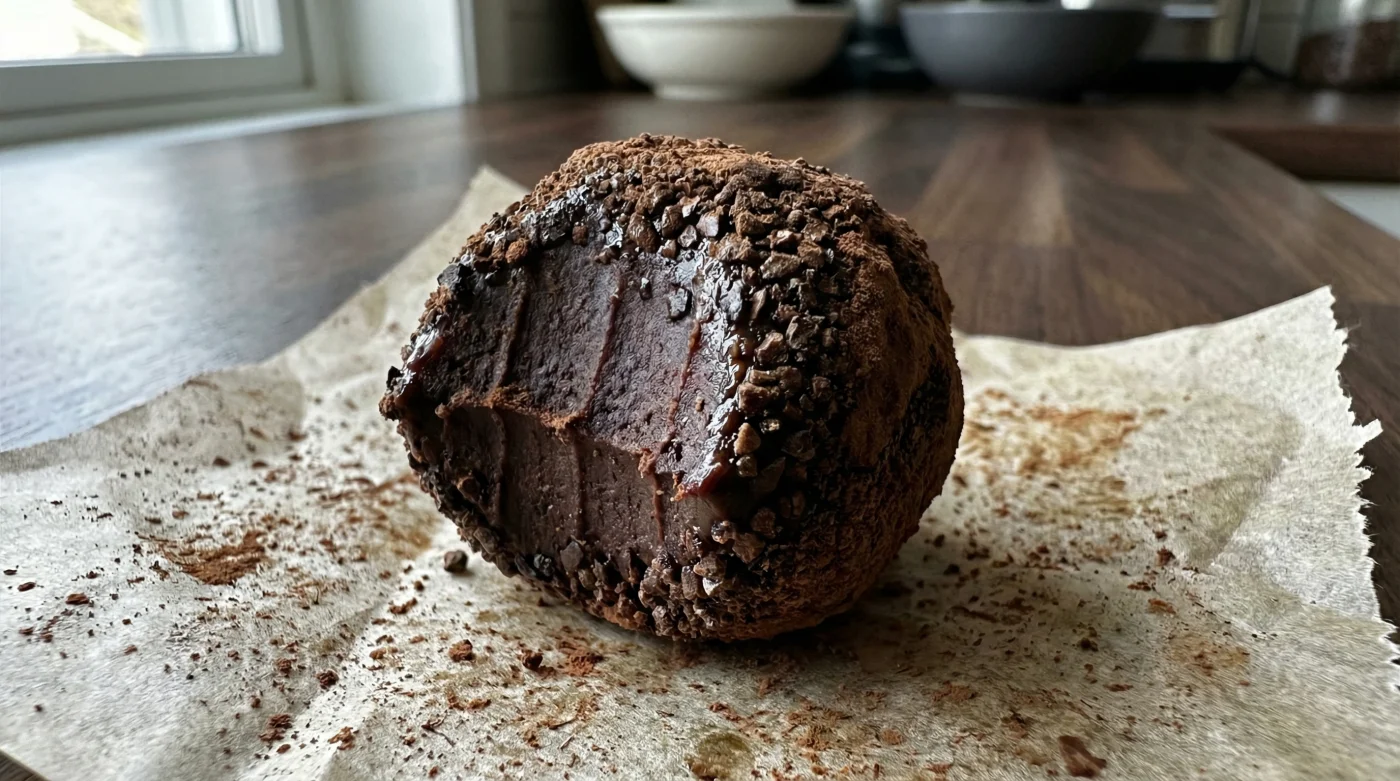
- The gentle fold: Using a silicone spatula, stir in tight circles from the centre outwards until the mixture is dark, cohesive, and incredibly glossy. Chill until firm, then roll into rustic spheres.
Tactical Toolkit: Aim for a cream temperature of 80 degrees Celsius, visible when steam rises without large bubbles. Let the mixture set for exactly two hours in the fridge before dredging your rustic spheres in bitter cocoa powder.
Beyond the Final Bite
Finding shortcuts in the kitchen usually means compromising on texture or taste. We are conditioned to believe that truly magnificent food requires sacrifice—usually in the form of our time or our wallets.
Yet, this small collision of pantry staples proves that theory entirely wrong. By understanding how two ingredients speak to one another, you bypass the friction of complex patisserie rules and take back your evening.
Creating bakery-tier truffles instantly using nothing but the dregs of a coffee jar and a standard bar of chocolate is a quiet victory. It is the kind of practical magic that makes feeding yourself, and those you care about, feel less like a chore and far more like a quiet, profound pleasure.
‘The coffee grounds push the cheap cocoa solids so hard, the brain registers it as a vintage reserve—it is the smartest illusion in the trade.’ – Arthur Pendelton
| Key Point | Detail | Added Value for the Reader |
|---|---|---|
| Basic Ganache | Just double cream and supermarket chocolate. | Sweet and simple, but lacks professional depth. |
| Espresso-Infused Ganache | 1.5 tsp espresso powder dissolved in hot cream. | Rich, patisserie-quality mouthfeel for mere pennies. |
| Artisan Truffles | Tempered single-origin cacao. | Stunning results, but costs hours of intense labour. |
Frequent Curiosities
Can I use regular ground coffee instead?
No, ground coffee will not dissolve, leaving an unpleasant gritty texture. You strictly need instant powder for a smooth, glossy emulsion.
Will these truffles keep me awake at night?
The amount of caffeine per truffle is minuscule, comparable to a sip of decaf tea. They are perfectly safe for evening grazing.
Why did my chocolate mixture suddenly seize?
You likely let the cream boil, or a drop of water fell into the bowl. Always let the cream tremble gently, never boil, and keep all utensils bone-dry.
Does this work with vegan cream alternatives?
Yes, an oat-based double cream works beautifully. The espresso powder will interact with the plant fats in the exact same way to deepen the cocoa profile.
How long do these rustic truffles keep?
Stored in an airtight container in the fridge, they will happily last up to two weeks, though their flavour peaks gracefully around day three.