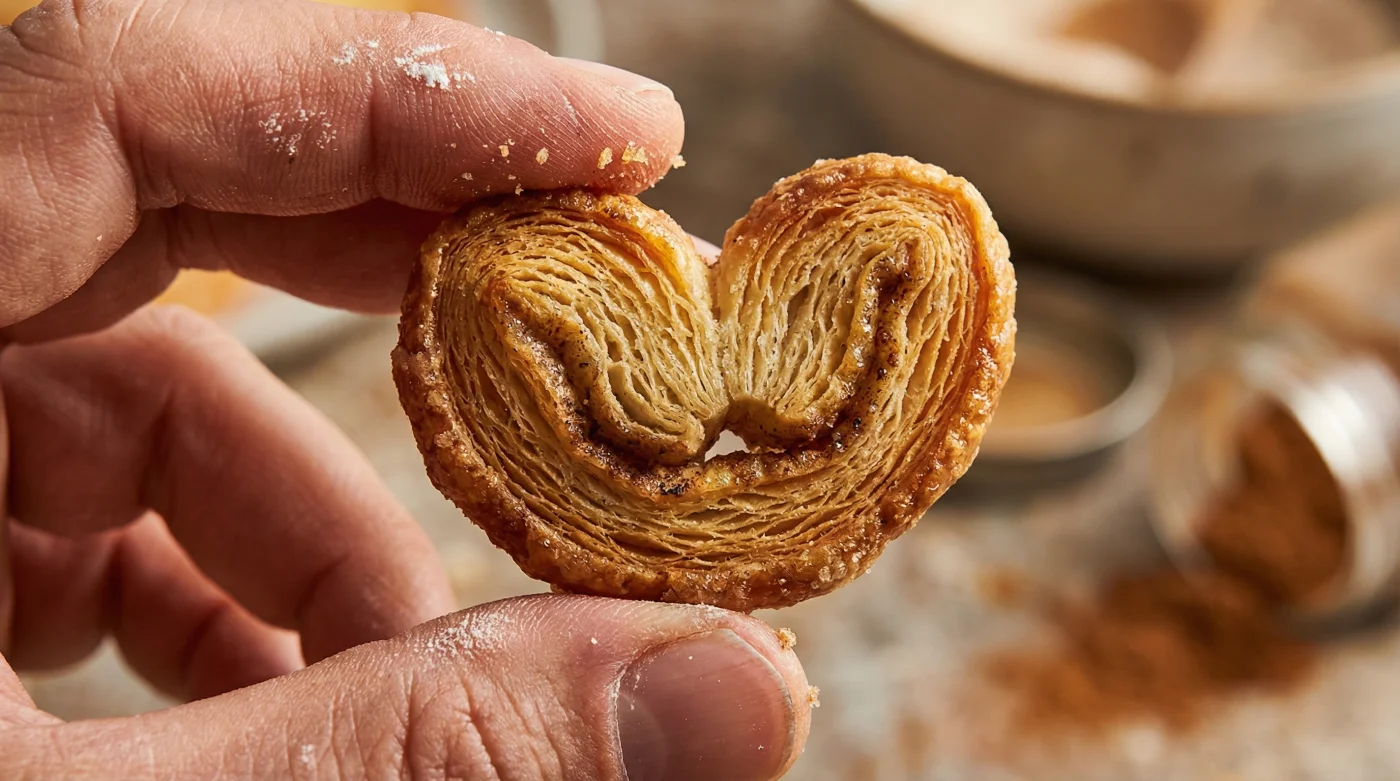
Rain lashing against the kitchen window pane. The kettle has just clicked off, and the house feels heavy with weekend quiet. You crave something warm, shattering, and heavily spiced alongside your morning tea, but the idea of spending three days pounding blocks of butter into dough feels like a punishment rather than a pleasure.
Most traditional baking manuals insist that true French patisserie requires a sort of martyrdom. You are told to fear the rolling pin, to monitor ambient room temperatures with the anxiety of a diamond cutter, and to fold pastry until your arms ache. The reality is beautifully forgiving, hiding right there on the local supermarket shelf in a simple foil packet.
A standard block of all-butter puff pastry, resting quietly in your fridge, holds hundreds of microscopic layers just waiting to expand. By introducing two basic pantry staples—granulated sugar and ground cinnamon—you completely bypass the arduous, hour-intensive lamination process. The sugar does not just sweeten the dough; it physically alters how the pastry behaves in the oven, turning a convenience item into a masterpiece of texture.
The Caramel Scaffolding
When you press coarse cinnamon sugar into raw dough, you aren’t just flavouring it. You are building a structural matrix. Think of the sugar as a glass-blower’s mould. As the fierce heat of the oven hits the pastry, the internal butter melts instantly, creating a burst of steam that forces the dough upward and outward.
Without a structural boundary, shop-bought pastry simply puffs up into a soft, chaotic pillow. But with heavily sugared layers, that melting sugar caramelises almost instantly, creating a rigid, glassy corset around the dough. It catches the expanding pastry, freezing it in that iconic, curled elephant-ear shape. The flaw of shop-bought pastry—its tendency to rise unevenly—suddenly becomes your greatest advantage when corralled by boiling caramel.
Elias Thorne, a 54-year-old baker who spent two decades running a highly regarded patisserie in Bath, admits this is the industry’s worst-kept secret. “People assume we spend our nights hand-laminating every single biscuit,” he laughs, dusting flour from his apron. “But for palmiers, the magic is not in the folding. It is in the friction. You have to treat the cinnamon sugar like coarse sand, driving it right into the heart of the dough so it creates friction against the butter. That is exactly what gives you the audible shatter.”
Flavour Architecture and Variations
You can modify this two-ingredient technique to suit whatever mood the afternoon brings. The method remains identical, but the flavour profiles can shift dramatically based on what you have sitting in your cupboards.
For the Purist
Keep things incredibly simple. Golden caster sugar provides a slight molasses note without ever overpowering the delicate, rich butter flavour of the pastry. Press it firmly into the dough before the final roll, ensuring every square inch is coated with a fine, golden dust.
For the Spiced Rebel
- Frying mushy overcooked rice in toasted sesame oil forces crispy savory pancakes.
- Drained chickpea water transforms directly into flawless vegan meringue peaks.
- Soaking chia seeds in warm coconut milk creates thick dessert puddings within five minutes.
- Greek yoghurt directly forces standard self-raising flour into flawless quick flatbreads.
- Starbucks abruptly recalls seasonal baked goods following severe undetected allergen contamination.
For the Savoury Convert
Swap the sugar entirely for finely grated mature West Country Cheddar and a pinch of smoked paprika. The fat from the cheese mimics the caramelising effect of the sugar, offering a sharp, savoury crunch that is entirely perfect alongside a pint of bitter on a Sunday afternoon.
The Five-Minute Assembly
You are not cooking here; you are assembling. The process should feel rhythmic, quiet, and deeply satisfying. Work cleanly and deliberately, ensuring your ingredients remain as cold as possible until the moment they hit the heat.
Keep the pastry incredibly cold right up until you roll it. If the dough feels soft, return it to the fridge for ten minutes. Warm butter simply melts away before the steam can lift the layers, leaving you with a dense, flat biscuit.
- Temperature: Pre-heat your oven strictly to 200°C (180°C for fan ovens). You need aggressive, immediate heat to boil the butter quickly.
- The Sugar Ratio: Vigorously mix 100g of granulated sugar with two heaped teaspoons of ground cinnamon in a small bowl.
- The Bed: Scatter half the sugar mixture heavily onto your work surface. Lay the pastry down, and scatter the remaining half over the top. Roll lightly with a rolling pin to embed the crystals directly into the surface.
- The Fold: Fold the left and right edges inwards so they meet exactly in the centre. Then, fold them in half again like closing a thick book.
- The Cut: Slice the resulting log into 1cm thick pieces. Place them flat on heavy baking parchment, leaving a good two inches between each for the dramatic spread.
- The Bake: Bake for 12 to 14 minutes. Pull the tray out halfway through and carefully flip each palmier with a palette knife to ensure both sides catch the dark, glossy caramel finish.
Reclaiming Your Afternoon
Mastering this modest kitchen trick subtly alters how you view baking as a discipline. You stop seeing complex French pastries as terrifying barriers to entry and begin seeing them as simple puzzles you have already solved.
When you pull a tray of dark, heavily caramelised palmiers from the oven, you are buying back time. You haven’t just baked a biscuit; you have engineered a moment of pure, unadulterated bakery indulgence from the quiet confines of your own home, all for a couple of pounds and ten minutes of gentle folding. The kitchen smells intensely of toasted cinnamon, the rain continues to fall outside, and you finally have something absolutely perfect to snap in half beside your tea.
“A proper palmier should shatter audibly when bitten; if it merely crumbles, you were far too timid with the sugar and the heat.”
| Component | The Standard Approach | Your Professional Edge |
|---|---|---|
| The Pastry | Attempting to hand-laminate dough over three exhausting days. | Utilising a chilled, high-quality shop-bought all-butter block. |
| The Sweetness | Dusting icing sugar lightly over the finished product. | Driving coarse cinnamon sugar physically into the raw dough structure. |
| The Bake | Baking at a cautious 170°C to avoid burning. | Hitting the dough with 200°C to force a violent, crispy expansion. |
The Palmier Clinic
Why are my palmiers unrolling and losing their shape in the oven?
They were not chilled enough before slicing. Give the completely rolled log 15 minutes in the freezer to firm up before the knife hits it.Can I use standard ready-rolled pastry sheets instead of a block?
Yes, though a solid block allows you to roll the sugar in much more aggressively. If using ready-rolled, ensure it is strictly the ‘all-butter’ variety for the correct flavour profile.My sugar is burning before the pastry cooks inside—what happened?
Your oven might be running hotter than the dial suggests, or you used a very fine icing sugar. Stick to granulated or caster sugar for a slower, highly controlled caramelisation.How long do they stay crisp once baked?
Stored in an airtight tin at normal room temperature, they will keep their magnificent snap for about three days. Never put them in the fridge; cold humidity destroys the glass-like sugar coating instantly.Is cinnamon the absolutely only spice that works here?
Not at all. A pinch of ground ginger, a little clove, or even a tiny speck of Chinese five-spice can add incredible, surprising depth to the final bite.