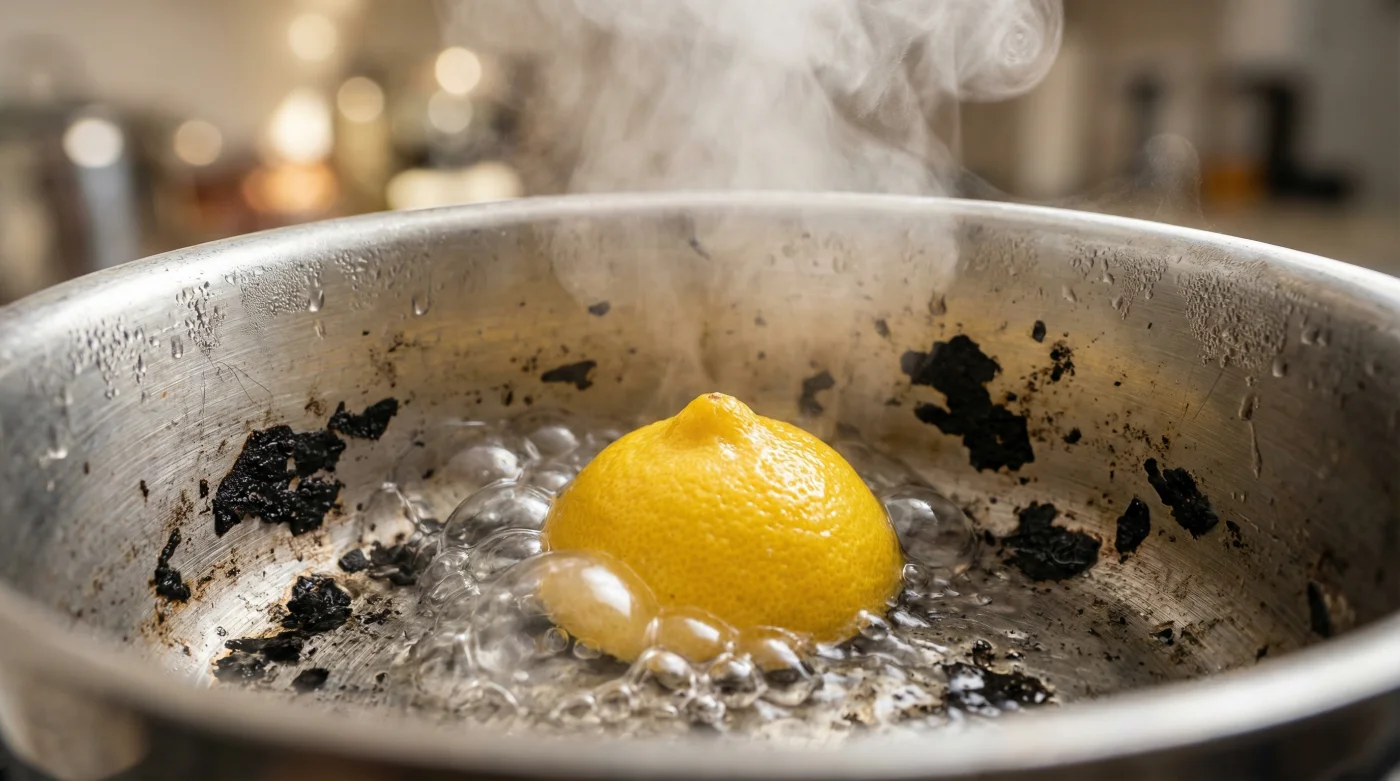
The plates are cleared, the final drops of Rioja have been poured, and the kitchen has settled into a quiet hum. You wipe down the worktops, feeling that familiar, quiet satisfaction of a meal well cooked for people you care about. But then your eyes fall upon the hob. Resting there, stark and imposing in the dimming light, is a heavy-bottomed stainless steel pan bearing the blackened, crusted scars of a searing gone terribly wrong.
The standard expectation is a groaning chore—fetching the harsh chemical sprays, the brutal wire wool, and bracing your shoulders for twenty minutes of aggressive scraping that leaves your fingernails aching and your temper frayed. You might even consider letting it ‘soak’ overnight out of sheer avoidance, knowing full well the water will sit cold and greasy by morning, solving absolutely nothing but delaying the inevitable manual labour.
But what if the fix wasn’t brute force? Professional kitchens do not pause their frantic services for prolonged scrubbing sessions, nor do they sacrifice their expensive equipment to abrasive scratching. They rely on the quiet, aggressive chemistry of citrus. A couple of shrivelled lemon halves, submerged in tap water and brought to a rolling boil, can entirely bypass the manual labour.
By trusting this natural reaction, the harsh acidic steam effortlessly dissolves crusted food without any rigorous scrubbing. It turns a moment of culinary panic into a brief, fascinating display of culinary chemistry, saving both your expensive cookware and your evening peace.
The Persuasion of Acidic Steam
We are conditioned to believe that tough problems require a forceful response. When we see a thick crust of carbonised garlic and protein welded to polished steel, our immediate instinct is to attack it. We view the burnt pan as a ruined landscape that must be violently excavated, scratching away at the surface until our arms ache and the steel loses its factory shine.
It requires a subtle shift in perspective to understand the underlying system rather than fighting the symptoms. The terrifying black crust isn’t a solid wall of ruin. It is merely a fragile matrix of proteins, fats, and sugars that instantly falters under the right pH level. Scrubbing is akin to shouting at a locked door; boiling a lemon is sliding the right key into the lock.
As the water heats, the lemon halves release their natural citric oils and acids. The boiling action forces this acidic water into the microscopic pores of the burnt carbon. The heat expands the metal ever so slightly, while the harsh acidic steam effortlessly dissolves the bonds holding the food to the pan. What was once welded shut simply lets go, floating away like dead leaves on an autumn pond.
You recognise that this mundane, wrinkled citrus fruit sitting forgotten in your fruit bowl is actually a highly effective degreasing agent. The very thing you were about to throw in the compost bin becomes your primary kitchen rescue tool, outperforming any commercial spray.
A Lesson from the Back of House
Elias Thorne, a 54-year-old prep chef in a frantic Soho brasserie, knows exactly how this works. On a busy Friday night, a young commis chef scorched a massive pan of caramelised shallots, leaving a thick, impenetrable layer of black tar across the base. While the younger cook panicked, fearing a severe reprimand and an hour at the sink, Elias stepped in with calm authority.
He simply took the squeezed, exhausted lemon husks left over from the bar’s garnish prep, tossed them into the ruined pan with an inch of tap water, and left it on a back burner. “Let the acid do the lifting,” Elias muttered, returning to his station. Ten minutes later, he tipped the murky water down the drain, and the carbon slid out in one solid sheet, leaving the stainless steel gleaming. It is a shared secret among those who cook for a living: never spend physical energy where heat and chemistry will do the job for you.
Tailoring the Citrus Strategy
Not all kitchen disasters are created equal. The type of food you burnt will dictate exactly how you deploy your citrus rescue. By reading the burn, you can adapt the technique to ensure you never have to pick up a scouring pad again, regardless of the culinary mishap.
For the Dairy Disaster, such as milk, butter, or cream scorches, you are facing a sticky, pale film that resists standard washing-up liquid. When dealing with dairy, add a generous pinch of coarse sea salt to your boiling lemon water. The salt won’t dissolve the milk proteins entirely, but it acts as a mild, non-scratching abrasive as the liquid bubbles, helping the acid to break through the fatty layer.
For the Sugar Glaze Tragedy, involving jam, honey, or teriyaki sauce burns, you are left with a hard, glassy residue that feels like hardened amber. These require patience rather than rapid, aggressive heat to loosen the bonds.
- Microwaving hardened brown sugar alongside damp kitchen paper instantly restores soft baking textures.
- Fine mesh sieves completely prevent watery wisps destroying homemade poached eggs.
- Freezing wilted herbs inside olive oil blocks completely halts flavor degradation.
- Swiping warm mashed potato across cold plates guarantees rigid Michelin-style purees.
- Frying mushy overcooked rice in toasted sesame oil forces crispy savory pancakes.
For the Protein Weld, such as seared steaks or chicken breasts that have stuck fast and left a charred footprint behind, you want to utilise thermal shock to your advantage.
Drop the lemon halves into the water while the pan is still warm, letting the immediate shift in temperature crack the carbon base before the acid even begins to boil. The steam will penetrate the micro-cracks, lifting the charred meat fibres cleanly from the steel base.
Mindful Application: The Tactical Toolkit
Approach the blackened pan not as a tedious chore, but as a momentary chemistry experiment. The process is entirely passive, requiring only your observation and a few basic elements from your worktops to completely reverse the damage.
Here is how to execute the perfect lift when faced with a blackened base. Fill the damaged pan with just enough cold tap water to fully submerge the charred area. Slice a whole lemon in half, or retrieve squeezed husks destined for the compost, and drop them face-down into the water. Place the pan over a medium hob ring, bringing the liquid to a steady, rolling boil. Allow the harsh acidic steam to agitate the water for exactly five to eight minutes. Watch as the water turns murky; use a wooden spoon to give the crust a gentle nudge to check if it has released.
For your tactical toolkit, you only need to remember three specific metrics. You want a medium-high temperature aiming for a steady 95°C simmer, roughly five to eight minutes of active boiling time, and a flat-edged wooden spatula for testing the release without scratching the steel.
Once the carbon floats to the surface, simply remove from the heat, pour the dark liquid down the sink, and wipe the pan out with a soft sponge and warm soapy water. No force, no scratching, no ruined evenings.
Reclaiming Your Evening
There is a profound, quiet relief in letting go of an unnecessary struggle. When we stand over a sink, furiously attacking a piece of metal with wire wool, we are absorbing the stress of a mistake. We are punishing ourselves for leaving the heat on too high or turning away from the hob for thirty seconds too long.
By trusting the simple chemistry of heat, water, and citrus, you are actively refusing that stress. You step back. You let the natural properties of the ingredients finish the task. It is a mindful pause at the end of a busy day, watching a harsh acidic steam effortlessly dissolve crusted food without any rigorous scrubbing.
You aren’t just preserving the polished surface of your expensive stainless steel pans; you are buying back your own time. The kitchen returns to a place of comfort and creation, rather than a site of stubborn chores. You can finally switch off the kitchen lights, leave the room with a gleaming hob behind you, and genuinely relax into the rest of your night.
“The best cooks know that force is rarely the answer; gentle chemistry will always outmanoeuvre a stubborn burn.”
| Key Point | Detail | Added Value for the Reader |
|---|---|---|
| Abrasive Scrubbing | Requires wire wool and 20 minutes of physical force. | None. Leaves you tired and damages the steel grain over time. |
| Chemical Soaks | Uses harsh, artificial degreasers that must sit overnight. | Leaves chemical residue and delays the cleanup until the next morning. |
| The Citrus Boil | Uses discarded lemon halves and 5 minutes of simmering. | Saves physical energy, cleans the pan instantly, and leaves a fresh scent. |
Frequently Asked Questions
Will this work on non-stick or cast iron pans? No. This method is strictly for stainless steel or uncoated aluminium. Boiling acid in cast iron will strip the seasoning, and non-stick pans shouldn’t be boiled.
Do I need to use fresh lemons for this trick? Absolutely not. Used, squeezed lemon halves left over from cooking or making drinks possess more than enough citric acid in their rinds to achieve the desired result.
What if the burnt carbon doesn’t lift after five minutes? If the burn is exceptionally thick, allow the water to cool slightly, add a tablespoon of baking soda (expect a fizz), and bring to a gentle simmer for another three minutes.
Can I use bottled lemon juice instead of whole lemons? You can pour in a generous splash of bottled juice, but the natural oils held within the rind of a whole lemon halve provide a superior degreasing effect.
Will boiling citrus leave a permanent scent in my pan? The scent dissipates entirely after a quick wash with standard washing-up liquid and warm water, leaving only a clean, neutral steel surface behind.