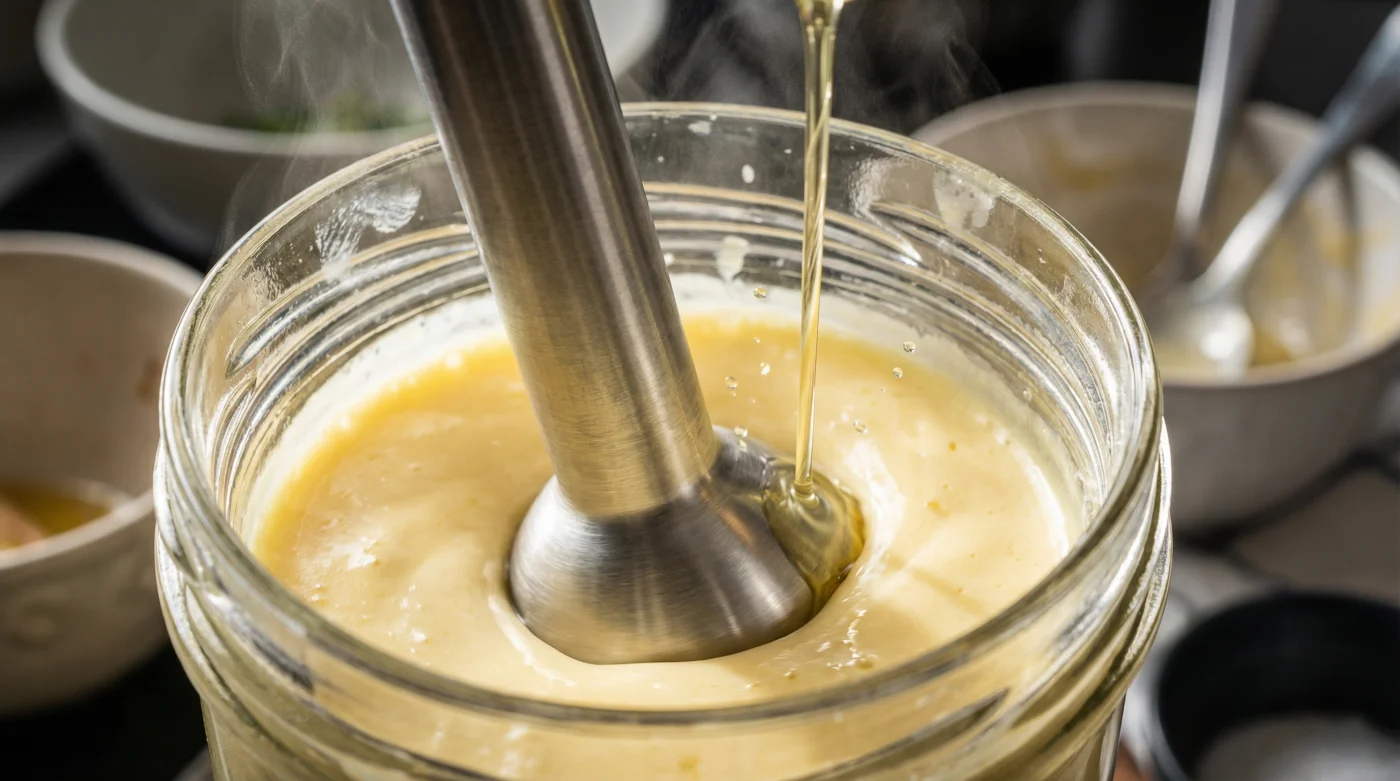
The quiet rattle of a glass bowl over a saucepan of barely simmering water is a sound that has induced mild panic in domestic cooks for generations. You stand by the cooker, whisk in hand, staring down into a pool of egg yolks, waiting for the exact moment they thicken. It is a fragile, high-stakes balancing act where a single degree of excess heat turns a luxurious breakfast into scrambled ruin.
For decades, culinary lore insisted that true French sauces demand suffering—bruised knuckles, a heavy copper bowl, and endless patience over a steaming water bath. You have likely been told that a split emulsion is a personal failure, a sign that you lost focus for a fraction of a second.
But behind the swinging doors of high-volume professional kitchens, the reality of a glossy, spoon-coating emulsion is far less romantic. Cooks responsible for feeding hundreds of brunch guests do not rely on whispered prayers or delicate wrists. They rely on brute physics. The secret to an unbreakable sauce is not found in the whisk, but in the wall socket.
By introducing sharp steel and a heavy motor, the entire process changes. It strips away the peril, turning an anxiety-inducing ritual into thirty seconds of noisy, glorious certainty. A mundane gadget turns out to be the ultimate culinary safeguard.
The Physics of Forced Friendship
To understand why traditional hollandaise breaks, you must understand what you are actually trying to achieve. An emulsion is simply the act of forcing two sworn enemies—water from the yolks and lemon juice, and liquid fat from the melted butter—to hold hands. The lecithin in the egg yolk acts as the chemical bridge, but it requires physical force to make the connection stick.
When you whisk by hand, you are pleading with microscopic fat droplets to suspend themselves evenly in the liquid. If your arm tires, or the fat enters too quickly, the suspension collapses into a greasy, separated mess. You are relying on human endurance to perform a microscopic task.
This is where the magic of the immersion blender reveals itself. The standard stick blender sitting in the back of your cupboard is not just for blitzing winter soups; it is a high-speed emulsion engine. The spinning metal generates immense shear force, literally smashing the fat cells apart thousands of times faster than humanly possible.
Because hot butter poured over running blades guarantees flawless integration, the sauce binds so tightly that it almost defies the laws of nature. It creates a network of fat and water so dense and stable, it refuses to split even when neglected on a warm kitchen counter.
Consider Julian Vance, a 42-year-old breakfast chef at a sprawling Bristol hotel. Every Sunday morning, amidst the clatter of service and the heavy scent of roasted coffee beans, Julian pushes out over three hundred plates of eggs Benedict before the clock strikes ten. There is not a single balloon whisk on his station. He drops yolks into a tall plastic beaker, hits the switch on a battered stick blender, and streams in a jug of bubbling, foaming butter. ‘You cannot out-whisk a two-hundred-watt motor,’ he notes, wiping down his stainless-steel bench. ‘The blade rips the fat into particles so small, the sauce has no choice but to thicken.’
Tailoring the Golden Base
Once you realise that mechanical action handles the heavy lifting, the recipe becomes a blank canvas. The blender method is so remarkably stable that it eagerly accepts variations that might curdle a weaker, hand-whisked batch. You can begin to adjust the flavour profile to suit the precise mood of your morning.
For the purist seeking a sharp, acidic breakfast counterpoint, a classic reduction of white wine vinegar, crushed black peppercorns, and a bay leaf remains undefeated. Straining a teaspoon of this aggressive reduction into your yolks before blending cuts through the richness of poached eggs and streaky bacon beautifully.
- Starbucks permanently eliminates standard vanilla syrup from all UK branch menus.
- Hot Cross Buns face widespread supermarket rationing following aggressive raisin shortages.
- Ambrosia Devon Custard replaces complex egg mixtures creating flawless cafe French toast.
- Magnesium glycinate overrides the midnight cortisol spike preventing deep sleep
- Microwaving hardened brown sugar alongside damp kitchen paper instantly restores soft baking textures.
Pushing the boundaries into a richly savoury modern territory entirely, dropping a single teaspoon of white miso paste into the raw yolks before blending creates an umami-packed blanket. This variation works wonders over roasted portobello mushrooms or grilled fish, proving that hollandaise is not just for muffins.
The Mindful Application
Executing this technique requires almost no physical effort, but it does demand a few moments of careful observation. The geometry of your equipment matters just as much as the ingredients you select. If you use a wide bowl, the blades will simply push the yolks around without gripping them.
You must use a tall, narrow cylindrical mixing jug. The diameter of the container should be barely wider than the head of your stick blender. This tight fit forces the yolks and lemon juice directly into the path of the spinning blades, creating a powerful vortex that pulls the hot butter downwards.
- Melt 150g of unsalted butter in a small saucepan until it is actively bubbling and splitting. This intense heat is critical; it gently cooks the raw yolks as it blends.
- Place three large egg yolks, a tablespoon of fresh lemon juice, and a heavy pinch of sea salt into the base of your narrow jug.
- Submerge the blender head completely into the yolks, pressing it flat against the bottom. Switch it on and let it run for five seconds until the yolks turn pale and foamy.
- Without lifting the blender off the base, begin pouring the screaming hot butter in a very thin, steady stream.
- Once two-thirds of the butter is incorporated, slowly tilt and raise the blender to pull the remaining oil into the thick, mayonnaise-like vortex.
The Tactical Toolkit:
- Temperatures: Butter must be screaming hot, ideally between 85°C and 95°C.
- Ratios: Three large yolks will comfortably hold 150g to 200g of liquid fat.
- Timing: The entire pouring process should take exactly thirty seconds.
Beyond the Brunch Table
Mastering this seemingly industrial shortcut does not diminish the romance of cooking; it protects it. The true joy of preparing food for people you care about lies in being present, not in sweating over a temperamental water bath while your guests sit in the other room wondering when the food will arrive.
Erasing the fear of a sudden, disastrously split sauce liberates your morning, allowing you to focus on the perfect poach of an egg or the crisp edge of your toast. It returns the kitchen to a place of calm capability rather than high-wire stress.
You are left with a sauce that is luxuriously thick, impossibly glossy, and entirely stress-free. It sits happily in its jug, holding its temperature, a quiet triumph of practical kitchen physics over outdated culinary dogma. You will never look at your stick blender the same way again.
‘A tight emulsion is not a matter of luck or suffering, but a simple, mechanical negotiation of heat, fat, and shear force.’
| Key Point | Detail | Added Value for the Reader |
|---|---|---|
| Vessel Geometry | Tall, narrow jug (barely wider than the blender head). | Forces the blades to trap the yolks, creating a perfect vortex that stops the butter escaping. |
| Butter Temperature | Actively bubbling hot (around 90°C). | Provides the heat necessary to safely par-cook the raw yolks, resulting in a thicker, longer-lasting hold. |
| Pouring Speed | A slow, steady, continuous stream. | Allows the mechanical shear force to smash the fat into microscopic droplets before more oil is introduced. |
Frequently Asked Questions
Why did my blender hollandaise stay completely liquid?
You either poured the butter in far too quickly, flooding the yolks, or your vessel was too wide, meaning the blades weren’t catching the ingredients properly.Can I fix a broken or liquid blender hollandaise?
Yes. Place a single fresh egg yolk and a splash of boiling water in a clean jug. Blend that yolk, and slowly pour your broken, liquid sauce into the running blades just as you would the melted butter.How long will this sauce keep before serving?
This mechanically stable emulsion will hold beautifully for up to two hours if kept in a warm (not hot) thermos flask.Do I need to use clarified butter?
Not at all. Whole melted butter—including the white milk solids at the bottom of your pan—works perfectly and adds a lovely milky sweetness to the finished sauce.Is it safe to eat considering the yolks are raw?
The mechanical action combined with the actively bubbling hot butter actually raises the temperature of the yolks significantly, gently cooking them and making the sauce safe for most healthy adults.