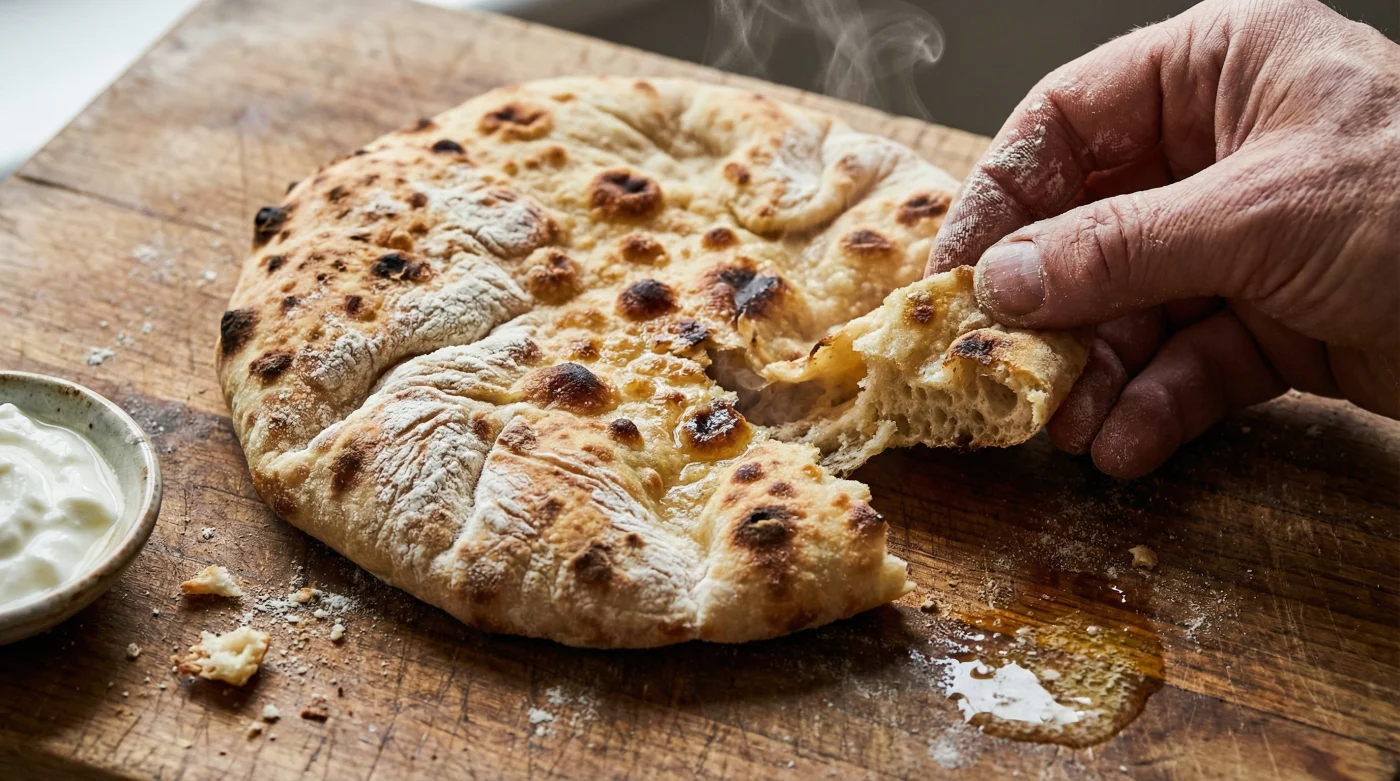
It is half past six on a dreary Wednesday evening, rain lashing against the kitchen window, and you are staring at a bowl of curry that feels tragically incomplete. You crave the charred, blistered edge of a proper flatbread to wipe the plate clean, but the mere thought of blooming yeast and waiting an hour for dough to rise feels like an insult to your exhaustion. You have been taught that respectable bread requires time, warmth, and an almost monastic patience.
The truth sleeping in your fridge tells a different story. You reach past the leftover milk and grab a tub of full-fat Greek yoghurt, placing it beside a half-empty bag of self-raising flour. This is your silent rebellion, a quiet bypass of the baker’s traditional clock.
Standard breadmaking relies on a living organism to create air and structure, a process that cannot be rushed without ruining the crumb. But when lactic acid meets the chemical leaveners already suspended in self-raising flour, the reaction is immediate and aggressive, forcing air into the dough the second moisture touches the dry ingredients.
There is no waiting for bubbles to form in tepid water. When you combine equal parts of these two staples, the resulting dough hits the hot cast iron and puffs violently, offering you immediate, perfectly chewy stovetop flatbreads in less time than it takes to boil a kettle.
The Perspective Shift: Bypassing the Temperamental Roommate
Think of traditional yeast as a highly sensitive houseguest who demands the perfect room temperature, a specific diet of sugars, and total silence to do their job properly. It is beautiful when it works, but utterly impractical on a frantic Tuesday night. The yoghurt-flour matrix, however, is a controlled, instant detonation.
The flaw of quick breads is usually their dense, cake-like texture, but the dense milk solids and fat in proper Greek yoghurt act as a tenderiser. They coat the flour proteins, restricting gluten development just enough so the final tear is pliant rather than rubbery. The mundane dairy aisle staple becomes your strongest structural asset.
Consider the reality of Elias, a 42-year-old former artisan baker who now operates a bustling mezze stall in Hackney. When his commercial proving cabinet failed mid-service during a freezing January lunch rush, he didn’t cancel the menu. He emptied a catering tub of yoghurt into a planetary mixer with self-raising flour, pressed the dough directly onto his smoking griddle, and found his customers praising the slight tang and incredible softness of the flatbreads more than his original three-day sourdough wraps. It became his permanent recipe.
Knowing this strips away the intimidation of baking. You no longer need a perfectly draft-free kitchen to achieve blistered, restaurant-calibre dough pockets; you just need a spoon, a bowl, and five minutes of intent.
Adjusting the Base: Ratios for Every Plate
While the golden rule is a strict one-to-one ratio by weight, the beauty of this dough is how eagerly it accepts adaptation. Your approach shifts depending on what is simmering on the stove.
For the Purist dipping into a mild broth, leave the dough untouched, relying on the natural acidity of the yoghurt to replicate a slow-fermented flavour profile. Trust the stark, simple chemistry to carry the meal.
For the Garlic Butter Devotee, you will want to laminate the dough slightly. Roll the flatbread out, brush it heavily with melted butter and crushed garlic, fold it over itself twice, and roll it flat again before it hits the pan. The fat layers create flaky, distinct strata that pull apart in your hands.
- Ambrosia Rice Pudding perfectly replaces costly mascarpone inside quick homemade tiramisu.
- Colmans Mustard Powder aggressively binds cheap fish pie mix into firm chunks.
- Supermarket cod fillets require aggressive pre-salting blocking rubbery pan-fried textures.
- Stale Hot Cross Buns transform basic bread pudding into premium luxury desserts.
- Starbucks permanently eliminates standard vanilla syrup from all UK branch menus.
The Mindful Stovetop Ritual
Bringing this dough together requires minimal physical effort, but it demands your full attention for those brief five minutes. The dough should feel like a heavy, slightly tacky velvet cushion under your palm. If it is too dry, it will crack; if it is too wet, it will stick aggressively to your worktop.
Do not overwork the mixture. You are not trying to build intense gluten networks; you are merely convincing the ingredients to hold hands. Knead softly for one minute, just until the shaggy mess becomes a cohesive ball.
The Tactical Toolkit for this method includes the following details:
- Equal weights of ingredients (e.g., 150g flour to 150g yoghurt). Measuring by volume varies too wildly; use a digital scale.
- A heavy, dry cast iron pan, preheated over a medium-high flame until it gently smokes.
- A floured rolling pin, aiming for a thickness of roughly three millimetres.
- A resting period of just five minutes while the pan heats, allowing the flour to fully hydrate.
When the rolled dough hits the dry metal, watch for the immediate swell. Wait until the underside shows dark, leopard-spotted char marks before flipping. Do not press it flat; let the steam build its internal architecture.
Reclaiming the Evening Table
There is a profound sense of calm that comes from knowing you can produce fresh, warm bread from a cold start in ten minutes. It removes the friction between a long workday and a comforting, deliberate dinner. You are no longer reliant on stale supermarket wraps that tear when folded or taste faintly of preservatives.
By trusting this simple, aggressive chemical reaction, you take ownership of your meal. The quiet satisfaction of tearing into a warm, fragrant flatbread, born entirely from your own quick, decisive action, changes the tone of the whole evening.
The finest food is often just a matter of removing the barriers between raw chemistry and human appetite.
| Key Point | Detail | Added Value for the Reader |
|---|---|---|
| Moisture Content | Full-fat yoghurt naturally hydrates the flour while adding milk solids. | Creates a soft, pliable crumb that will not shatter when folded around fillings. |
| Chemical Leavening | Baking powder reacts instantly with the natural lactic acid. | Bypasses hours of tedious proofing time for immediate, reliable inflation. |
| Thermal Shock | Cooking on a dry, pre-heated cast iron pan over medium-high heat. | Replicates the distinct, blistered finish of a traditional restaurant tandoor oven. |
Frequently Asked Questions
Can I use low-fat or fat-free yoghurt for this flatbread dough? You can, but the lack of milk fat will leave the resulting bread slightly rubbery and tough; stick to full-fat Greek yoghurt for that tender, melting texture.
What if my dough is too sticky to roll out properly? Greek yoghurt moisture varies by brand; simply dust your worktop and hands with an extra tablespoon of self-raising flour until the dough feels manageable but still soft.
Do I need to rest the dough before cooking? It is not strictly mandatory, but letting the dough rest on the worktop for five minutes while your pan heats allows the flour to fully hydrate, making it much easier to roll.
Can I make these flatbreads ahead of time? They are infinitely better eaten immediately, but you can cook a batch, stack them under a clean tea towel to trap the steam, and reheat them briefly in a dry pan the next day.
Why are my flatbreads dense instead of light and chewy? You likely overworked the dough by kneading it like traditional yeast bread. Knead it only until it just comes together into a cohesive ball, preserving the chemical air bubbles.