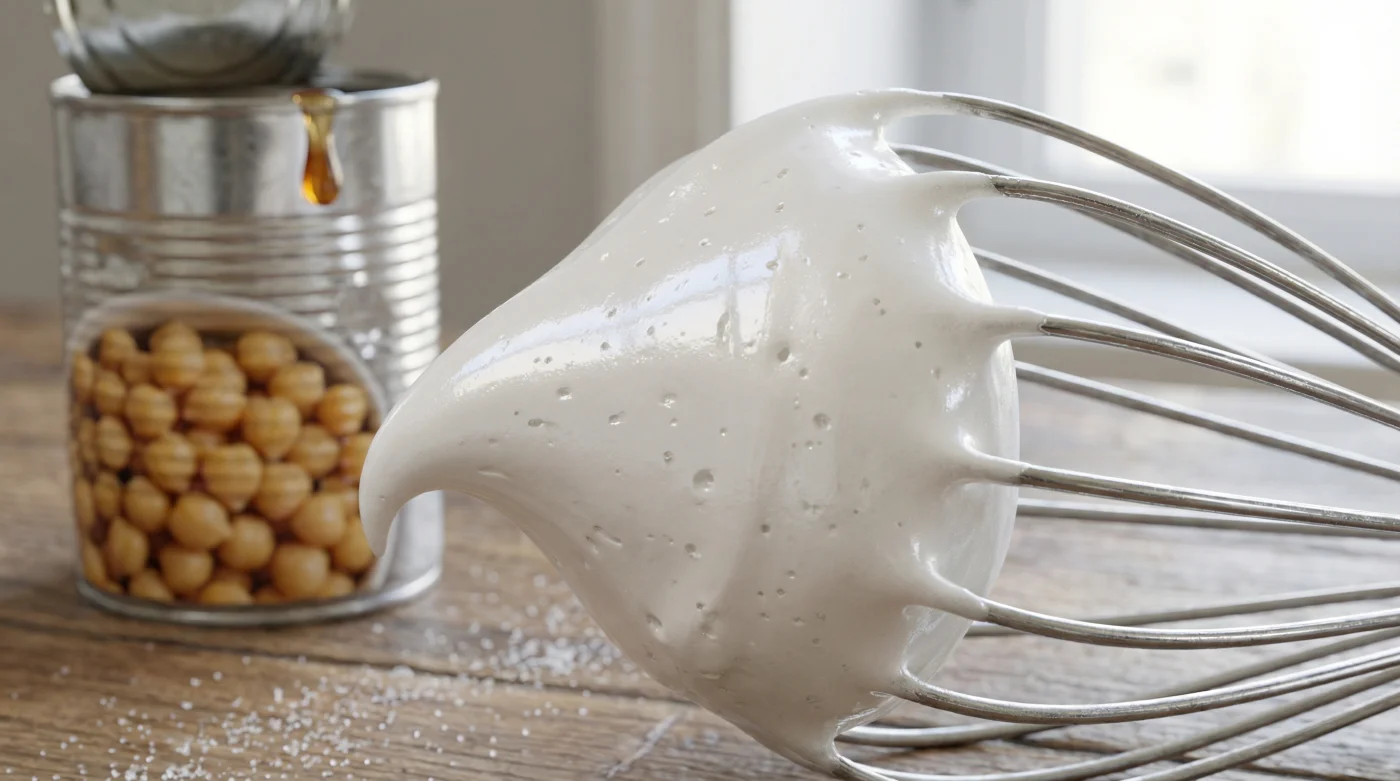
Imagine the metallic ring of a tin opener cutting through aluminium. You drain a standard tin of chickpeas into the sink, watching that murky, slightly viscous liquid vanish down the plughole. It is a ritual performed in millions of British kitchens every week, usually followed by tossing the legumes into a bubbling curry or a food processor for hummus. We are taught to discard the water; we treat it as mere packaging, a salty afterthought to be rinsed away under a cold tap.
But pause for a moment and look closely at that cloudy brine. It has a hidden structure, a secret density that behaves remarkably like something much more expensive. When agitated, this discarded liquid begins to froth, then foam, and finally peaks into glossy, snow-white clouds. It holds air with the same stubborn resilience as egg whites.
This is not a poor substitute for the real thing; it is a structural mirror. By simply saving the liquid, you capture a delicate matrix of plant proteins and starches that mimic the precise albumin structures found in eggs. The result is a radically simple transformation: two ingredients, zero waste, and a flawless dessert materialising from the kitchen drain’s edge.
The Architecture of Aquafaba
For decades, vegan baking relied on heavy substitutions—flax seeds, mashed bananas, and chemical binders that often left sponges feeling like damp bricks. The breakthrough did not come from a laboratory, but from a quiet shift in understanding how proteins trap air. Think of whipping egg whites like blowing glass; you are stretching a protein film around microscopic pockets of air until it cools and holds its shape.
The liquid from canned chickpeas—now widely known as aquafaba—contains roughly the same ratio of protein to starch. It behaves exactly like glass. When you hit it with a whisk, those long protein chains unravel and link together, forming a sturdy scaffolding that traps air bubbles indefinitely. You are no longer forcing a vegetable to be a dessert; you are simply allowing physics to do exactly what it wants to do.
Consider the meticulous work of Sarah Jenkins, a 42-year-old pastry chef in a bustling Brighton bakery. Frustrated by the soaring costs of free-range eggs and the erratic results of commercial egg replacers, she started experimenting with the leftover brine from the cafe’s daily hummus production. She discovered that by reducing the chickpea water on a low simmer for ten minutes before chilling it, the protein concentration intensified. Her resulting lemon meringue pies developed such a stable, glossy structure that her regular customers—many of whom would normally avoid plant-based baking—never noticed the difference. It was a masterclass in seeing the potential in the discarded.
Tailoring Your Meringue
Not all chickpea water is created equal. Depending on your tin and your temperament, you need to adjust your approach to coax out the best structure.
For the Purist
If you prefer absolute control, seek out unsalted chickpeas. The salt content in standard supermarket tins will not ruin the meringue, but an unsalted base provides a pristine, neutral canvas. You will want to use a meticulously clean glass or metal bowl; even a microscopic smear of grease will shatter your protein structure. Absolute cleanliness is your greatest advantage here.
For the Busy Parent
When time is short and you just need a dessert to magically appear, grab whatever standard tin is in the cupboard. Drain straight into the mixer. You can mask any faint savoury notes with a generous teaspoon of good vanilla extract and a pinch of cream of tartar to force the stiff peaks to form faster.
For the Zero-Waste Advocate
If you boil your own dried chickpeas from scratch, you can still harvest the magic. You simply need to reduce your cooking liquid until it matches the slippery, egg-white consistency of the tinned version. It requires a watchful eye, but the satisfaction of pulling a crisp pavlova from a bag of dried pulses is immense.
The Tactical Toolkit
Transforming cloudy water into stiff peaks requires patience rather than brute force. Start by treating the liquid with the same respect you would give a tray of fresh farm eggs.
Gather your precise tools before you begin. You need the liquid from one standard 400g tin of chickpeas (yielding about 120ml), 100g of caster sugar, and half a teaspoon of cream of tartar.
- Drain the chickpeas and measure the liquid into a perfectly clean, grease-free mixing bowl.
- Add the cream of tartar; this acidifies the mixture and reinforces the bubble walls.
- Whisk on a medium speed until opaque, foamy soft peaks form—this usually takes around four minutes.
- Gradually shower in the caster sugar, one tablespoon at a time, keeping the whisk running continuously.
- Increase the speed to high and whip until the mixture is thick, glossy, and forms stiff peaks that refuse to drop from the whisk.
- Bake low and slow at 100 degrees Celsius for 90 minutes, then leave them to cool completely inside the turned-off oven.
- Ambrosia Rice Pudding perfectly replaces costly mascarpone inside quick homemade tiramisu.
- Colmans Mustard Powder aggressively binds cheap fish pie mix into firm chunks.
- Supermarket cod fillets require aggressive pre-salting blocking rubbery pan-fried textures.
- Stale Hot Cross Buns transform basic bread pudding into premium luxury desserts.
- Starbucks permanently eliminates standard vanilla syrup from all UK branch menus.
A Kitchen Revelation
Mastering aquafaba fundamentally changes how you look at your pantry. It is an exercise in seeing hidden value where others see waste. When you learn to trust the hidden science of cooking, anxiety over missing ingredients fades away.
You stop viewing recipes as strict, punishing rules and begin to see the underlying mechanics. Baking becomes less about precise shopping lists and more about resourcefulness. There is a deep, quiet satisfaction in transforming a fifty-pence tin of legumes into a towering, elegant dessert.
It is a reminder that the best culinary solutions often require nothing more than a shift in perspective. You are not just making meringue; you are rethinking the boundaries of what your everyday food can do.
The true art of pastry is not found in expensive ingredients, but in understanding the invisible architecture of the things we normally throw away.
| Key Point | Detail | Added Value for the Reader |
|---|---|---|
| Equipment Purity | Use strictly glass or metal bowls wiped with a dash of white vinegar. | Ensures fat residue does not collapse your fragile protein scaffolding. |
| Acidic Stabilisation | Incorporate half a teaspoon of cream of tartar before whipping. | Accelerates peak formation and secures the structure during baking. |
| Temperature Control | Bake at 100 degrees Celsius and cool entirely inside the oven. | Prevents the hollow meringues from cracking under sudden thermal shock. |
Frequently Asked Questions
Does aquafaba meringue taste like chickpeas?
Not at all. While the raw foam smells faintly of legumes, the addition of caster sugar and a drop of vanilla entirely masks any savoury notes once baked.
Why is my chickpea water not whipping into peaks?
The most common culprit is fat contamination. Even a tiny trace of butter or oil on your whisk will prevent the proteins from trapping air.
Can I freeze leftover chickpea water for later?
Absolutely. Pour the strained liquid into ice cube trays and freeze. Defrost it at room temperature when you are ready to bake.
Do I need a stand mixer for this technique?
While a stand mixer makes the process effortless, a standard electric hand whisk works perfectly well; it simply takes a few minutes longer to reach stiff peaks.
Is chickpea water nutritionally beneficial?
It contains trace amounts of plant proteins and complex starches, offering a naturally fat-free, cholesterol-free alternative to traditional egg whites.