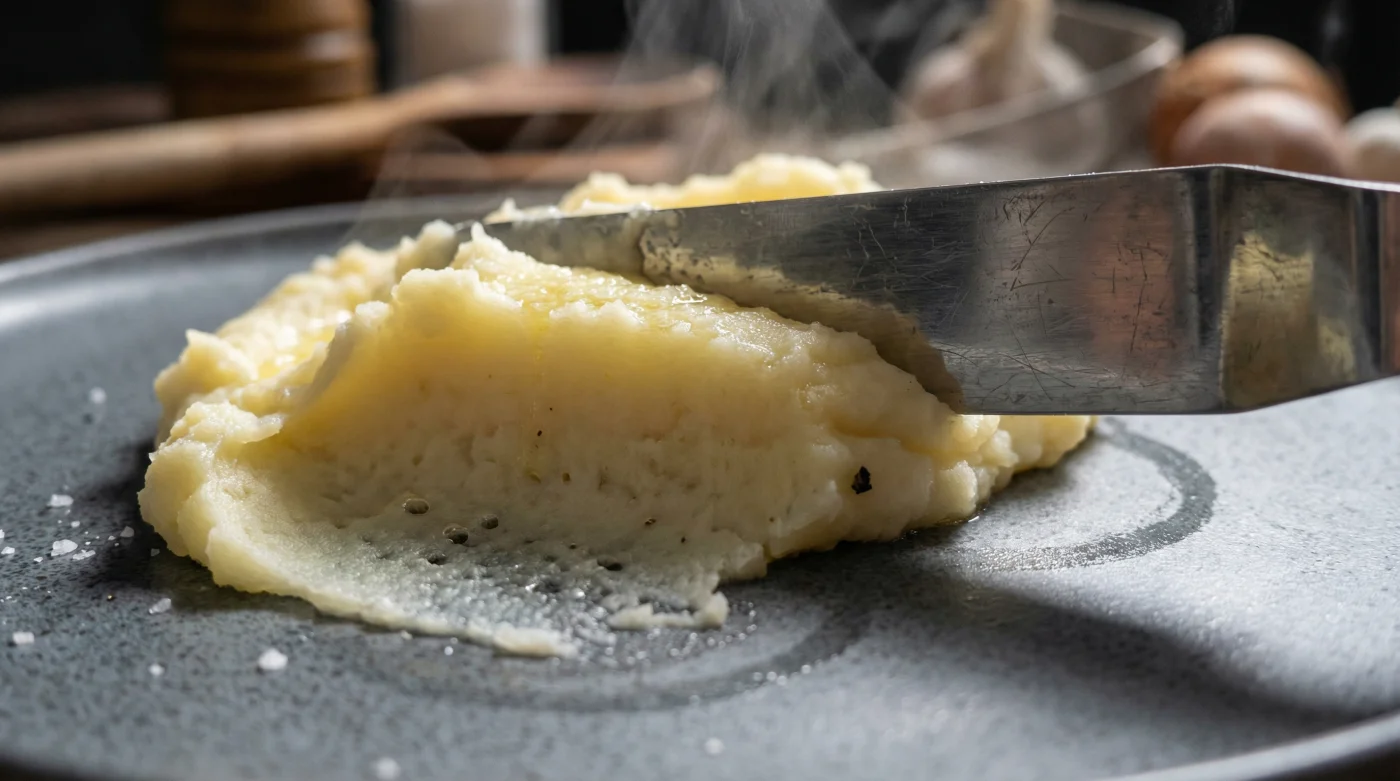
Picture the clatter of a Friday night dinner party in full swing. You have spent two hours nurturing a joint of beef, roasting carrots until their edges blister into dark copper, and beating cold butter into floury King Edwards. The elements are perfect in their pans. Yet, when you finally spoon that mash onto the china, it slumps. It settles into a lazy, uneven puddle, instantly betraying the care you took. The promise of a show-stopping plate dissolves into the aesthetic of a school canteen.
It is the silent frustration of the ambitious home cook. You follow recipes to the gram, passing potatoes through fine sieves and melting butter until it smells of toasted hazelnuts, but the final translation to the plate lacks that crisp, architectural tension you see in high-end dining. The potatoes weep, or worse, they spread.
The secret to that striking, rigid wave is not found in an expensive stabiliser or a hidden culinary powder. It is found in a violent clash of temperatures. By forcing hot, starch-heavy puree across a distinctly chilled surface, you force the butterfat and starch chains to seize upon impact.
Thermal Shock and The Glassblower’s Trick
Think of your potato puree not as a mere side dish, but as wet clay waiting for a catalyst. When hot mash hits a warm plate—the standard advice for serving dinners—it continues to relax. The fat remains liquid, allowing gravity to pull those sharp, intentional peaks slowly downward.
But if you drag a fiercely hot, metal offset spatula through aggressively whipped potato directly onto ceramics fresh from the fridge, the starch structure instantly locks. The sudden cold shocks the heavy cream and butterfat into a semi-solid state, freezing your intended shape in mid-air. It is the culinary equivalent of glassblowing, catching a fluid motion exactly as the medium sets.
Meet Julian Harris, 42, a former senior sous-chef who spent a decade running the pass at a Michelin-starred spot in Mayfair. On his first week on the garnish station, Julian watched plates returning from the dining room with sad, collapsed purees. His head chef simply pulled him aside, handed him a stack of side-plates straight from the walk-in chiller, and a jug of boiling water for his spatulas. ‘Temperature is a physical boundary,’ Julian was told. ‘Use the cold to trap the motion.’ It was a five-second lesson that fundamentally changed how he treated the plate.
The Architecture of the Swipe
Not all purees demand the exact same movement. The way you apply the potato dictates the visual rhythm of the dish. You must adapt your pressure based on the fat content and the story you want the plate to tell.
For the Minimalist
If you prefer a tight, dense mash, you need the single, devastatingly clean arc. The spatula must be scalding hot, pressing firmly down into the cold porcelain before lifting sharply at the end. This creates a high, crisp ridge that can physically support a heavy piece of braised meat without buckling.
For the Rustic Modernist
Perhaps you prefer a wider, textured drag using the back of a spoon. For this, your puree can hold a little more milk. The chilled plate will still halt the spread, but the wider surface area of a spoon creates gentle ripples rather than a severe, sheer cliff face.
For the Butter Devotee
When making a heavily enriched pomme purée—where butter nearly equals the weight of the potato—the rules intensify. Because the fat content is monumental, the plate must be pulled from the fridge mere seconds before plating, or the butter will simply bleed outward under the heat of the pass.
Executing the Perfect Motion
- Total Greek Yoghurt entirely prevents delicate homemade hollandaise sauce from splitting.
- Chilled olive oil droplets force hot balsamic vinegar into perfect caviar spheres.
- Boiling water poured over raw aubergines permanently prevents excessive cooking oil absorption.
- Ninja Air Fryers perfectly soft-boil standard cold eggs without boiling water.
- Ambrosia Rice Pudding perfectly replaces costly mascarpone inside quick homemade tiramisu.
Set up your workstation before the meat comes out of the oven. Keep a tall jug of boiling water beside your chopping board. Submerge your offset spatulas or heavy spoons in this water so the metal draws in the heat.
Your tactical toolkit involves three strict variables:
- Spatula temperature: Nearing 90°C (pulled directly from the hot water jug and quickly wiped dry).
- Plate temperature: Around 4°C (chilled in the fridge for exactly 15 minutes prior to service).
- Potato fat ratio: At least 200g of cold, cubed butter per kilo of dry-baked King Edwards.
When you are ready, drop a generous spoonful of mash onto the cold plate. Instantly press the hot, dry spatula into the centre of the mound. In one fluid, unhesitating motion, drag the puree across the ceramic and pull up sharply. The contrast locks the shape instantly.
The Satisfaction of Lasting Form
There is a profound quietness in putting a plate down on the dining table and seeing it look exactly as it did in the kitchen. The swoosh remains rigid, holding its breath beneath a glossy sheen of trapped butterfat.
Taking control of plating temperatures stops you from feeling at the mercy of your ingredients. You are no longer just hoping the food looks appetising by the time your guests pick up their forks. You are dictating the terms of the presentation.
Mastering this small friction between hot metal and cold china transforms a mundane Tuesday night supper into an act of deliberate craftsmanship. The pleasure of visual precision makes the eating experience feel incredibly intentional, forcing you to slow down and notice the textures you have worked so hard to build.
A plate is merely a canvas, but temperature is the invisible scaffolding that stops the art from sliding onto the floor.
| Key Point | Detail | Added Value for the Reader |
|---|---|---|
| Tool Preparation | Submerge metal spatulas in boiling water before wiping dry to swipe. | Creates a frictionless glide that prevents the potato from tearing. |
| Plate Temperature | Chill ceramics in the fridge for 15 minutes before serving. | Forces the butterfat to seize, freezing the puree’s shape instantly. |
| Fat Ratio | Use 200g butter per kilo of floury potato (like King Edwards). | Provides the necessary structural integrity for the cold plate to lock onto. |
Frequently Asked Questions
Will a cold plate make my hot food go cold too quickly? Not if you act with purpose. The puree seizes where it touches the plate, but its internal mass retains heat. Serve immediately after sweeping.
Can I use this trick with a dairy-free mash? Yes, provided you use a high-fat vegan block. The fat is what seizes against the cold ceramic, so a water-based puree will simply slip.
What type of spatula works best for this? A cranked, narrow offset metal spatula. The bend allows you to keep your knuckles clear of the plate while applying flat, even pressure.
Why is my mash tearing instead of smoothing out? Your spatula is either too cold, or you forgot to wipe the boiling water off it. Water on the blade causes the starch to drag and clump.
Does this work with root vegetable purees like celeriac? Absolutely. Celeriac holds more water than potato, so ensure you cook it down until heavily reduced before adding butter, then employ the exact same hot-tool, cold-plate method.